
SLIDE 1
1
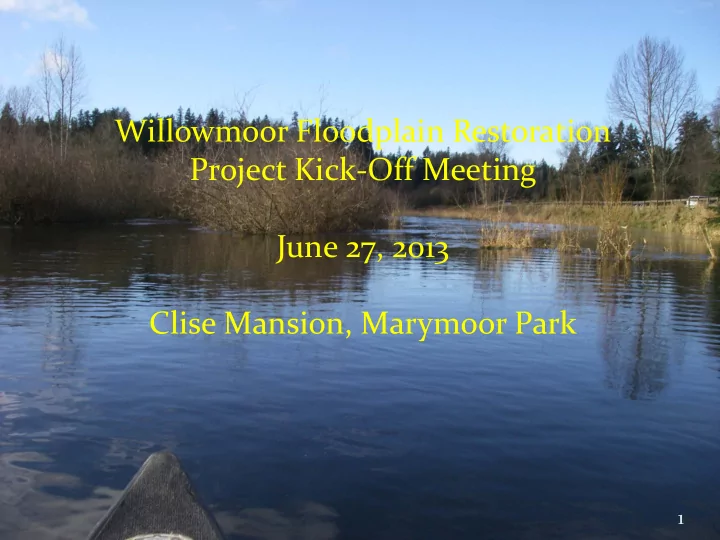
Willowmoor Floodplain Restoration Project Kick-Off Meeting June 27, - - PowerPoint PPT Presentation
Willowmoor Floodplain Restoration Project Kick-Off Meeting June 27, 2013 Clise Mansion, Marymoor Park 1 Presentation Overview Project Area History & Context Transition Zone Maintenance Willowmoor Project Purpose &
1
Project Area History &
Context
Transition Zone
Maintenance
Willowmoor Project
Purpose & Goals Project Scope Funding & Schedule Public Involvement 2
3
4
Project Site
Transition Zone Marymoor Park Lake Sammamish
5
Bear Cr.
6
Low Flow Channel Willow Buffer High Flow Channel
7
Weir
Meandered through large
wetland complex
River channel very shallow, with
frequent logs and log jams
Flooding was common Floodplain wetlands provided storage
for flood waters
8
Known as “Squak Slough” Traditional hunting
and fishing area for Native Americans
Floodplain cleared and developed for
homesteads and farming
Logs and log jams removed for improved
navigation
Floodplain ditched and drained for farming River channel straightened Chronic flooding of farm fields during spring
run-off 9
Period of European
settlement
Logging in
surrounding forests
Project Elements:
Deepened river channel Further straightened the river channel Reconstructed river banks Constructed Transition Zone to control flows
into Sammamish River channel
Constructed weir at upstream end of TZ
10
Project Goals:
Prevent spring-time
flooding of Sammamish Valley ag-lands
Provide more control
water levels
1990’s Salmon Habitat Enhancements
1990’s Sensitive Area’s Ordinance + imminent listing Chinook
Habitat Related Enhancements
Example: Mammoth Sammamish: King County, City of Redmond,
USACE
Projects addressed high water temperatures and lack of structural
diversity
Innovative methods to increase vegetation while maintaining flood
capacity
2002 Sammamish River Corridor Action Plan – Path Forward
King County, USACE
11
12
1990’s Transition Zone modifications
1998 weir rebuild included Chinook low-flow fish passage Dog exclusion fencing and re-vegetation projects Willow buffer allowed to grow Reduced intensity of mowing banks
2003 Willowmoor Conceptual Report
Long term plan to provide better flood and habitat benefits Similar goals as current project Smaller study area Data, analyses and design concepts will be used as
appropriate in current effort
13
BEFORE AFTER Sammamish River Transition Zone 2011 Vegetation Maintenance: Before/After Photo Monitoring
Photo 5 before, left bank buffer missing willow, no navigation issue, weir found. Photo 5 after, no trimming, willow planted on left bank, weir reported and surveyed. Photo 6 before, both bank buffers >> 10 feet, encroaching on navigation Photo 6 after, both banks trimmed, buffer width and navigable channel Log revealed Weir found
14
15
Increase mowing on banks and removing clippings Trim willow buffer and restore navigation channel
Monitor plan effectiveness Re-invigorate Willowmoor effort as long term
Develop better site design for the flood project in
Reduce maintenance costs by installing a design that
16
17
Design:
Process:
18
19
Conduct Technical Studies & Data Collection Develop and Evaluate Design Alternatives Select Preferred Alternative Prepare Preliminary Design
20
Conduct suite of technical studies to:
Prepare “Basis of Design” report
21
Backbone of design process Hydrology: quantity & timing of rainfall and river flow Hydraulics: how water moves through the river (speed,
direction, depth, etc.)
Examine original (early 1960’s) design with respect to:
Develop updated hydrology Recommend appropriate design values
22
Identify Land Use Restrictions on Parks Property Wetland and Vegetation Mapping Stream Corridors and Connectivity
Identify opportunities and constraints for improving riparian
and wetland habitat connectivity
Cold Water Sources
Develop planning level sketches and estimates for a variety of
cold water sources
Fish and Wildlife
Identify opportunities and constraints for habitat
improvement for listed species and others
WRIA 8 goals and 2002 Sammamish Corridor Action Plan
goals
23
Consideration of existing uses (dog park, rowing,
walking, bird-watching, etc.)
Public access potential on southwest (left) bank Safety and access for water users Improved conditions for passive recreation
24
Develop suite of conceptual design alternatives Based on Basis of Design report Solicit suggestions and input from Stakeholder
Committee
Conduct selection process for a preferred
alternative
25
Further develop design of the preferred
alternative
Prepare more detailed cost-estimate Permit ready plan set Suitable for grant applications.
26
Current Project Phase
from Redmond
Future Project Phases
restoration grants
27
Partnership between KC-FCD, KC-DNRP (Parks & Rivers)
and City of Redmond
Large variety of stakeholders representing diverse set of
interests:
28
Park users Lake property owners River valley property
Environmental interests Tribes Municipalities Local, state and federal
agencies
Businesses Public at large.
Tech Studies & Data Collection Now – Dec 2013 Alternatives Development & Selection Jan– Jun 2014 Preliminary Design Jul – Dec 2014
29
Website Mailings Public Meetings Stakeholder Advisory Committee
30
Represent their organization’s positions and interests
related to design of the project;
Exchange information and ideas with the project team
and other stakeholders;
Assist with the creation of design goals and criteria; Help to develop project alternatives; Disseminate information about the project to their
membership or peers; and
Provide a public voice to help guide the project toward
implementation.
31
Jun 27, 2013 Public Mtg #1: Project Kick-off Jul 2013 Stakeholder Mtg #1: Committee Kick-off Aug – Oct 2013 Stakeholder Mtg s #2-3: Discuss project criteria/review tech studies Nov – Dec 2013 Stakeholder Mtg #4: Brainstorm on Project Alternatives Concepts Jan 2014 Public Mtg #2: Technical Studies Results / Intro of Early Concepts Feb – May 2014 Stakeholder Mtg #5-6: Further Development of Project Alternatives Jul 2014 Stakeholder Mtg #7: Discussion of Alternative Selection Aug 2014 Public Mtg #3: Presentation of Preferred Alternative
32
33