
SLIDE 1
1
CPSC 425: Computer Vision (Jan-April 2007)
David Lowe Prerequisites: 4th year ability in CPSC Math 200 (Calculus III) Math 221 (Matrix Algebra: linear systems) Useful: Numerical analysis
Why study Computer Vision?
- Images and video are everywhere
- Fast-growing collection of useful applications
– matching and modifying images from digital cameras – film special effects and post-processing – building representations of the 3D world from pictures – medical imaging, household robots, security, traffic control, cell phone location, face finding, video game interfaces, ...
- Various deep and attractive scientific mysteries
– what can we know from an image? – how does object recognition work?
- Greater understanding of human vision and the brain
– about 25% of the human brain is devoted to vision
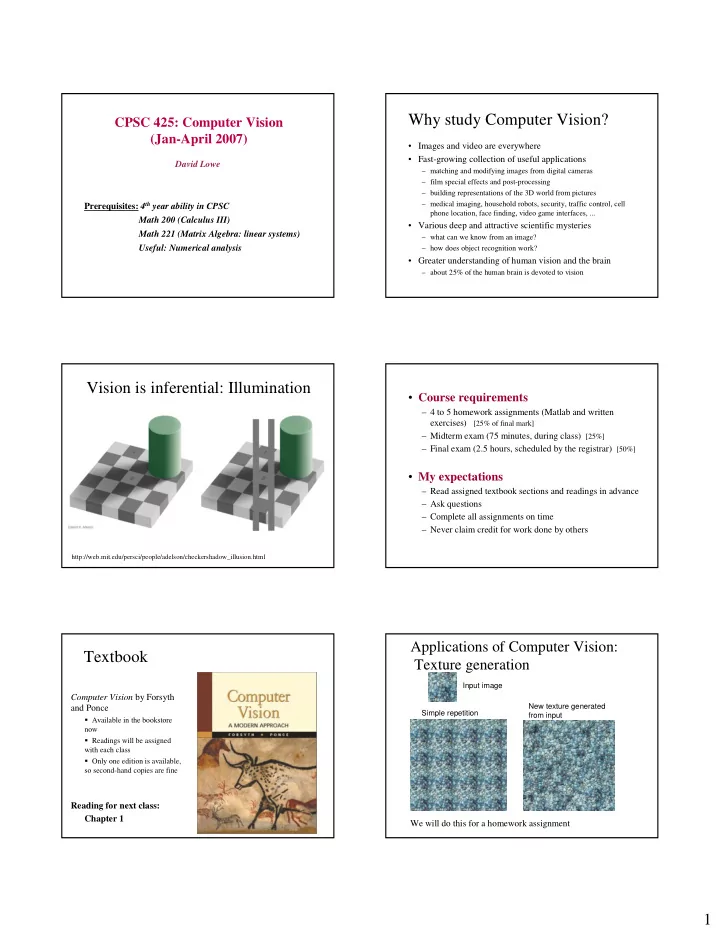
Vision is inferential: Illumination
http://web.mit.edu/persci/people/adelson/checkershadow_illusion.html
- Course requirements
– 4 to 5 homework assignments (Matlab and written exercises) [25% of final mark] – Midterm exam (75 minutes, during class) [25%] – Final exam (2.5 hours, scheduled by the registrar) [50%]
- My expectations
– Read assigned textbook sections and readings in advance – Ask questions – Complete all assignments on time – Never claim credit for work done by others
Textbook
Computer Vision by Forsyth and Ponce
Available in the bookstore now Readings will be assigned with each class Only one edition is available, so second-hand copies are fine
Reading for next class: Chapter 1
Applications of Computer Vision: Texture generation
Input image
Pattern Repeated Pattern Repeated Pattern Repeated
New texture generated from input Simple repetition