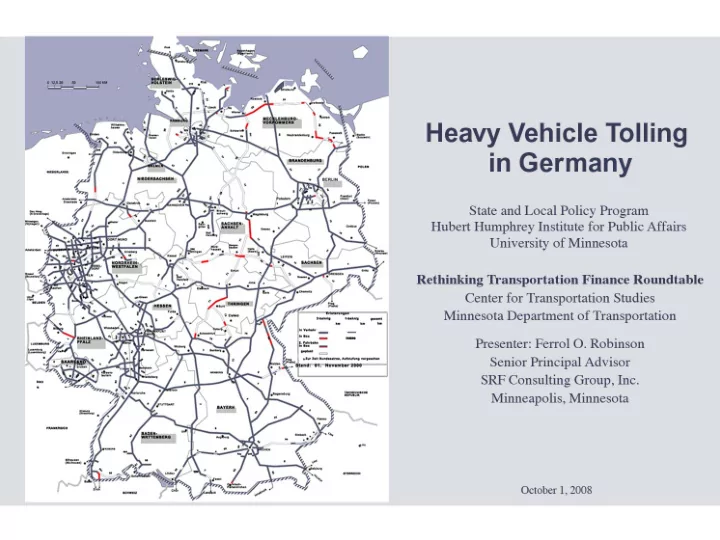
SLIDE 1
SLIDE 2 Why Pricing?
- Unpriced commodities lead to excessive use
- Unconstrained demand results in congestion,
delays, and higher emissions
- Pricing can be used to manage system capacity
more effectively
- It rations scarce highway capacity by
discouraging over-use
- Can be used to promote competition among
modes
SLIDE 3 German Heavy Vehicle Tolling System
Public
- Ministry of Transport
- Federal Office for Goods Transport (BAG)
Private-Toll Collect
- Daimler-Chrysler Financial Services
- Deutsche Telecom
- Cofiroute
Public-Private Partnership
SLIDE 4 German Heavy Vehicle Tolling System
- Estimated 2 billion Euro shortfall for roads
(1.5B for rail, 0.25B for waterways)
- Substantial infrastructure cost imposed by heavy
trucks ($0.38 per vehicle-mile)
- 35% of truck-miles by foreign vehicles
- Non-compliance with emission standards by
many foreign vehicles Rationale
SLIDE 5 German Heavy Vehicle Tolling System
- Introduce mileage charges applying user-pay
principle
- Secure funding for upgrade/maintenance of
transportation infrastructure
- Provide incentives to shift truck freight to rail
and inland waterways
- Promote environmental interests and more
efficient deployment of HCV
- Promote innovative tolling technology
Objectives
SLIDE 6 Tolling System Description
GVW (26,400 pounds)
(Federal Motorways)
- Vehicles tolled daily: 1.5
million
billion per year Coverage
SLIDE 7 Tolling System Description
- Average toll: 34 cents per mile
- Range of toll rates: 23 to 35 cents per mile
- Toll rate factors: Number of axles (up to 3 and
4+) and emission class (Euro I-Euro VI)
- Tolls per axle group: 25 to 36 cents per mile
- Tolls per emissions class: 23 to 35 cents per
mile (dirtier trucks pay a 50% premium) Toll Rates
SLIDE 8 Tolling System Description
Revenues
- 2005: $4.5 billion
- 2006: $4.8 billion
- 2007: $5.3 billion
- Revenue distribution: 50% roads, 38% rail,
12% waterways Cost
- 15 to 20 percent of revenues
Annual Revenues and Cost
SLIDE 9 Tolling System Description
Electronic Tolling (90%)
- USGPS vehicle location
- On-board computer
- Mobile communication data
transmission (GSM)
communications (DSRC) Manual Booking (10%)
- Internet or terminals
- Data processing center
Technology
SLIDE 10 Tolling System Description
- Automatic, using gantries and
cameras
- Stationary, at parking areas
- Mobile, using computer-
equipped vans
Fines:
unintentional $300; maximum $30,000
driver; 50% to shipper
Enforcement
SLIDE 11
- Reliability: 99.7%
- Accuracy: Negligible charge-related problems
- Flexibility: Added non-Autobahn roads and
Euro VI emissions charge
- Enforceability: 1.7% violation rate
- Privacy/Security: No issues identified
Outcomes
System Performance has Met or Exceeded Expectations
SLIDE 12
- Successfully applied mileage-based charge on a large
scale using user-pays principle
- Revenues generated exceeded prediction in 2nd year
- f operations
- Success in shifting freight from truck to rail uncertain
- Environment objectives achieved:
– Dirty trucks have decreased from 50% to 36% – Empty truck trips have declined by 20%
- Succeeded in deploying innovative, state-of-the-art
tolling technology and clean vehicle technology
Outcomes
System Has Largely Achieved Objectives:
SLIDE 13
- Initial schedule: 11 months; delayed 2 years
- Given system magnitude and complexity,
unreasonable initial schedule
- Private sector underestimated technological
complexity
- Claim by federal government pending
Outcomes
Implementation Delays
SLIDE 14 Lesson learned from German Experience
- 1. Clear and well-supported rationale needed to
create support by affected stakeholders
- 2. Clear statement of objectives
- User-pays principle
- Earmarking revenues to transportation
infrastructure
- Cross-subsidy of rail and waterways
- Promoting environmental interests
- Promoting development of innovative
technologies
SLIDE 15 Lesson learned from German Experience
- 3. Ensure adherence to principles and objectives
- 4. Implementation schedule must consider project
magnitude and complexity, including state-of- the-art technology requirements
- 5. Carefully weigh the impacts on cost of system
requirements
- 6. Address concerns about privacy and security at
the outset
SLIDE 16 Conclusions
- Technology is no longer an impediment to large-
scale pricing implementation
- Build support around common-good principles
such as users pay, users benefit and polluters pay
- Do not allow political expediency to interfere with
agreed-upon principles and objectives
- Evaluate system requirements for cost
effectiveness and achieving objectives
- Measure success or failure based on performance
- bjectives and outcomes
- Address privacy/security concerns early
SLIDE 17
SLIDE 18 Innovative Transportation Infrastructure Financing
- Fuel taxes in Germany go directly to the general
fund
- Fuel taxes have been raised 8 times since 1991
- Taxes are close to 50 percent of fuel price
- Estimated deficit: 2 billion for roads: 1.5 billion
for rail; 0.25 billion for waterways Debate:
- Need for a dedicated funding source for
transportation Germany’s Issues With Fuel Taxes:
SLIDE 19 Innovative Transportation Infrastructure Financing
- Tied to damage to roads (users pay for amount
- f use)
- Payers benefit (dedicated funds)
- Polluters pay (through higher tolls)
- Key objective: generate dedicated revenues for
transportation infrastructure financing Mileage-Based Tolls
SLIDE 20 Innovative Transportation Infrastructure Financing
- The Federal Highway Trust Fund went into
deficit in 2009. Congress made a temporary infusion of $8 billion to keep it solvent
- It took MN 20 years to raise the gas tax
- The federal gas tax has not been raised since
1993 Issues for MN and the US
SLIDE 21 Innovative Transportation Infrastructure Financing
- Continued growth in non-petroleum-based
vehicles
- Continued improvement in fuel efficiency
- Revenues are eroded by inflation: stagnant,
fixed fuel taxes
- Vehicle-miles of travel have peaked and may be
declining Issues with Fuel Taxes vs Revenue Generation
SLIDE 22 Innovative Transportation Infrastructure Financing
Fuel taxes do not provide a direct relationship between price paid and cost imposed on roads and
- n other drivers
- Fuel taxes don’t provide drivers with the right
incentives:
– To change how often and when they use the roads – To shift to transit – To shift to lower-emission vehicles – To shift to higher fuel-efficiency vehicles
SLIDE 23
Innovative Transportation Infrastructure Financing
A continuous erosion of fuel tax revenues and worsening revenue projections Result:
SLIDE 24 Innovative Transportation Infrastructure Financing
- It relates directly to road damage
- Not affected by alternative propulsion vehicles
(but can provide incentives to shift)
- Not affected by fuel efficiency gains (but fees can
be used to provide incentives)
- Sends clear signals to drivers: the more you drive,
especially in peak periods, the more you pay. Why a Mileage-Based Fee?
SLIDE 25 Innovative Transportation Infrastructure Financing
- Privacy and security
- Equity
- Diversions
Issues with Distance-Based Tolls
SLIDE 26
Innovative Transportation Infrastructure Financing
Mileage-based fees are a more robust and sustainable revenue source than fuel taxes for transportation infrastructure financing Conclusion
SLIDE 27
SLIDE 28
Policy Framework
The future of fuel taxes as a transportation infrastructure financing mechanism is in question as can be seen by years of diminishing tax revenues going into the Federal Highway Trust Fund Rationale
SLIDE 29
Policy Framework
Is the German distance-based truck tolling model appropriate for Minnesota?
SLIDE 30
Policy Framework
Would the user-pays, user-benefits and polluter-pays principles be applicable to the Minnesota system?
SLIDE 31 Policy Framework
Germany’s shippers and carriers were able to pass on the toll payments to
- consumers. If this element is part of a
Minnesota pricing approach, would shippers and carriers support a mileage- based charge?
SLIDE 32
Policy Framework
Should toll revenue funds be dedicated to transportation?
SLIDE 33
Policy Framework
How should revenues from distance-based tolling be used?
SLIDE 34 Policy Framework
The German system has demonstrated that differential toll rates can be used to reduce pollution levels and improve truck
- peration efficiency. Are these
- bjectives desirable for Minnesota?
SLIDE 35
Policy Framework
Is advancing Minnesota’s innovative technology edge a desirable objective?
SLIDE 36
Policy Framework
The State of Minnesota is in the middle of a country, just like Germany is in the middle of Europe. Can distance-based pricing be implemented in a single state?
SLIDE 37
Policy Framework
Up to this point, Germany’s system does not assess time-of-day tolls. This means that they cannot use differential tolls to manage congestion. Would it make sense for a Minnesota approach to incorporate this element of demand management?
SLIDE 38 Policy Framework
- Fuel efficiency
- Alternative propulsion systems
- Emissions reduction
- Type of road
- Weight/number of axles
What other elements should be incorporated in a MN scheme in terms of providing incentives for achieving positive changes: