"WHY?" County ordinance enacted in was response to an - - PDF document

why
SMART_READER_LITE
LIVE PREVIEW

"WHY?" County ordinance enacted in was response to an - - PDF document

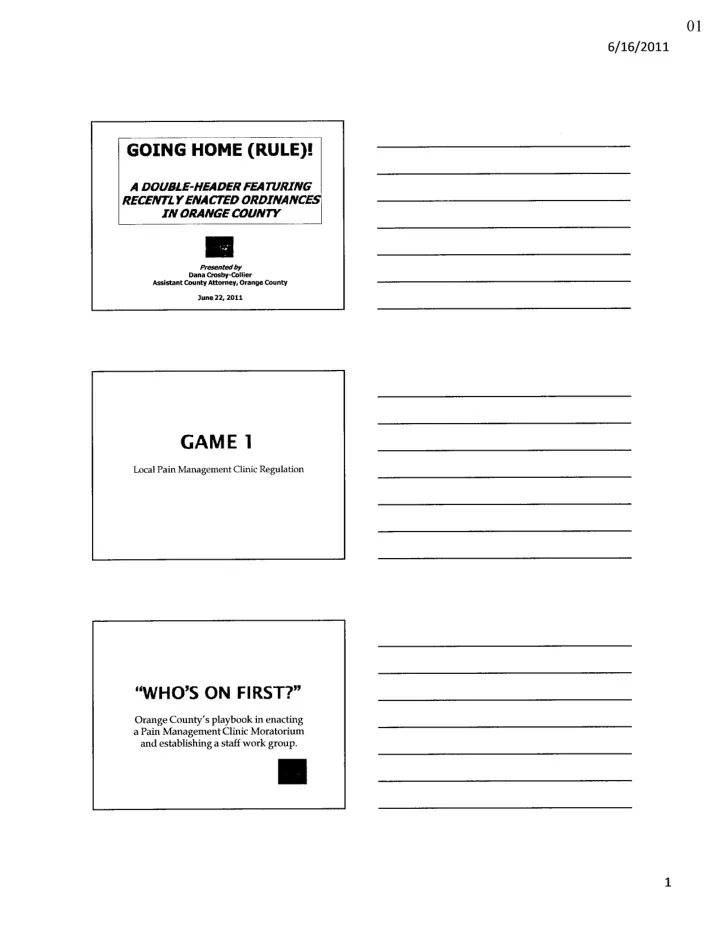
O] 611612011 GOING HOME (RULE)! A DOUBLE-HEADER FEATURING RECENTL Y ENACTED ORDINANCES IN ORANGE COUNTY Presented by Dana Crosby-Collier Assistant County Attorney, Orange County June 22, 2011 GAM E 1 Local Pain Management Clhic Regulation


slide-1
SLIDE 1

O]

611612011

GOING HOME (RULE)!

A DOUBLE-HEADER FEATURING

RECENTL Y ENACTED ORDINANCES

IN ORANGE COUNTY

Presented by Dana Crosby-Collier Assistant County Attorney, Orange County June 22, 2011

GAM E

1

Local Pain Management Clh•ic Regulation

"WHO'S ON FIRST?"

Orange County's playbook in enacting

a Pain Management Clinic Moratorium

and establishing a staff work group.

slide-2
SLIDE 2

02

6/16/2011

"WHY?"

County

  • rdinance

was

enacted

in

response to an urgent local situation and

uncertainty

  • f regulation

at

the

state

level...

Starting Line Up Game 1

Introduction

Summary of the Orange County Ordinance and

staff work group State Law Overview/State Leadership Issues 2011 Update

Introduction

Timeline:

September 30, 2010

Former Orange County Mayor Richard Crotty announced plans for

  • rdinance

regulating pain management clLrfics November 9, 2010

BCC work session on issues relating

to regulation of pain management clinics and

prescription drug/use and abuse December 7, 2010

Public Hearing on Ordinance

2

slide-3
SLIDE 3

03

6/16/2011

Summary of Ordinance

Country Ordinance adopted December 7, 2010: Moratorium

issuance of business tax receipts for

pain management clinics (PMC). PMC defined per 2010 state law Any privately owned

clinic, facility

  • ffice which advertises in any medium for any

type of pain management services,

employs physician

who is primarily engaged in the treatment of pain by

prescribing dispensing controlled substance AND PMC is registered m•der requirements of state law.

Summary of Ordinance

Exemptions to moratorium mirror exemptions to

registration under 2010 state law:

  • Licensed

facility under Chapter 395, FS;

  • Majority of physicians in the office primarily provide

surgical services;

  • Facility is owned by a publicly held corporation;
  • Facility affiliated with an accredited medical school at

which training is provided for medical students, residents, or fellows;

  • Facility does not prescribe

dispense controlled

substances for the treatment of pain;

  • Facility is owned by a corporate entity exempt from

federal taxation under 26 U.S.C. 501(c) (3) or (4).

Summary of Ordinance

Ordinance also Provides no PMC demand cash only as a

  • f

payment;

Restricts operating hours of existing PMCs to 7 a.m. to 9 p.m. of the same day; and Establishes staff work group to report back findings and

recommendations to BCC by July 12, 2011. Ordinance effective December 15, 2010 Moratorium expires at the latest December 14, 2011

slide-4
SLIDE 4

O4

6/16/2011

Summary of Ordinance

Work Group Members

Orange County Sheriff, Metropolitan Bureau of Investigation, County Plamfng, ZonLng, and Code Enforcement,

City of Orlando representatives, Ocoee, Apopka and Winter Park police departments,

Florida Department of Law Enforcement,

U.S. Attorney's office,

Drug Enforcement Administration/HIDTA

STATE LAW/STATE

LEADERSHIP ISSUES

In spite of the ever growing numbers of PMCs in our state and associated deaths both in and

  • ut
  • f
  • ur

state,

implementation

  • f

a

statewide program has been fraught with

issues.

State law/PDMP

In 2009 the Florida Legislature passed SB 462 (2009-198,

Laws of Florida):

  • Established a Prescription Drug Monitoring Program

(PDMP) in Florida law;

  • PDMP is

central repository for controlled substance prescription medication information 2009 law required Florida's PDMP to be established

by Dec. 1, 2010

4

slide-5
SLIDE 5

05

6/16/2011

State law/PDMP

Early issues •dth implementation of PDMP included delays to

the project-

  • DOH bid selection

challenged

  • DOAH ruled

the bid challenge March 8, 2011

Bottom line: PDMP

not implemented by Dec. 1, 2010

**Should be implemented by October 2011"*

State Leadership Issues/PDMP

Governor Scott

As part of his 2011 budget, Gov. Scott

proposed repealing the state's PDMP saying the database is government "overreach" **May 2011 update

Legislature passed

bill which left

PDMP intact.**

is that"What?!" "1 Don't Care?"

State law/PMC

In 2010 the Florida Legislature passed SB 2272 (2010-211,

Laws of Florida): Defines PMC;

Requires DOH to register, regulate and inspect PMCs;

PMCs must designate a physician responsible for registration and operations of PMC; Law contains stringent penalties for violations.

slide-6
SLIDE 6

O6

6/16/2011

State law/PMC

Additionally: eOnly

licensed physician may dispense medication at

PMC;

  • eEff. July 2012,

physician cannot practice in PMC

without having completed

pain management fellowship pain management residency; Physician must physically examine the patient at the time

medication is dispensed; and

Physician must document the reasons for giving more than

72 hr supply of medication.

2010 Act took effect October 2010;

registration of PMCs commenced

State Leadership Issues/PMC

Legislat•re- Rules to implement regs for medical doctors practicing in PMCs stalled in November 2010.

Why? HB 1565, which passed

veto override, required

Legislature to approve rules with a specific fiscal impact.

Court Challenge/PMC

U.S. District Court, Florida Northern (Tallahassee)

  • Ps originally pled many challenges to 2010 Act (vague

and overly broad definition of PMC; equal protection; due process; free speech; anti-trust...) Most issues mooted by 2011 legislation; two issues remain:

  • Advertising

a criteria for defining PMC (1

amendment challenge)

  • 72 hour dispensing limit (should

longer be issue

due to 2Oll legislation)

Case 4:10cv414 (fded 9-23-10)

6

slide-7
SLIDE 7

07

6/16/2011

Mve

2011 Update

Attorney General Pare Bondi February 2, 2011

AG Bondi's "top priority" is to

aggressively tackle pill mills public safety crisis.

AG proposed legislation, aggressive enforcement, increased

criminal prosecution, and prevention strategies.

March 28, 2011

  • Gov. Scott and AG Bondi announce pill

mill strike force to attack prescription drug abuse from

law enforcement angle.

  • May 6, 2011
  • Gov. Scott and AG Bondi stand side by side to

applaud passage of the 2011 PMC bill in House.

2011 Update

State Law

In 2011 bills fried

PMCs

SB 810 (by Fasano) SB 818 (by Fasano)

HB 1147 (by Garcia) HB 7095 (Schenck)

SB 1386 (Bogdanoff)

HB 7095 passed the Legislature in 2011 and

approved by Governor Scott June 3, 2011

2011 Update State Law

HB 7095 (codified at ch. 2011-141, Laws of Florida)- Did not repeal regulations and standards of care from the

2010 legislation and did amend definition of PMC. Did not repeal PDMP but did change PDMP to require data be entered in 7 days (down from 15).

Requires PDMP manager and staff to undergo criminal

background checks/fingerprints;

Contains a physician dispensing ban;

Requires practitioners who prescribe controlled

substances to register with DOH and comply with specific standards of care;

slide-8
SLIDE 8

08

6/16/2011

2011 Update State Law

HB 7095 (cont'd)

Requires pharmacies that dispense Schedule II and III

narcotics to go through rigorous permitting by July 2012;

Requires additional reports of distributions of controlled substances; Requires DOH conduct annual Level 2 screening

pharmacy owners/controlling interest (down from

every 2 years); Tracks the wholesale distribution of controlled substances; Creates a mandatory buy-back program for physicians to

return controlled substances to distributors;

Imposes stronger administrative and criminal penalties

for doctors who overprescribe narcotics.

2011 Update

State Law

HB 7095 Identified "Loopholes" Doctors and pharmacists are not required to check PDMP prior to giving the patient the drugs. (This has always been

an issue with the PDMP.)

Board-certified pain specialists, anesthesiologists,

neurologists and surgeons need not register with the State.

(State officials reply that the exempted doctors have not been the main offenders.) No drug testing required of patients though doctors must

write a detailed treatment plan and monitor patients for abuse.

l•pholes, S•z•nel (May 10, 2011).

Update: County Workgroup

Orange County workgroup has been meeting since January

and has been considering recommendations for the Board. Threshold issue

How do you define the PMC?

The state amended the definition in 2011 but definition still

may not catch all PMCs.

Of note: Prior to HB 7095 Sarasota County drafted

  • rdinance that offers

great model dentition for PMC.

8

slide-9
SLIDE 9

09

6/16/2011

Update: County Workgroup

County workgroup is considering two-pronged approach: Zoning and Substantive regulations Zoning regulation could limit location of PMCs, hours of

  • peration, separation distances, loitering, and waiting

space (HB 7095 contains

requirement for waiting room)

Substantive regulation could extend to requiring local PMC

providers check the PDMP before prescribing controlled

substances, engage in daily reporting of operational records, and keep detailed staff records.

Update: County Workgroup

Orange County PMC workgroup will be merged

with

comprehensive Prescription Drug

Abuse Task Force in the near future. Recommendalions will most likely be brought to

the BCC in the Fall.

GAME 2

Additional Local Regulation of the

Secondary Metals Industry

9

slide-10
SLIDE 10

]0

6/16/2011

"BECAUSE"

Orange County enacted additional

local regulation due to an increase of

secondary metals theft in our

coininunity.

Starting Line Up Game 2

Introduction

State Law Overview

Summary of the Orange County and City of

Orlando Ordinances

State Leadership Issues Timeline:

Introduction

August 30, 2010

City of Orlando adopted ordInance placIng additional regulations on secondary metals

dealers In the City

August 31, 2010 County Commissioner Scott Boyd brought report to BCC September 22, 2010 County met with City, industry, law

enforcement, and others to discuss options October 5, 2010 BCC discussed item; staff seeking Board

direction

November 4, 2010 -County met with City, Industry, law enforcement, and others to discuss draft ordInance December 7, 2010

Public Hearing Ordinance

10

slide-11
SLIDE 11

]]

611612011

State law

Part II, Chapter 538, Florida Statutes

Significant changes to state law in 2008.

Secondary metals recyclers must maintain

record of

seller hfformation

FDLE form: Identification information Statement of ownership

Description of seller

Seller's thumbprint

Description of seller's vehicle

Photo video of metal being sold Photo of seller receiving money for sale Allows for law enforcement inspection of property and records

State law

Part II, Chapter 538, Florida Statutes (cont'd)

Provides no cash transaction over $1000

Requires all dealers register with the state

State Law Prohibits:

Purchase of regulated metals between 9 pm and 6 am Purchase anywhere but fixed location Purchase of property not transported in a motor vehicle Florida Statutes did not prohibit County from imposing

stringent reporting requirements.

Summary of Ordinance

County Ordinance adopted December 7, 2010:

  • Electronic reporting of all transaction details (except

consideration amount) using the FINDER system

  • Requires dealers have access to

fax machine to receive

law enforcement alerts Creates a definition for restricted regulated metals and

requires:

  • -Seller show's additional proof of ownership;
  • -Dealer processes as

cashless transaction (check is mailed

EFT); and

  • -Seller may receive

check at time transaction if

exempt (civic, nonprofit, business to business, part of judicial process).

11

slide-12
SLIDE 12

]2

611612011

Summary of Ordinance

17 restricted regulated metal items including: Manhole

Electric lighl pole

utility Guard rail

Street sign traffic signal Funeral marker Historical marker Railroad equipment Metal item observably marked with initials,

logo

governmental entity, utihty company, cemetery Copper

aluminum coils from hea•lg

air condittonmg unit

window units

auto a/c

  • Stainless steel beer kegs

Any part of

catalytic (except shell) unless sold with vekude

Brass

bronze"FDC valves" and Shopping

County's Ordinance took effect January 3, 2011

City of Orlando Ordinance

By comparison, City of Orlando:

Adopted an ordinance Aug. 30, 2010

Ordinance took effect Jan. 3, 2011 Established

purely cashless system

Listed 20 restricted items

County's list plus

copper tubing, copper or aluminum guttering, and aluminum siding.

"Today"

Since Orange and Orlando adopted ordinances, numerous cities and counties

adopting ordinances

similar to the both ordinances.

Industry took language similar to the County's

but with express preemption via grandfather clause

to the

Legislature in 2011.

12

slide-13
SLIDE 13

]3

6/16/2011 2011 Session

In 2011 bills filed on secondary metals

HB 753 (by Ford)

SB 1528 (by Altman) Both bills died in committee but they will probably be back next year.

"TOMORROW"

The Orange County ordinances included in your back up.

If you need any additional information

wish to be added to

my email list for either item, please contact

at

Dana Crosby-Collier

Orange County Attorney's Office

406-836-7320

dana.crosby-collier@ocfl.net

13

slide-14
SLIDE 14

14

APPROVED

BY ORANGE COUNTY BOARD OF COUNIY

ORDINANCE NO. 2010-17

AN

ORDINANCE

OF

ORANGE

COUNTY,

FLORIDA RELATING

TO PAIN

MANAGEMENT

CLINICS; ADOPTING FINDINGS; PROVIDING DEFINITIONS; IMPOSING

A MORATORIUM ON THE ISSUANCE OF

BUSINESS TAX RECEIPTS FOR NEW

PAIN

MANAGEMENT CLINICS;

ESTABLISHING THAT

NO PAIN

MANAGEMENT

CLINIC

MAY

LIMIT

ITS

BUSINESS TO CASH ONLY; ESTABLISHING HOURS OF

OPERATION

FOR

PAIN

MANAGEMENT

CLINICS; DIRECTING STAFF TO STUDY, ANALYZE AND REPORT

TO

THE

BOARD

ON ISSUES

RELATING

TO PAIN

MANAGEMENT

CLINICS

BY

A

DATE

CERTAIN; PROVIDING

FOR

PENALTIES;

PROVIDING

AN

EFFECTIVE DATE.

WHEREAS, the Orange County SherifFs Office and the Metropolitan Bureau of

Investigation for the Ninth Judicial Circuit have advised the Orange County Board of

County Commissioners ("BCC") that a pattern of illegal drug use and distribution has

been linked in large part to certain pain management clinics operating in and around

Orange County; and

WHEREAS,

the

illegal

distribution

  • f prescription

drugs,

increased crime associated with such activity, and the high number of deaths in Orange County relating to

prescription drug abuse has created

an urgent situation requiring immediate action to

reduce the threat to the health, safety and welfare of county citizens; and

WHEREAS,

the

Florida Legislature has identified

concerns regarding

the

increased use and abuse of substances controlled by federal and/or state law and the

frequency of injury and death occurring

as

a result of the increased availability of

controlled substances via medical practitioners operating in pain management clinics or facilities; and

WHEREAS, Florida Statutes require physicians and other persons dispensing

prescription drugs through pain management clinics, facilities or offices, to register with

the State Department of Health in order to conduct such business; and

WHEREAS, several counties and municipalities

in Florida have established

moratoria

  • n certain

new pain management clinics

to curb the immediate negative

impacts created by these clinics, such as illegal prescription drug trafficking and sales of

illegal drugs around the clinics, and loitering in areas surrounding the clinics; and

WHEREAS,

the negative impacts associated with certain pain management clinics creates an urgent situation necessitating immediate investigation into and potential

regulation of such clinics in Orange County; and
slide-15
SLIDE 15

15

WHEREAS,

it is not the intent of this Ordinance

to interfere with the legal

prescription, dispensation, or use of controlled substances; and

WHEREAS, under its home rule authority Orange County can pass additional

legislation

to

further regulate pain management clinics

as long as these additional

regulations

are not preempted

in the law and

are not inconsistent with the statutory

provisions; and

WHEREAS, the BCC intends by this ordinance to implement

a moratorium on

the issuance of any new Business Tax Receipts for pain management clinics and to direct

County staff to analyze the effects of pain management clinics on our community and to

prepare recommendations to better promote, protect and improve the health, safety and

welfare of the citizens of the county by local regulation of pain management clinics and

to restrict cash only operations and hours of operation of existing clinics through the

period of this moratorium; and

WHEREAS,

at least during the term of this moratorium, the BCC desires to

adopt restrictions on the form of payment that is made at pain management clinics and

limitations on the hours of operation of such clinics.

THEREFORE,

BE

IT ORDAINED

BY THE BOARD OF COUNTY

COMMISSIONERS OF ORANGE COUNTY, FLORIDA:

Section 1. Recitals. The

tbregoing "WHEREAS"

clauses

are hereby

ratified and confirmed as being true and correct and are hereby made a specific part of

this Ordinance upon adoption hereof.

Section 2.

Title.__.•. This Ordinance shall be known as the "Chad Phillips Act."

Section 3. Definitions. For the purposes of this Ordinance, the following terms,

meanings:

A.

whether appearing

in

the singular

  • r plural form,

shall have the following

Chronic nonmalignant pain means pain unrelated to cancer, which persists

beyond the usual course of the disease or injury that is the cause of the pain, tbr more

than ninety (90) days after surgery.

2

slide-16
SLIDE 16

16

B.

Controlled substance is defined as in section 893.02, Florida Statutes, and

means a controlled substance listed in Schedules I to V in section 893.03, Florida

Statutes.

C.

Pain management clinic means any privately owned pain management clinic, facility or office which advertises in any medium for any type of pain management

services, or employs a physician who is primarily engaged in the treatment of pain by

prescribing or dispensing controlled substance medication and is required to register with

the Florida Department of Health pursuant to sections 458.3265

  • r 459.0137, Florida

Statutes, as may be amended from time to time. Pain management clinic does not include

a clinic:

1.

Licensed as a facility pursuant to Chapter 395, Florida Statutes, as may be amended;

2.

Where the majority of the physicians who provide services in the

clinic primarily provide surgical services;

3.

Owned by a publicly held corporation whose shares are traded on a

national exchange or on the over-the-counter market and whose total assets at the end of

the corporation's most recent fiscal quarter exceeded $50 million dollars;

4.

Affiliated with an accredited medical school

at which training is

provided for medical students, residents, or fellows;

That does not prescribe or dispense controlled substances for the

treatment of pain; or

6.

Owned by

a corporate entity exempt from federal taxation under

26 U.S.C. 501(c) (3) or (4) as may be amended.

slide-17
SLIDE 17

17

D.

Physician primarily engaged in the treatment of pain means

a physician

who prescribes or dispenses controlled substance medications when the majority of the patients

seen

are prescribed

  • r dispensed controlled substance medications

for the

treatment of chronic nonmalignant pain.

Section 4.

Moratorium.

A.

Beginning on December 15, 2010,

a moratorium shall exist for one year

and expire on December 14, 2011, or sooner as provided herein, during which time the Tax Collector shall not issue any new Local Business Tax Receipt to any person for the

purpose of engaging in, operating,

  • r managing

a pain management clinic. The Tax

Collector

is

authorized

to

renew

  • r transfer

any

Local Business Tax Receipt

  • r

Occupational License to any person for the purpose of engaging in or managing a pain management clinic existing on the effective date of this ordinance. However, if a pain management clinic is not registered with the Florida Department of Health as required by

sections 458.3265

  • r 459.0137, Florida Statutes, the Local Business Tax Receipt
  • r

Occupational License is not eligible for renewal or transfer.

B.

The moratorium shall expire upon the earlier of the following:

1.

On December 14, 2011, one year from the effective date of this

Ordinance;

2. "Iq•e effective date

  • f

an ordinance, adopted by

the Board of

County Commissioners,

to address drug use and distribution associated with pain

management clinics which dispense narcotic drugs on site in Orange County; or

3.

At such time

as the Board of County Commissioners receives

a

report from County staff on issues relating to pain management clinics and votes by

majority vote to repeal this moratorium.

4

slide-18
SLIDE 18

18

C. If, during the period of this moratorium,

an application is made

for

issuance of a Local Business Tax Receipt for the operation of any of the following

categories, which the applicant represents at the time of application, is not being operated

and will not be operated during the period of term covered by the Local Business Tax

Receipt as

a pain management clinic, the applicant, as a condition of issuance of the

Local Business Tax Receipt, shall execute and deliver to the "Fax Collector an affidavit

confirming such representation.

If, during the time covered by the Local Business Tax

Receipt,

the clinic, facility

  • r
  • ffice

is found to be,

in fact, operating

as

a pain

management clinic,

the Local Business Tax Receipt shall be subject

to immediate

suspension

  • r

revocation

in

proceedings

before

the

Code Enforcement Special

Magistrate, in addition to any other civil or criminal remedies or penalties available under

local, county, state, and federal laws. Failure or refusal of applicant to execute and deliver

the above-described affidavit shall result in a denial of the issuance of the Local Business

Tax Receipt. An executed affidavit shall accompany an application for a Local Business Tax Receipt in all of the following categories: Local Business Tax Receipt

Description Category Number

2711

Amusement Center

3001

Physician

3005 Dentist 3011

Massage Therapist (state certified)

3012

Chiropractor

3014

Ophthalmologist

slide-19
SLIDE 19

19 3016

Psychologist

3020 Miscellaneous professional 3100 Miscellaneous 3110

Consulting

3200

Retail store

3502

Wholesale

5000 Business Section 5. No Cash Only. During the moratorium established herein, no pain

management clinic in operation

as of December 15, 2010 shall limit patient payment

  • ptions to cash only.

Section 6.

Hours of Operation. During the moratorium established herein,

the hours of operation of a pain management clinic in operation as of December 15, 2010 shall be limited to 7 a.m. to 9 p.m. of the same day.

Section 7.

Staff Report.

A.

This moratorium has been established

for the minimum time period

necessary for County staff to analyze the effects and impacts of pain management clinics

in Orange County; analyze the criteria for additional standards needed, if any, under

zoning, land use, land development, and general police power regulations in connection

with the issuance of any development permits, business licenses, business tax receipts, or

approvals

Ibr pain management clinics within the County; analyze any new laws

regarding pain management clinics enacted by the Florida Legislature; complete

an

analysis of illegal drug use, distribution patterns, and other public health, safety and

welfare issues that

are associated with some pain management clinics that dispense

6

slide-20
SLIDE 20

20

narcotics on site; and, to make recommendations to the Board of County Commissioners

regarding whether there

is

a need to enact an ordinance regulating pain management

clinics so as to better promote the health, safety and general welfare of the citizens of the

County.

B.

County staff is directed to provide a report to the BCC of its findings and recommendations by not later than July 12, 2011.

Section 8. Penalties. Unless as otherwise provided herein, violations of this

Ordinance shall be punishable in accordance with Section 1-9 of the Orange County Code of Ordinances. In addition, the County may bring any other action available at law

  • r equity to penalize or enjoin violations of this Ordinance.

Section 9. Note to Codifier. This Ordinance may be codified as

a new Article

XIV, Chapter 2, of the Orange County Code.

Section 10.

15, 2010.

ADOPTED THIS 7 th DAY OF DECEMBER, 2010.

.•IJeputy-Clerk

s:\dcrosby\ordinances\pain mgml\pain mgmt mora final

Effective Date. This Ordinance shall become effective on December

ATTEST: Martha O. Ilaynie, County Comptroller

As Clerk of the Board of County Commissioners

7

ORANGE COUNTY, FLORIDA

By: Board of County Commissioners "I"<ichard T. Croti-y

¢

County Mayor

slide-21
SLIDE 21

APPROVED

BY ORANGE COUNTY BOARD OF COUNTY CO•i.•['RI$SIONERS

ORDINANCE NO. 2010-16 ORDINANCE

OF

ORANGE

COUNTY,

FLORIDA

EFFECTIVE DATE AN

¢lt[• 0 • Z01J

RELATING

TO

SECONDARY METALS RECYCLERS;

  • CREATING A NEW ARTICLE VII

IN CHAPTER 26 OF

THE ORANGE COUNTY CODE OF ORDINANCES

BY

CREATING SECTIONS

26-140

THROUGH

26-145,

ENTITLED "SECONDARY METALS

RECYCLERS";

PROVIDING DEFINITIONS; PROVIDING

FOR

LIMITATIONS

ON

CASH

TRANSACTIONS

FOR

CERTAIN RESTRICTED

REGULATED METALS;

PROVIDING

A

LIST OF

RESTRICTED REGULATED

METALS; REQUIRING

ADDITIONAL

OWNERSHIP

DATA BE PRESENTED

IN A SALE OF RESTRICTED

REGULATED METALS;

PROVIDING

FOR

INFORMATION SFLARING; REQUIRING ELECTRONIC TRANSACTION RECORD

OF ALL

PURCHASES; REQUIRING THE SECONDARY METALS RECYCLER TO

MAINTAIN

OR

HAVE

IMMEDIATE ACCESS

TO

A

FACSIMILE

OR SIMILAR EQUIPMENT;

PROVIDING FOR

A PENALTY; AND PROVIDING

AN EFFECTIVE

DATE.

WHEREAS, increasing worldwide demand for metals and the associated rising price of

metals have contributed to increased criminal activity in areas such as thefi of copper wiring

fi'om construction sites, underground telecommunication wires, utility wires, air conditioning

units, and beer kegs; and

WHEREAS, law enforcement officials have testified that increased criminal activity

relating to theft of secondary metal and secondary metal products such as those described above

is impacting the public health, safbty and welfare of the residents of Orange County; and

WHEREAS, in 2008 the state law took effect that had goals of reducing secondary metal

theft and increasing the penalties for violation of the

state law (Chapter 2008-69, Laws of

Florida); and

WHEREAS, law enforcement in both the City of Orlando and Orange County have

identified areas in the law where additional regulation will be helpful to curb theft of seconck•ry metals in Orange County; and

WHEREAS, the City of Orlando, Orange County, law enforcement, secondary metals

recyclers, and other interested persons have sought to find a way to share information, cooperate,

and move forward collectively in an effort to further reduce secondary metal theft locally; and

21

slide-22
SLIDE 22

22

WHEREAS, the state has

a specific goal of increasing recycling and that recycling

secondary materials is a vital part of preserving our state's environment; and

WHEREAS, under its home rule authority Orange County can pass additional legislation

to further regulate the secondary metals recycling industry, which is regulated at Part II, Chapter

538, Florida Statutes, as long as those additional regulations are not preempted in the law and are

not inconsistent with the statutory provisions.

THEREFORE,

BE

IT

ORDAINED

BY

THE

BOARD

OF

COUNTY COMMISSIONERS OF ORANGE COUNTY, FLORIDA:

Section 1. The foregoing "WHEREAS" clauses are hereby ratified and confirmed

as being true and correct and are hereby made a specific part of this Ordinance upon adoption

hereof.

Section 2. A new Article Vii, Chapter 26, Orange County Code of Ordinances, is

hereby created to read as follows:

CHAPTER 26, ARTICLE VII SECONDARY METALS RECYCLERS

  • Sec. 26-140. Definitions

A.

Ferrous Metals

means

any metals

containing significant quantities of iron or steel.

B.

Fixed Location

means

any

site occupied

by

a

secondary metals rec¥cler as owner of the site or as lessee of the

site

under

a

lease

  • r
  • ther

rental

agreement providing

for

  • ccupation of the site by the secondary metals recycler for a total

duration of not less than 364 days,.

C.

Monel• means a medium of exchange authorized or adopted by

a domestic

  • r foreign government

as part

  • f

its

currency.

D.

Nonferrous Metals

means

metals

not containing

significant quantities of iron or steel, including,_ without limitation,

copper, brass, aluminum, bronze, lead, zinc, nickel, and alloys

thereof, excluding precious metals subject to regulation under Part

I, Chapter 538, Florida Statutes.

slide-23
SLIDE 23

23

E.

Purchase Transaction means a transaction in which

a secondary metals recvcler gives consideration

for regulated

metals property.

F.

Regulated

Metals

Property

means

any item

composed primarily of any nonferrous metals, but shall not include

aluminum beverage containers,

used beverage

containers,

  • r

similar beverage containers. For purposes of enforcement under

this ordinance, the term shall also include stainless steel beer kegs. G.

Restricted Regulated Metal Property

means the

specific regulated metal items that are listed in section 26-142 of

this Code.

It.

Secondary Metals Recycler shall have the meaning

ascribed

in subsection 538.18(8),

Florida Statutes,

as may

be

amended from time to time.

1.

Seller means the person from whom the regulated metal property_ is acquired.

J.

Utility

means any

person, firm,

corporation,

association,

  • r political subdivision, whether private, municipal,

county,

  • r cooperative, which is engaged in the sale, generation,

provision,

  • r delivery of gas, electrici _ty, heat, water, oil, sewer

service, telephone service, telegraph service,

radio service,

  • r

telecommunication service.

  • Sec. 26-141. Limitations on Cash Transactions

A.

A secondary metals recvcler shall not enter into any cash transaction lbr purchase of any restricted regulated metals

property listed in section 26-142 of this Code.

B.

Payment by

a secondary metals recycler

for the

purchase of restricted regulated metal property shall be made by

check issued to the Seller and payable to the Seller or by electronic

payment to the Seller's bank account or to the Seller's employer's

bank account.

C.

Each check

lbr payment shall be mailed by the

secondary metals rec¥cler directly to the current street address of

the Seller which

is

  • n

file with the secondary metals recvcler

unless otherwise provided

in this Article. Pa•,ment shall not be

mailed to a post office box. Electronic payments shall be sent to a

slide-24
SLIDE 24

24

bank account for which the Seller is listed as an account holder or

an employee or agent thereof.

D.

Each check or electronic payment shall be mailed or electronically transferred by the secondary metals recvcler to the

Seller within three (3) business days of the purchase transaction unless otherwise provided in this Article.

  • Sec. 26-142.

Restricted

Regulated

Metal

Property; Exemptions.

A.

A secondary metals recycler shall not purchase any

  • f the following

items

  • f restricted regulated metal property

without obtaining reasonable proof that

the

Seller

  • wns

the

property (such as a receipt or bill of sale) or reasonable proof that

the Seller is an employee, agent, or contractor of a governmental

entity, utility company, cemetery, railroad, manufacturer, or other

person, business, or entity owning the property and that the Seller

is authorized to sell the item of regulated metal property on behalf

  • f the person, business,
  • r other entity owning the property (a

secondary metals recycler may retain on file an official document

  • n

the

letterhead

  • f the

entit,•, indicating that the Seller

is

authorized to sell the item of regulated metal property-; however, such a letter must be dated within 90 days of the transaction):

1.

A manhole cover.

2.

An electric light

pole

  • r
  • ther

utility

structure and its fixtures, wires, and hardware which

are

readily identifiable as coming from the utility structure.

3.

A guard rail.

4.

A street sign, traffic sign,

  • r traffic signal

and its fixtures and hardware.

5.

Communication, transmission, distribution,

and service wire, from

a

utility

including

copper

  • r

aluminum bus bars, connectors, and grounding plates

  • r

grounding wire.

6.

A funeral marker or funeral vase.

7.

An historical marker.

slide-25
SLIDE 25

25

8.

Railroad

equipment, including,

but

not

limited to a tie plate, signal house, control box, switch plate, E clip,

  • r rail tie junction.

9.

Any metal item that

is observably marked

upon reasonable inspection with any form of the name, initials, or

logo

  • f

a governmental entity, utility company,

cemetery,

  • r

railroad.

10.

A copper, aluminum,

  • r aluminum-copper

condensing or evaporator coil, including its tubing or rods, from a

heating or air conditioning unit (excluding coils from window air conditioning units and automobiles)._

11.

An aluminum or stainless steel container or

bottle designed to hold propane for fueling forklifts.

12.

Stainless steel beer kegs.

13. A catalytic converter or any nonferrous part

  • f a catalytic converter unless purchased as part of a vehicle.

14.

Metallic wire that was burned in whole or in part to remove insulation.

15.

Brass

  • r

bronze

commercial

valves

  • r

fittings, referred to as "FDC valves," that are commonly used on

structures for access to water for the purpose of extinguishing fires. 16.

Brass

  • r bronze commercial potable water

backflow preventer valves

that

are valves commonly used

to

prevent backflow of potable water into municipal domestic water

service systems from commercial structures.

17.

A shopping cart.

B.

Exemptions.

The secondary metals recycler may

provide a check at the time of the purchase transaction, rather than mailing said check as required in subsection 26-141 of this Article,

if the Seller is in one of the following exempt categories:

1.

Organizations, corporations,

  • r associations

registered with

the

state

as charitable, philanthropic, religious,

fraternal, civic, patriotic, social, or school-sponsored organizations

  • r associations, or from any nonprofit corporation or association;
slide-26
SLIDE 26

26

  • fficial capacity;

A

law enforcement

  • fficer acting

in

an 3.

A trustee

in

bankruptcy,

executor,

administrator, or receiver who has presented proof of such status to

the secondary metals recycler;

4.

Any public

  • fficial acting under judicial

process or authority who has presented proof of such status to the

secondary metals recycler;

5.

A sale on the execution, or by virtue of any

process issued by a court, if proof thereof has been presented to the

secondary metals recycler; or

6.

A

manufacturing,

industrial,

  • r
  • ther

commercial vendor

that

generates regulated materials

in

the

  • rdinary course of business.
  • Sec. 26-143. Electronic Transaction Records Required.

A. All secondary metals recyclers shall maintain

a

legible electronic record, in the English language, of all purchase

transactions involving regulated metal property and restricted

regulated •netal property to which such secondary metals recycler

is

a party. Such electronic format will be the Florida Integrated

Network

for

Data Exchange and Retrieval software

  • r

such software

as is otherwise designated

in writing by the Orange

County

Sheriff's Office.

It

shall be the responsibility

  • f the

individual secondary metal recycler,

  • r any employee thereof, to
  • btain

the most current data specifications

  • f the designated

electronic format.

B.

The following information shall be maintained and transmitted to the Orange County Sheriff's Office in the specified electronic data format described in subsection A., above: metals recycler; The

name

and

address

  • f the secondary

2.

The name, initials, or other identification of

the individual entering the information regarding the transaction;

3.

The date and time of the transactioni

slide-27
SLIDE 27

27

4.

The

weight, quantity,

  • r volume

and

a

description of the type of regulated metals property purchased in a purchase transaction;

5.

The distinctive number from the personal identification card of the Seller;

6.

A description of the Seller including:

a.

Full name, current residential

address, workplace, and home and work phone numbers;

b.

Height, weight, date of birth, gender,

hair color, eye color, and any other identifying marks;

c.

A vehicle description to include the

make, model, and tag number of the vehicle and trailer of the

Seller of the regulated metals property; and

d.

Any other information required by

the form approved by the Florida Department of Law Enforcement

and

as specified

in section 538.19, Florida Statutes, except the

amount of consideration given in the purchase transaction.

C.

Such information shall be electronically transmitted

for the previous day's business

to the Orange County Sheriff's

Office by 10 a.m.

  • n each day the secondary metals recycler is
  • pen for business.

D. A secondary metals recycler shall maintain or cause

to be maintained the information required by this section for not

less than five (5) years from the date of purchase transaction.

E. If the purchase transaction involves the transfer of

regulated metals property from

a)

a secondary metals recycler

registered with the State or bl

a•l exempl seller trader section 26-

142 B. of this Code to a secondary metals recycler registered with the State, the secondary metals recycler receiving the regulated

metals property shall record the Seller's business name and address

and the name of the Seller's business representative

  • r Seller's

point of contact in lieu of the requirements listed in paragraph 6.,

above.

slide-28
SLIDE 28

28

  • Sec. 26-144.

Facsimile, Telecopier•

  • r

Similar Equipment

Required.

A secondary metals recycler shall maintain at its place of business,

  • r otherwise have immediate access to, a facsimile, telecopier, or
  • ther equipment of similar function
  • n which notifications
  • f

stolen property

  • r other notifications relating to regulated metal

property may be expeditiously received from the Orange County

Sheriff's Department. The equipment shall be operable at all times

during the usual and customary business hours of the secondary

metals recycler. The secondary metals recycler shall maintain the facsimile number or other access number of the equipment on file with the Sheriff and shall not, ify the Sheriff within 24 hours of any

change in the number.

  • Sec. 26-145. Penalty.

Whoever violates this Article may be punished as provided

in section 1-9 of the Orange County Code.

Section 3.

Effective date. This ordinance shall become effective on January 3,2011.

ADOPTED THIS 7th DAY OF DECEMBER, 2010.

ATTEST: Martha O. Haynie, County Comptroller

As Clerk of the Board of County Commissioners

B•:/•..:.

Depub Clerk ORANGE COUNTY, FLORIDA

By: Board of County Commissioners By: Richard T. Crotty

County Mayor

s:\dcrosby\ordinances\secondary metads\secondar•' metals