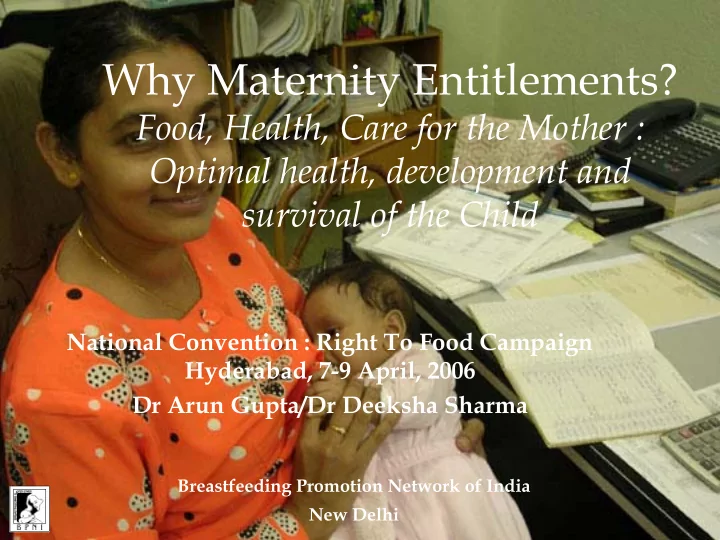
Why Maternity Entitlements? Food, Health, Care for the Mother : - - PowerPoint PPT Presentation

why maternity entitlements
SMART_READER_LITE
LIVE PREVIEW

Why Maternity Entitlements? Food, Health, Care for the Mother : - - PowerPoint PPT Presentation

Why Maternity Entitlements? Food, Health, Care for the Mother : Optimal health, development and survival of the Child National Convention : Right To Food Campaign Hyderabad, 7-9 April, 2006 Dr Arun Gupta/Dr Deeksha Sharma Breastfeeding


slide-1
SLIDE 1

Why Maternity Entitlements?

Food, Health, Care for the Mother : Optimal health, development and survival of the Child

National Convention : Right To Food Campaign Hyderabad, 7-9 April, 2006 Dr Arun Gupta/Dr Deeksha Sharma

Breastfeeding Promotion Network of India New Delhi

slide-2
SLIDE 2

Maternity entitlements – It’s Woman’s Right.

slide-3
SLIDE 3

First year is critical!

  • Malnutrition strikes in infancy from 11 % at 0-6 months reaches its peak by 23

months, then flat.

  • 36 million under three/ nearly 60 million U-5 are underweight and

undernourished thus underdeveloped

  • 2.4 million children die and 2/3rd in first year

Years of life Brain development

Underweight (-2sd) NFHS-2 Over 60 million

Child deaths U-5 (Lancet 2003 16 Lacs during first year and 8 lacs during next 4 years

slide-4
SLIDE 4

What happens with infants?

  • Only 40% EX BF for the first 6 months,
  • 33% adequately CF 6-9 months.
  • Brain development is dependent on level of interaction with the child.

Years of life Brain development

slide-5
SLIDE 5

Under Weight U-3 (-2sd)

(NFHS-2)

34.7 43.6 34.6 34.5 28.7 51.7 20 40 60 80 100

Delhi Himachal Pradesh Haryana Jammu & Kashmir Punjab Uttaranchal

This cannot be “poverty”

slide-6
SLIDE 6

Under-5 deaths preventable through universal coverage with individual interventions (2000)

India *Breastfeeding: Exclusive for first 6 months and continued for 6 to 12 months Source: Jones et al. LANCET 2003;362:65-71 0% 2% 4% 6% 8% 10% 12% 14% 16% 18% Breastfeeding* Complementary feeding Clean delivery Hib vaccine Clean water, sanitation, hygiene Zinc Vitamin A Antenatal steroids Newborn temperature management Tetanus toxoid Antibiotics for PRM Measles vaccine Nivirapine and replacement feeding Insecticide-treated materials Antimalarial IPT in pregnancy Intervention Percent

slide-7
SLIDE 7

Risk of neonatal mortality according to time of initiation of breastfeeding

0.7 1.2 2.3 2.6 4.2 0.5 1 1.5 2 2.5 3 3.5 4 4.5

With in 1 hour From 1 hour to end of day 1 Day 2 Day 3 After day 3

Pediatrics 2006;117:380-386

slide-8
SLIDE 8

Risk of neonatal mortality according to established breastfeeding pattern

1.1 1.6 5.6 1 2 3 4 5 6

Exclusive Predominant Partial

Pediatrics 2006;117:380-386

slide-9
SLIDE 9

Breastfeeding !

  • We are a breastfeeding nation
  • We are “drop outs” in EX BF/CF
  • 90% coverage can achieve reduction in infant mortality rate(IMR) (lancet

Study

Months Brain development 6 12 18 24

Breastfeeding status (NFHS-2) Exclusive BF 0-6 months (NFHS-2)

slide-10
SLIDE 10

Global consensus

Efforts should be targeted to

pregnant women and children under two.

  • ”Child development Overcoming persistent

‘undernutrition” EPW, March 25-31, 2006

  • “Repositioning Nutrition as central to

Development: A strategy for large scale Action”, March 2006

slide-11
SLIDE 11

Evidence supports !

Employed mothers often terminate

breastfeeding within a month of resuming work

To achieve recommended six months

  • f breastfeeding requires maternity

leaves of “at least six months” Lindberg,

Journal of Marriage and the Family. 1996; 58, 239-251.

slide-12
SLIDE 12

Maternity entitlements !

Years of life

Pregnancy Exclusive BF for 6 months Continued BF with CF for 2 yrs

slide-13
SLIDE 13

The impact of community interventions: Improving infant feeding in rural Haryana, India

The impact of community interventions: Improving infant feeding in rural Haryana, India through multiple contacts is feasible and improves uptake of other child health

  • interventions. Health policy and

Planning 2005; 20(5):328-336.

slide-14
SLIDE 14

Effect of breastfeeding support household visits by trained local mothers

20 40 60 80 100 1 2 3 4 5

Infants age in months

Received support visits Control group

Haider R, Ashworth A, Kabir I et al. Effect of community-based peer counsellors on exclusive breastfeeding practices in Dhaka, Bangladesh: a randomized, controlled trial. The Lancet 2000;356:1643-1647.

slide-15
SLIDE 15

What is breastfeeding education?

It includes

Good Information Assistance at birth and later Answers to their question Counsel to prevent sore nipples,engorgement, and

help if they come up

Counseling on complementary feeding Counseling on feeding options for HIV IF

slide-16
SLIDE 16

Breastfeeding Support Centers

slide-17
SLIDE 17

Breastfeeding Support Centers

slide-18
SLIDE 18

Reorganize resources, programmes, each step requires assured resources

Prenatal- 0-6 months

6 m-3 yrs 3 -6 yrs.

Baby care /breastfeeding support centers Skills training, Counseling, care of Women maternity leave

HEALTH Immunization etc

FOOD SUUPLY for Hunger/ PSE

slide-19
SLIDE 19

Emerging Issues

  • Repositioning of ICDS- RCH – focus on

development and survival, shift ‘SNP-food” to education with MDM.

  • Baby care centres / breastfeeding support

centres/counselling home visits by skilled workers

  • “One-hour breastfeeding support at birth” as

entitlement, can it be included in “Supreme Court

  • rder”
  • Length of maternity leave to six months; who will

fund? (if not the employers)

  • Informal sector workers : how they get benefits
  • Family housewives’ entitlements: community

responsibility.

slide-20
SLIDE 20

Thank you