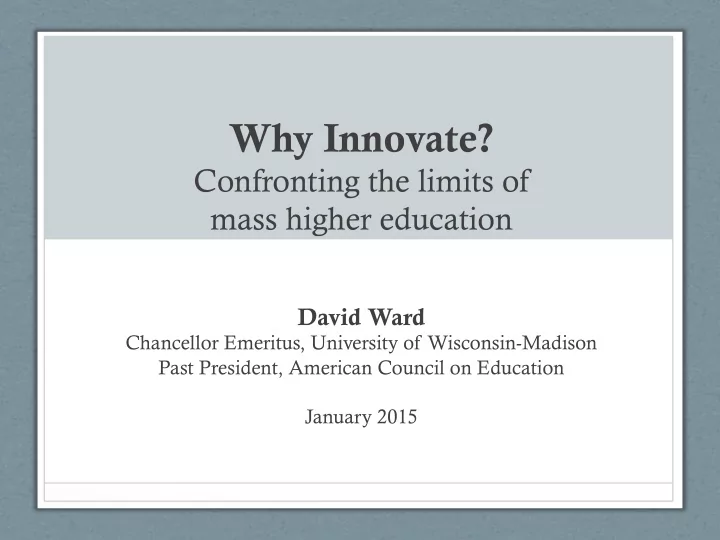
Why Innovate? Confronting the limits of mass higher education - - PowerPoint PPT Presentation

why innovate
SMART_READER_LITE
LIVE PREVIEW

Why Innovate? Confronting the limits of mass higher education - - PowerPoint PPT Presentation

Why Innovate? Confronting the limits of mass higher education David Ward Chancellor Emeritus, University of Wisconsin-Madison Past President, American Council on Education January 2015 Current Issues Squeezed between high expectations and


slide-1
SLIDE 1

Why Innovate?

Confronting the limits of mass higher education

David Ward

Chancellor Emeritus, University of Wisconsin-Madison Past President, American Council on Education January 2015

slide-2
SLIDE 2

Current Issues

  • Squeezed between high expectations and systemic

vulnerabilities

  • Tensions between past traditions and the digital

revolution

  • Tensions are grounded in the outmoded assumptions

about mass HE

  • Innovation may need to question these assumptions
  • Educational values, as well as cost, must drive

innovation

slide-3
SLIDE 3

Expectations

  • Competitive asset in the global knowledge economy
  • Insistence on high accessibility
  • Shift in balance of existential and utilitarian roles
  • Balance of public and individual share of cost
slide-4
SLIDE 4

Vulnerabilities

  • Diminished or stable public investments
  • Inflationary costs and rising student debt – doubts

about the value proposition

  • Concerns about performance – efficiency and quality

– accountability

  • Curricula and program priorities – cost of

comprehensiveness

  • Global dialogue with national and regional

magnitudes

slide-5
SLIDE 5

Global Dialogue But U.S. Often a Key Benchmark

  • First example of mass HE – idealism of post WW2
  • Low cost – High Access – Uniform Mission
  • Integrated Mission – 4 year undergraduate residential

program

  • National Research Funding despite limited federal scope
  • First to reach the fiscal limits of mass HE
  • Anxieties about quality – paradox of precocity and

mediocrity

slide-6
SLIDE 6

New Era and New Outcomes

  • Need-based differential tuition – loans rather than grants
  • Student demographics
  • Mission Variability
  • Concentration of Funded Research and Philanthropy
  • Alternative Providers
  • Misfits of policy and practice – Standardization v

Customization

slide-7
SLIDE 7
slide-8
SLIDE 8

Restrained Institutional Responses

  • “Let the pendulum swing” or “is the pin lost?”
  • Focus on a revenue crisis
  • Limits of current cost containment
  • Legitimacy narrowly defined – multiple

stakeholders

  • Highly decentralized elaborate decision-making
  • Nevertheless major innovations at individual or

group level

slide-9
SLIDE 9

Need to Respond at Scale

  • Define mission niche and institutional partnerships
  • Redefine the meanings and proportions of tripartite missions
  • Simplify the academic division of labor
  • Provide hybrid pedagogies at scale
  • Customize time to degree, timetable and examinations
  • Create structured student pathways
  • Promote collaborative and integrative research
  • Integrate infra-structure
  • Implications for future physical environments of HE
slide-10
SLIDE 10

Recapitulation

  • Confusion of future visions and past virtues
  • Mid-20th Century Model designed for 25% of

student age cohort

  • Past virtues still relevant for this 25%
  • Cannot serve the remaining 75% without redesign
  • Redesign at scale justified by educational motives
  • Execution needs a vision and a plan
slide-11
SLIDE 11

The Pendulum in Off Its Pin. It’s Time to Innovate