Why America Entered World War I An Online Professional Development - - PowerPoint PPT Presentation

why america entered world war i
SMART_READER_LITE
LIVE PREVIEW

Why America Entered World War I An Online Professional Development - - PowerPoint PPT Presentation

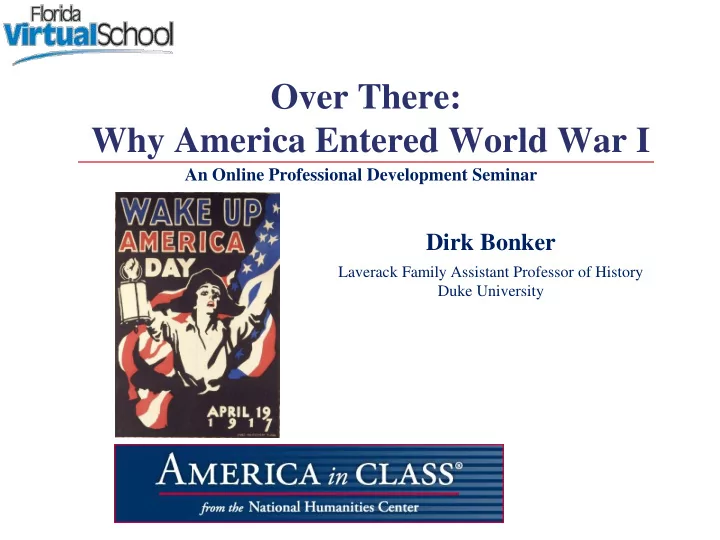
Over There: Why America Entered World War I An Online Professional Development Seminar Dirk Bonker Laverack Family Assistant Professor of History Duke University We will begin promptly on the hour. The silence you hear is normal. If you do


slide-1
SLIDE 1

We will begin promptly on the hour. The silence you hear is normal. If you do not hear anything when the images change, e-mail Caryn Koplik ckoplik@nationalhumanitiescenter.org for assistance.

Over There: Why America Entered World War I

Dirk Bonker

Laverack Family Assistant Professor of History Duke University

An Online Professional Development Seminar

slide-2
SLIDE 2

americainclass.org 2

Why America Entered World War I

GOALS

  • To deepen understanding of America’s entry into the Great War
  • To provide fresh resources and approaches to teach the topic
slide-3
SLIDE 3

americainclass.org 3

FRAMING QUESTIONS

  • Why did the United States enter World War I?
  • What were the arguments for and against entering?

Why America Entered World War I

slide-4
SLIDE 4

americainclass.org 4

Why America Entered World War I

FROM THE FORUM

Challenges, Issues, Questions

  • What threat, if any, did the stalemate in Europe pose to the United States?
  • What role, if any, did Williams Jennings Bryan play in America’s entrance

into World War I?

  • Which side, Allies or Central Powers, owed the most to the United States

in goods and loans?

  • Were American banks making conscious or unconscious decisions

favoring one side over the other?

  • Was the American press making an issue over British seizing of American

goods on the high seas?

  • What affect did WWI have on American agriculture? Did the demand for

food stuffs spur agriculture expansions which lead to the “Dust Bowl”?

slide-5
SLIDE 5

americainclass.org 5

Why America Entered World War I

FROM THE FORUM

Challenges, Issues, Questions

  • Socialists opposed the war, but with the increased demand for goods, what

position did labor union take?

  • America appears to have been firmly behind President Wilson’s desire to

remain neutral. Did the press, the captains of American industry, and bankers conspire to bring America into the war?

  • If a brokered peace had occurred with America as a mediator, what would

have been the result of the debt owed to American banks given that the burden for war reparations was place on the “loser”?

  • Did America delay its entry into the War, letting both sides exhaust

themselves, so that it would emerge as a super power on the world stage?

  • Why did the War become a battle of trenches?
  • Could the US have avoided participation in the War?
slide-6
SLIDE 6

americainclass.org 6

Dirk Bonker

Laverack Family Assistant Professor of History Duke University Research interests: militarism, empire, and warfare in the modern United States and Germany Militarism in a Global Age: Naval Ambitions in Germany and the United States before World War I (Cornell University Press, 2012)

Why America Entered World War I

slide-7
SLIDE 7

americainclass.org 7

U.S. Entry the War

  • Shaped outcome of the war
  • Signaled changing place of the U.S. in the world
  • Profound domestic impact
slide-8
SLIDE 8

americainclass.org 8

Road to War

  • Decisions and their Makers
  • A big debate: neutrality, preparedness, intervention
  • A divided nation
slide-9
SLIDE 9

americainclass.org 9

Decisions for War

  • Going to war, 1917
  • A partial neutral, 1914-17
  • Wartime conduct, 1917-18
slide-10
SLIDE 10

americainclass.org 10

SEMINAR OUTLINE

  • Wilson initially takes a position of neutrality
  • Neutrality tested by economic issues and maritime war
  • Wilson is caught between the British blockade and German

submarine warfare

  • Divisive debates:
  • preparedness vs. militarism
  • War in Europe is class war in the US
  • War will destroy American national unity
  • Propaganda images
  • Wilson defines American participation as a fight for new world
  • rder and the US enters the conflict
  • Critics and supporters of the War

Why America Entered World War I

slide-11
SLIDE 11

americainclass.org 11

Discussion Question

The United States declared its neutrality in 1914. According to President Wilson’s August 1914 appeal to the American people, what were the challenges of neutrality for the United States as both a great power and an immigrant nation? What is Wilson worried about? How in this text does he try to meet the challenges the nation faces? The people of the United States are drawn from many nations, and chiefly from the nations now at war. It is natural and inevitable that there should be the utmost variety of sympathy and desire among them with regard to the issues and circumstances of the conflict. Some will wish

  • ne nation, others another, to succeed in the momentous struggle. It will be easy to excite passion

and difficult to allay it. Those responsible for exciting it will assume a heavy responsibility, responsibility for no less a thing than that the people of the United States, whose love of their country and whose loyalty to its Government should unite them as Americans all, bound in honor and affection to think first of her and her interests, may be divided in camps of hostile opinion, hot against each other, involved in the war itself in impulse and opinion if not in action. Such divisions among us would be fatal to our peace of mind and might seriously stand in the way of the proper performance of our duty as the one great nation at peace, the one people holding itself ready to play a part of impartial mediation and speak the counsels of peace and accommodation, not as a partisan, but as a friend.

Woodrow Wilson: An Appeal for Neutrality, August 19, 1914

slide-12
SLIDE 12

americainclass.org 12

Robert Lansing to President Wilson, September 6, 1915

Discussion Questions

From the beginning, American wartime neutrality became a contested proposition in need continuous clarification. How did matters of transatlantic finance and trade test the commitment to neutrality? What impact was the War having on the US economy? How has the economic impact of the War affected America’s neutrality?

“Doubtless Secretary McAdoo has discussed with you the necessity of floating government loans for the belligerent nations, which are purchasing such great quantities of goods in this country, in order to avoid a serious financial situation which will not only affect them but this country as well. … “If the European countries cannot find means to pay for the excess of goods sold to them over those purchased from them, they will have to stop buying and our present export trade will shrink proportionately. The result would be restriction of outputs, industrial depression, idle capital and idle labor, numerous failures, financial demoralization, and general unrest and suffering among the laboring classes.”

slide-13
SLIDE 13

americainclass.org 13

Robert Lansing to President Wilson, September 6, 1915

“Manifestly the Government has committed itself to the policy of discouraging general loans to belligerent governments. The practical reasons for the policy at the time we adopted it were sound, but basing it on the ground that loans are “inconsistent with the true spirit of neutrality” is now a source of embarrassment. This latter ground is as strong today as it was a year ago, while the practical reasons for discouraging loans have largely disappeared. We have more money than we can use. Popular sympathy has become crystallized in favor of

  • ne or another of the belligerents to such an extent that the purchase of bonds would in no way

increase the bitterness of partisanship or cause a possibly serious situation. Now, on the other hand, we are face to face with what appears to be a critical economic situation, which can only be relieved apparently by the investment of American capital in foreign loans to be used in liquidating the enormous balance of trade in favor of the United States. Can we afford to let a declaration as to our conception of ‘the true spirit of neutrality’ made in the first days of the war stand in the way of our national interests which seem to be seriously threatened?”

Discussion Questions

From the beginning, American wartime neutrality became a contested proposition in need continuous clarification. How did matters of transatlantic finance and trade test the commitment to neutrality? What impact was the War having on the US economy? How has the economic impact of the War affected America’s neutrality?

slide-14
SLIDE 14

americainclass.org 14

The Lusitania Crisis

128 Americans lost

slide-15
SLIDE 15

americainclass.org 15

Response to the British and German Conduct of the Maritime War

Discussion Questions

How impartial was the Wilson administration’s handling of the maritime war? The British and German conducts of maritime war severely tested American neutrality. How did the Wilson administration deal with this challenge? How impartial was its response?

Wilson, Second Lusitania Note, June 9, 1915

The fact that more than one hundred American citizens were among those who perished made it the duty of the Government of the United States to speak

  • f these things and once more . . . to call the attention
  • f the Imperial German Government to the grave

responsibility which the Government of the United States conceives that it has incurred in this tragic

  • ccurrence, and to the indisputable principle upon

which that responsibility rests. The Government of the United States is contending . . . of nothing less high and sacred than the rights of humanity, which every Government honors itself in respecting and which no Government is justified in resigning on behalf of those under its care and authority.

  • W. J. Bryan to Wilson, May 12, 1915

Outside of the country the document will be applauded by the allies, and the more they applaud the more Germany will be embittered, because we unsparingly denounce the retaliatory methods employed by her without condemning the announced purpose

  • f the allies to starve the non-combatants of

Germany and without complaining of the conduct of Great Britain in relying on passengers, including men, women and children of the United States, to give immunity to vessels carrying munitions of war-without even suggesting that she should convoy passenger ships as carefully as she does ships carrying horses and gasoline.
slide-16
SLIDE 16

americainclass.org 16

Theodore Roosevelt, “Murder on the High Seas,” Metropolitan Magazine, May 11, 1915

“In the teeth of these things, we earn as a nation measureless scorn and contempt if we follow the lead of those who exalt peace above righteousness, if we heed the voices of those feeble folk who bleat to high heaven that there is peace when there is no peace. For many months our government has preserved between right and wrong a ‘neutrality’ which would have excited the emulous admiration of Pontius Pilate—the arch-typical neutral of all time. We have urged as a justification for failing to do our duty in Mexico that to do so would benefit ‘American dollars.’ Are we now to change faces and advance the supreme interest of ‘American dollars’ as a justification for continuance in the refusal to do the duty imposed on us in connection with the world war?”

Discussion Questions How impartial was the Wilson administration’s handling of the maritime war? The British and German conducts of maritime war severely tested American neutrality. How did the Wilson administration deal with this challenge? How impartial was its response?

slide-17
SLIDE 17

americainclass.org 17

The War Affects the US

Discussion Question

The right to travel into a war zone played a key role in the American uproar over German submarine warfare and the sinking of ships such as the

  • Lusitania. How was this right

itself asserted, defended, and challenged?

slide-18
SLIDE 18

americainclass.org 18

The Gore-McLemore Resolution, 1916

Discussion Questions The right to travel into a war zone played a key role in the American uproar over German submarine warfare and the sinking of ships such as the Lusitania. How was this right itself asserted, defended and challenged?

“Resolved by the Senate (the House of Representatives concurring), That it is the sense of the Congress, vested as it is with the sole power to declare war, that all persons owing allegiance to the United States should, in behalf of their own safety and vital interest of the United States, forbear to exercise the right to travel as passengers upon any armed vessel of any belligerent power, whether such vessel be armed for

  • ffensive or defensive purposes: and it is the further sense of the

Congress that no passport should be issued or renewed by the Secretary

  • f State or by anyone acting under him to be used by any person owing

allegiance to the United States for purpose of travel upon any such armed vessel of a belligerent power.”

slide-19
SLIDE 19

americainclass.org 19

T.R. Talks at Plattsburgh, New York Times, Aug. 26, 1915

Discussion Questions

The debate over “preparedness” surrounded American neutrality and paved the road to eventual U.S. intervention. How does this passage illustrate the terms of the debate on preparedness? “Such service would be an immense benefit to the man industrially. It would not only help the nation, but it would help each individual who undergoes the training. Switzerland has universal military service; and it is the most democratic and least militaristic of countries, and a much more

  • rderly and less homicidal country than our own. Camps like this are schools of civic virtue, as well

as of military efficiency. They should be universal and obligatory for all our young men. Every man worth his salt will wish to come to them.”

….

“As for the professional pacifists and the poltroons and college sissies who organize peace-at-any- price societies, and the mere money-getters and mere money-spenders, they should be made to understand that they have got to render whatever service the country demands. They must be made to submit to training in doing their duty. Then if, in the event of war, they prove unfit to fight, at any rate they can be made to dig trenches and kitchen sinks, or do whatever else a debauch of indulgence in professional pacifism has left them fit to do. Both the professional pacifist and the professional hyphenated American need to be taught that it is not for them to decide the conditions under which they will fight. They will fight whoever the Nation decides to fight, and whenever the Nation deems a war necessary.”

slide-20
SLIDE 20

americainclass.org 20

A Memorial to the President of the United States by the American Union Against Militarism, c. May 8, 1916

Discussion Questions

The debate over “preparedness” surrounded American neutrality and paved the road to eventual U.S. intervention. How does this passage illustrate the terms of the debate over preparedness? “Recent political events have demonstrated the existence of a strong and widespread distrust

  • f the movement which, in the guise of ‘preparedness,’ is rapidly introducing Old World

militarist institutions into American life. It is a distrust which is seeking political expression and is breaking down party lones [lines] in its search. It feels itself faced by a conspiracy of class and press, and seems determined to free itself and the country from that conspiracy. These American citizens crave some assurance from you that under your leadership we need fear no break with the splendid anti-militarist traditions of our past.” … “In short, we come to you, not only as the President of the United States but also as the man who has stood most firmly for the maintenance of our democratic institutions. We bring to you the evidence we have found of an abiding American spirit, tenacious of democracy, that fears the militarist propaganda as an ass[a]ult upon democracy. These people are far less fearful of an invading army than they are of the enemy in our midst. East and West, and North and South, we find good true American citizens, wage earners, farmers, members of the professions, and business men, who are stirred by a common desire to join with those in our own country and elsewhere who stand for democracy and against militarism.”

slide-21
SLIDE 21

americainclass.org 21

Eugene V. Debs, “Majority Report,” New Times, May 26, 1917

Discussion Question

Prominent anarchist Emma Goldman and socialist leader Eugene Debs belonged to the most principled critics of war and U.S. intervention. What was the source of their much-vilified Opposition, and what does it tell us about their views of the United States? We are neither pro-German nor pro-Ally. We are Socialists, international Socialists, and we have no use, not one bit, for capitalist wars. We have no enemies among the workers of other countries; and no friends among the capitalists of any country; the workers of all countries are our friends and the capitalists of all countries are our enemies. The class war is our war and our only war. We have no interest in national wars for ruling class conquest and plunder. In all these wars the workers are slaughtered while their masters wax fat in the spoils of conquest. The time has come for the workers to cease fighting the battle of their masters and to fight their own; to cease being slaughtered like cattle for the profit of the ruling class and to line up in the class struggle regardless of race or nationality for the overthrow of class rule and for the emancipation of their class and humanity. These are our principles and convictions as international revolutionary Socialists, and if this be treason we plead guilty and stand ready to take the consequences.

slide-22
SLIDE 22

americainclass.org 22

George Sylvester Viereck, “Americans, Be On Guard,” The Fatherland, May 26, 1915

Discussion Question

As the United States moved towards war and then entered the war, the community of German- Americans found itself increasingly under attack. How did George Sylvester Viereck, a prominent writer and editor who claimed to speak on behalf of this community, make the case for U.S. abstention from the war and answer allegations of his insufficient allegiance to the American nation? And on what terms did he eventually offer his support in April 1917? “We have not taken any action against England’s lawlessness. We cannot therefore rightfully protest against Germany’s measure of defense. If we do, and if we refuse to accept a reasonable compromise, we are irresistibly led to the conclusion that the Administration is a tacit ally of Great Britain. If Mr. Bryan had simultaneously dispatched a note to Great Britain protesting against her violations of International Law we would still think that he had exceeded the limits

  • f moderation in his note to Germany, but we should have no reason to doubt his sincerity.

“All patriotic Americans, irrespective of descent, owe unflinching loyalty to their country, but they do not thereby forfeit the right of free speech. We shall not permit Mr. Bryan’s blunders and the hurrahs of dangerous demagogues of the Roosevelt type to drag our country into war against

  • ur will and our better judgment.

“War would lead perhaps not to a revolution but it would create a rift in the heart of our

  • citizenship. It would take centuries to bury the memories of such a conflict. We feel sure that

Germany will make every possible concession to avoid a conflict. If a conflict should arise nevertheless, the blame will rest on Washington, and not Berlin.”

slide-23
SLIDE 23

americainclass.org 23

Why America Entered World War I

Discussion Questions

Outright propaganda played a prominent role in World War I, and visual images, in turn, were central to the propagandistic mobilizations over “preparedness” and U.S. intervention. What were some of the most powerful aspects of these images? What kind of arguments were they making and how did the frame the case for American belligerency?

slide-24
SLIDE 24

americainclass.org 24

Propaganda

slide-25
SLIDE 25

americainclass.org 25

Woodrow Wilson, An Address to a Joint Session of Congress, April 2, 1917

Discussion Question

In his addresses to the Congress, President Wilson made his case for U.S. intervention. On what grounds and with what goals did he take the nation into war? We are accepting this challenge of hostile purpose because we know that in such a government, following such methods, we can never have a friend; and that in the presence of its organized power, always lying in wait to accomplish we know not what purpose, there can be no assured security for the democratic governments of the world. We are now about to accept gauge of battle with this natural foe to liberty and shall, if necessary, spend the whole force of the nation to check and nullify its pretensions and its power. We are glad, now that we see the facts with no veil of false pretense about them, to fight thus for the ultimate peace of the world and for the liberation of its peoples, the German peoples included: for the rights of nations great and small and the privilege of men everywhere to choose their way of life and of obedience. The world must be made safe for democracy. It’s peace must be planted upon the tested foundations of political liberty. We have no selfish ends to serve. We desire no conquest, no dominion. We seek no indemnities for ourselves, no material compensation for the sacrifices we shall freely

  • make. We are but one of the champions of the rights of mankind. We shall be satisfied when

those rights have been made as secure as the faith and the freedom of nations can make them.

slide-26
SLIDE 26

americainclass.org 26

Senator Robert LaFollette, Speech, April 4, 1917

Discussion Questions

In April 1917 Congress debated the U.S. entry into the war. What was the case against the war, as articulated by its most prominent opponents in the Senate and House? [President Wilson] says that this is a war . . . for democracy, for the right of those who submit to authority to have a voice in their own government. . . . [T]he President says that we have become convinced that the German Government . . . ‘Prussian autocracy’ he calls it—can never again maintain friendly relations with us . . . [A]nd repeatedly throughout the address [he suggests] that if the German people would overturn their Government it would probably be the way to peace. . . . But the President proposes alliance with Great Britain, which, however liberty-loving its people, is a hereditary monarchy, with a hereditary ruler, with a hereditary House of Lords, with a hereditary landed system, with a limited and restricted suffrage for one class and a multiplied suffrage power for another, and with grinding industrial conditions for all the wageworkers. The President has not suggested that we make our support of Great Britain conditional to her granting home rule to Ireland, or Egypt, or India. . . . [A]ll of the countries with whom we are to enter the alliance, except France and newly revolutionized Russia, are still of the old order—and it will be generally conceded that no one of them has done as much for its people in the solution of municipal problems and in securing social and industrial reforms as Germany.

slide-27
SLIDE 27

americainclass.org 27

Senator Robert LaFollette, Speech, April 4, 1917

Discussion Questions

In April 1917 Congress debated the U.S. entry into the war. What was the case against the war, as articulated by its most prominent opponents in the Senate and House?

“Is it not a remarkable democracy which leagues itself with allies already far

  • vermatching in strength the German nation and holds out to such beleaguered nation

the hope of peace only at the price of giving up their Government? I am not talking now

  • f the merits or demerits of any government, but I am speaking of a profession of

democracy that is linked in action with the most brutal and domineering use of autocratic power. Are the people this country being so well represented in this war movement that we need to go abroad to give other people control of their governments? Will the President and the supporters of this war bill submit it to a vote of the people before the declaration of war goes into effect?”

slide-28
SLIDE 28

americainclass.org 28

Discussion Questions

The U.S. military elite supported the decision to enter into the war in 1917 (in which they took no direct part), yet its members did not necessarily share President Wilson’s larger views. How did prominent navy leaders such as Admiral Benson, the Chief of Naval Operations, think about the war, global politics, and U.S. national interests in the spring of 1917?

“Our entry into the war cannot be guided by questions of immediate interest alone. The possible combinations, of powers and circumstances, are too numerous and too pregnant with possibilities adverse to our interest to permit us to consider any plan

  • ther than one which will permit us to exercise eventually the full naval and military

strength of the United States in the defense of our interests. The possibilities of the situation are too appalling to justify us in considering any temporary arrangement not in harmony with the building up of our maximum power as an independent nation….”

William S. Benson, “The Possibility of War,” Feb. 1917

slide-29
SLIDE 29

americainclass.org 29

William S. Benson, “The Possibility of War,” Feb. 1917

Discussion Questions

The U.S. military elite supported the decision to enter into the war in 1917 (in which they took no direct part), yet its members did not necessarily share President Wilson’s larger views. How did prominent navy leaders such as Admiral Benson, the Chief of Naval Operations, think about the war, global politics, and U.S. national interests in the spring of 1917?

“We have therefore to expect and to prepare for a war in which we shall be unsupported and in which we may be opposed by great powers in both oceans at once. From these considerations we derive: OUR GREAT GENERAL MISSIONS To develop the full military and naval strength of the United States as fast as possible. To employ our forces in war so as best to build up our fighting power as an independent nation. To render the maximum possible support now to the enemies of the Central Powers.

slide-30
SLIDE 30

americainclass.org 30

Randolph Bourne, Twilight of Idols, 1917

Discussion Questions What were the temptations of war and what, in turn, animated Bourne’s critique? “How could the pragmatist mind accept war without more violent protest, without a greater wrench? Either Professor Dewey and his friends find that the forces were too strong for them, that the war had to be, and it was better to take it up intelligently than to drift blindly in; or else they really expected a gallant war, conducted with jealous regard for democratic values at home and a captivating vision of international democracy as the end of all the toil and pain. If their motive was the first, they would seem to have reduced the scope of possible control of events to the vanishing

  • point. If the war is too strong for you to prevent, how is it going to be weak enough for you to control

and mould to your liberal purposes? And if their motive was to shape the war firmly for good, they seem to have seriously miscalculated the fierce urgencies of it. Are they to be content, as the materialization of their hopes, with a doubtful League of Nations and the suppression of the I. W. W.?” … “A policy of ‘win the war first’ must be, for the radical, a policy of intellectual suicide. Their support

  • f the war throws upon them the responsibility of showing inch by inch the democratic gains, and of

laying out a charter of specific hopes. Otherwise they confess that they are impotent and that the war is submerging their expectations, or that they are not genuinely imaginative and offer little promise for future leadership.”

slide-31
SLIDE 31

americainclass.org 31

  • W. E. B. DuBois “Close Ranks,” The Crisis, (July 1918)

Discussion Questions

African-Americans were subjected to White racial rule, especially in the South, yet community leaders such as Du Bois or African American newspapers editors rallied behind the cause of U.S. intervention in the war. What were they thinking? What, in their view, could be the promise of the war and how did they link it to the racial discrimination and violence at home?

“We of the colored race have no ordinary interest in the outcome. That which the German power represents today spells death the to the aspirations of Negroes and all darker races for equality, freedom and democracy. Let us, while this war lasts, forget our special grievances and close our ranks shoulder to shoulder with our own white fellow citizens and the allied nations that are fighting for democracy. We make no ordinary sacrifice, but we make it gladly and willingly with our eyes lifted to the hills.”

slide-32
SLIDE 32

americainclass.org 32

Discussion Questions

What were they thinking? What, in their view, could be the promise of the war and how did they link it to the racial discrimination and violence at home?

Why America Entered World War I

slide-33
SLIDE 33

americainclass.org 33

Why America Entered World War I

slide-34
SLIDE 34

americainclass.org 34

Why America Entered World War I

Could we have avoided entering the War?

slide-35
SLIDE 35

americainclass.org 35

Final slide. Thank you