
SLIDE 1
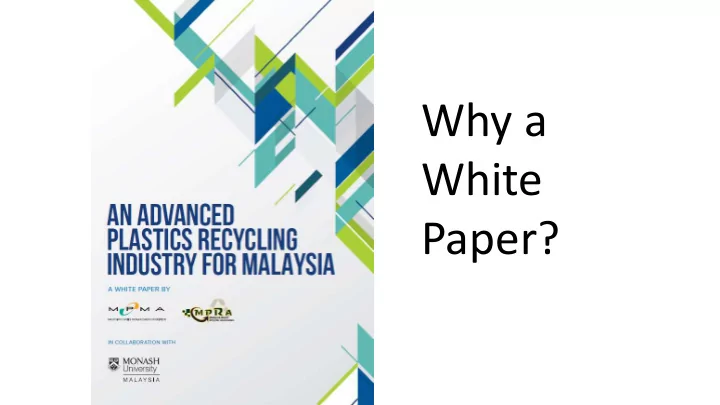
Why a White Paper? Negative news creating a misconception of - - PowerPoint PPT Presentation
Why a White Paper? Negative news creating a misconception of Recycling sampah plastic A symptom of mismanaged foreign waste smuggled in by unlicensed recycling operators A timely reminder that Malaysia also needs to address
Negative news creating a misconception
‘sampah plastic’
Recycling is a core component of efficient and effective waste management systems, and an advanced plastics recycling industry will support an effective and sustainable waste management system
The White Paper:
plastics recycling industry -
pollution
vibrant plastics recycling industry will benefit the country’s economy and enhance the government’s efforts to advance its sustainability agenda
as a key component in the country’s efforts to embrace circular economy
effective and efficient waste management system
GOALS
Malaysia is in critical need of wider collaboration, as managing the flows of plastics from cradle to the grave is a multi-stakeholder undertaking
GOALS
The importance of properly managing plastics streams and waste management infrastructure in order to develop a viable and successful circular economy
instead of being buried in landfills.
their equipment and technology to produce higher value recycled feedstock.
materials, from plastics to construction waste.
Sampah Plastik is caused by illegal recyclers who have smuggled in dirty, contaminated, unsorted plastic household waste from high-income countries
This has caused:
Jenjarom and Teluk Gong, Selangor and Sungai Petani, Kedah
recyclers attempt to escape the clampdown
surrounding communities
months, local authorities have shut down more than 150 of these unlicensed factories
against unlicensed recycling operators who break the law and pollute the environment
management system.
amount of recyclable material which would be permanently lost.
system.
UPSTREAM
Petrochemical Industry
MIDSTREAM
Plastics Conversion Industry
DOWNSTREAM
Plastics Recycling Industry
Revenue Total Investment Exports RM165 billion RM122.5 billion 90% RM31 billion RM18 billion 47% RM4.5 billion RM2.8 billion 70%
Plastics Recycling industry produces 1.5 million tonnes of recycled resins a year worth approximately RM4.5 billion in revenue, roughly 50% of its production generating foreign exchange earnings for the country Plastics recycling industry supports the RM31 billion local plastics industry - a key supply chain to the local electrical and electronics and automotive industry
the entire value chain of the manufacturing sector - With manufactured goods comprising 55% of exports, and electronic and electrical products making up 34% of total exports
goods, or goods containing plastics parts, across sectors in the economy amounts to approximately RM320 billion per annum - the electronic and electrical sector produces RM290 billion of end- products which contain plastics, while the automotive sector produces RM25 billion and the F&B sector RM3 billion
An advanced plastics recycling industry will require significant
This is necessary to achieve better efficiencies and efficacy in recycling plastics wastes
Department of Environment Malaysia -DOE (MESTECC)
PETRONAS Extraction Production MITI / MIDA
Approvals
Approvals
Approvals Ministry of Domestic Trade and Consumer Affairs (KPDNKK)
Protection LOCAL COUNCILS (State/ Ministry of Housing and Local Government - KPKT)
JPSPN (KPKT)
Waste Management
SOLID WASTE CORPORATION (KPKT)
Management Enforcement Raw Material Supply Chain Design and Manufacturing Distribution and Use End of Life
TAKE MAKE USE THROW
Crude oil/ Natural Gas Chemicals + Resins Plastics Products + Components Plastics Products + Components Plastics Waste
REGULATORY AREAS AGENCIES / GOVT BODIES PLASTIC S VALUE CHAIN
A simple outline which shows there is a complex array of regulators enforcing various laws and policies, from raw material to consumption to waste
stakeholder undertaking
Malaysia - in order to better connect regulation with the circular
change product designs in environmentally benign ways, such as making products that are easily recyclable or reusable
(Organisation for Economic Co-operation and Development, n.d)
In a circular economy, the waste becomes a valuable resource, to be recycled as raw material and made into new products and not thrown away
Proper management of plastics streams and waste management infrastructure for a successful circular economy
in the current waste management system which lacks the resources to develop sustainably
http://www.conversio-gmbh.com/res/Roadmap.pdf
MRFs
(Sorters) Industry Waste Household Waste
Commercial Waste
Clean & Sorted PLASTICS Clean & Sorted PAPER Clean & Sorted GLASS Clean & Sorted METAL UNRECYCLABLE WASTE WTE Collectors Recyclers Landfill / Incinerator Recycled Secondary Material Energy Final Disposal
http://www.wrap.org.uk/about-us/about/wrap-and-circular-economy
Proper management of plastics streams and waste management infrastructure for a successful circular economy
waste becomes a valuable resource, to be recycled as raw material and made into new products and not thrown away.
extract more natural resources and the impact
resource to used be over and over is the organising principle of circular economies, which is why recycling plays an important role
Build an Advanced PLASTICS Recycling Industry to Counter PLASTICS Pollution
ESTABLISH BUILD SUSTAIN
Education & Training Recommendations for Regularisation & SAS Enforcement Advanced Recycling Technology Increase MRFs Plastics Recycling Policy & Standards Investments from private sector Implement EPR Promote MyHijau Products MPMA/ MPRA White Paper for Circular Economy Master Plan Recycling Incentives MPMA/ MPRA White Paper for Waste Management Master Plan
Continuous engagement and collaboration with the Government and stakeholders
national recycling policy
enforcement
recycling industry
infrastructure
economy
regularisation and standards of recycled plastic material (fit-for- reuse)
Action Areas Main Objectives
With better technology and increased capacity, Malaysia’s advanced plastics recycling industry could grow its contribution by three to four times, to RM15 billion to RM20 billion annually