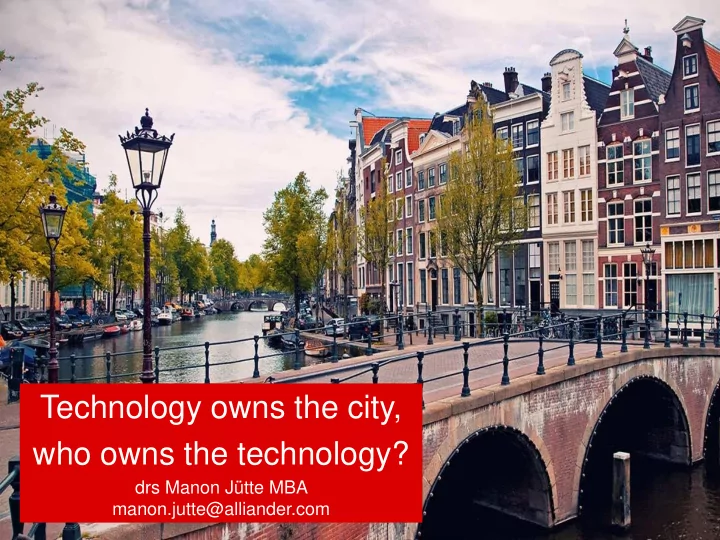
who owns the technology? drs Manon Jtte MBA - - PowerPoint PPT Presentation

who owns the technology
SMART_READER_LITE
LIVE PREVIEW

who owns the technology? drs Manon Jtte MBA - - PowerPoint PPT Presentation

Technology owns the city, who owns the technology? drs Manon Jtte MBA manon.jutte@alliander.com 1 We live in a rapidly changing world World in 1926 World in 2050? 2 Cities are changing in Smart Cities Self organizing communities


slide-1
SLIDE 1

1

Technology owns the city, who owns the technology?

drs Manon Jütte MBA manon.jutte@alliander.com

slide-2
SLIDE 2

2

We live in a rapidly changing world

World in 1926 World in 2050?

slide-3
SLIDE 3

3

Cities are changing in Smart Cities

  • Energy
  • Water
  • Connectivity
  • Internet of Things
  • Open Data
  • Sharing Economy
  • eMobility
  • Public

Transportation

  • Sensoring
  • Self organizing communities
  • Encouragement of self initiatives
  • Knowledge Economy
  • Security
  • Healthcare
  • Waste disposal
  • Sustainability

Physical and digital infrastructures merge

slide-4
SLIDE 4

4

For example: Amsterdam Smart City

Amsterdam

  • 4th Port in Europe
  • 4th Airport in Europe
  • 1st Internet Exchange
  • 120.000 Students
  • 182 Nationalities
  • 2016: innovation capital Europe

Amsterdam Smart City - liveable sustainable economic city

  • urban innovation platform
  • challenging businesses,

residents, the municipality and knowledge institutions

  • test innovative ideas & solutions

for urban issues. +100 Smart City projects

slide-5
SLIDE 5

5

  • Concept Smart is broad and can mean anything.
  • Smart refers often to a new type of technology
  • It should refer to make cities a better place to live,

more sustainable, better air quality, socially attractive and secure.

  • Energy and digitalisation play an important part of the

change cities are going through

But what is a Smart City?

slide-6
SLIDE 6

6

Which values prevail when developing technologies that shape the future?

slide-7
SLIDE 7

7

A scenario…

CHINESE MANUFACTURER US MANUFACTURER

slide-8
SLIDE 8

8

Newspaper: conflict China and USA (not a real case!)

slide-9
SLIDE 9

9

Your car is not loaded and the battery is empty… Is this due to a operational issue or to the Chinese and US conflict? You are in shock, are you really the victim of an international conflict? You wonder: shouldn’t your car and energy be independent of the interests of

  • ther parties?

You walk to your car….

slide-10
SLIDE 10

10

Voorbeeld 1: uber

slide-11
SLIDE 11

11

slide-12
SLIDE 12

12

slide-13
SLIDE 13

13

What about the other decentralised intelligent systems?

slide-14
SLIDE 14

14

Your focus for Democracy by Design

Inclusivity: sharing of costs and minimisation

  • f complexity

Freedom of choice: autonomy and impact

  • f choices

Equal treatment: division of roles, transparency decision making process

slide-15
SLIDE 15

15

Smart Cities need an IoT trust-framework

slide-16
SLIDE 16

16

Key components of IoT Trust Frameworks

Ownership and reuse of information and data Reliability & Independent Validation, Identification & Authorisation Monitoring, control & tracebility Security & privacy by design Open and inclusive governance

slide-17
SLIDE 17

17

Different public and private partners own sensors(air pollution, camera’s, traffic flows etc.) in a city which can provide useful data for multiple actors. By reusing data from these sensors more value can be created, but also superfluous investments can be prevented, eg: multiple organisation have similar sensors in the same geographic areas.

Access rights. Who has access under what conditions? Who checks compliancy? Can owner trust his personal data are used anonomous. Can owners check if no data is stored without permission?

Case Study – Sharing Sensors

Other use cases: lamppost, camera for cctv, air quality from private parties/civilians, traffic sensor, etc. In fact: all sensors!

slide-18
SLIDE 18

18

  • Common framework to accelerate and lower

threshold for smart city initiatives

  • Integral approach to smart cities & communities,
  • Collaboration and knowledge exchange between

cities and stakeholders

  • Scalability and reuse of solutions across cities
  • Solution market for cities & Improvement
  • Allowing flexibility for new implementations

Towards Open Urban Platforms with a new EU Reference Architecture

slide-19
SLIDE 19

19

Urban Platforms are a key part of the EIP-SCC (European Innovation Partnership for Smart Cities & Communities )

Source: DG Connect, Svetoslav Mihaylov

slide-20
SLIDE 20

20

Make the difference in your city: best practices and colaboration

Knowledge transfer platform Current partners: AMS, Alliander, Amsterdam, Eindhoven, Helsinki Maastricht University Target groups: municipalities, infrastructure operators, scientists,

  • thers..

Strategies for Amsterdam and Eindhoven www.democracybydesign.org MIT Boston, University Delft, University Wageningen, Amsterdam, Boston, Helsinki, La Fabrique de la Cité, Alliander, IBM, Cisco, etc.

slide-21
SLIDE 21

21

IoT trust framework: sharing knowledge

21

We are looking for examples:

  • Which other Cities are working together with multiple

parties on a trusted digital infrastructure?

  • What is the governance framework?
  • Which parties are involved?
  • What are your lessons learned?

Share your knowledge with EIP-SCC, Amsterdam, Alliander, Eindhoven and others and contact the speaker.

slide-22
SLIDE 22

22