White Rock Wind Farm Stage 2 IPC Presentation on Modification 6 23 - - PowerPoint PPT Presentation

white rock wind farm stage 2
SMART_READER_LITE
LIVE PREVIEW

White Rock Wind Farm Stage 2 IPC Presentation on Modification 6 23 - - PowerPoint PPT Presentation

White Rock Wind Farm Stage 2 IPC Presentation on Modification 6 23 September 2019 Presentation Structure Goldwind and CECEP Project Background Modification 6 Key Assessment Issues Community Consultation Conclusion


slide-1
SLIDE 1

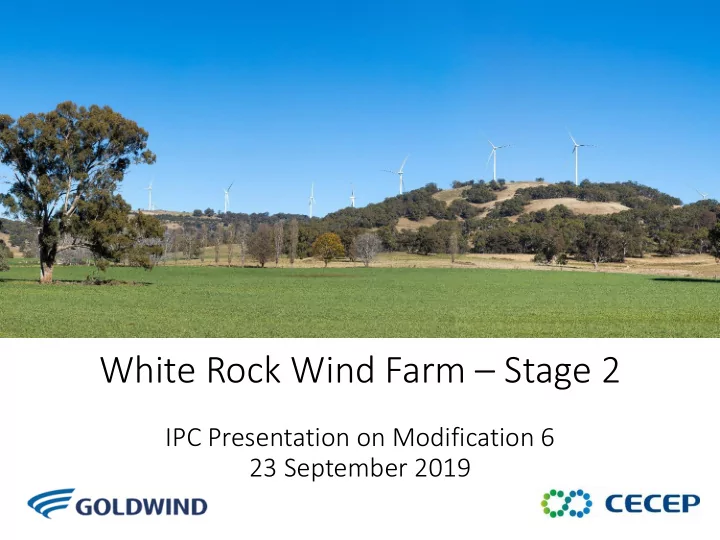
White Rock Wind Farm – Stage 2

IPC Presentation on Modification 6 23 September 2019

slide-2
SLIDE 2

Presentation Structure

  • Goldwind and CECEP
  • Project Background
  • Modification 6
  • Key Assessment Issues
  • Community Consultation
  • Conclusion
  • Q&A
slide-3
SLIDE 3

Goldwind

  • A global leader in manufacturing wind turbines, across six continents
  • 20 years of experience in the wind industry
  • 28,500 turbines, 44+ GW installed worldwide
  • Leader in permanent magnet drive wind turbines – no gear box
  • Goldwind Australia (est. 2009):
  • Offices in Sydney, Melbourne as well as site offices
  • 250+ people employed
  • Multiple projects in Australia:
  • Operating (570+ MW)
  • In construction (1,300+ MW)
  • In planning (1,000+ MW)
  • Goldwind owns 25% of White Rock Wind Farm
slide-4
SLIDE 4

CECWPC

  • CECWPC is majority owned by the China Energy Conservation and

Environmental Protection Group (CECEP)

  • CECEP is China’s largest technology-based service group in the field of

energy conservation, emission reduction and environmental protection.

  • CECWPC was founded in 2006 and listed in Shanghai Stock Exchange in

2014, specializing in development, investment, management, construction and operation & maintenance of wind power projects.

  • The total capacity both installed and under construction in China has

reached 1900 MW.

  • CECWPC is 75% owner of White Rock Wind Farm
slide-5
SLIDE 5

Project Background

  • Initially developed by Epuron 2007-2014, acquired

by Goldwind in 2015

  • Development consent under Part 3A (MP10_0160,

2012):

  • 119 wind turbines (150m tip)
  • 132 kV grid connection
  • 17 host landowners
  • Modifications to approval:

1. [Withdrawn] 2. Administrative (clearing, noise) (2015) 3. Stage 1 detailed design, staging (2016) 4. 330 kV connection, clearing (2017) 5. Administrative (subdivision) (2017)

  • Stage 1 (70 x 2.5 MW turbines) built
  • Construction 2016-2018
  • Operational from April 2018
  • Modification 6 to allow Stage 2 (see next slide)
  • Stage 2 construction commence late 2020
slide-6
SLIDE 6

Modification 6

Mod 6 seeks to consent Stage 2 development of White Rock Wind Farm, specifically:

  • A reduction in the number of Stage 2 turbines from 49 to up to 48 turbines;
  • Increased turbine dimensions (200m tip height, up to 85m blades, up to 130m

hub)

  • Changes to the project area:
  • add four additional properties within the project area; and
  • to remove a property originally included in the project area in response to

the landowner’s request.

  • Modifications to and additional access tracks, cabling and connection circuits for

the new or relocated wind turbines;

  • Expansion of the existing Stage 1 132 kV substation;
  • Additional temporary construction and ancillary facilities;
  • Additional hub height monitoring masts; and
  • Variations to specific conditions of the Project Approval including increased

clearing limits and project area.

slide-7
SLIDE 7

Why Mod 6?

  • Current consent based on a 10 year old design methodology
  • Original approval lacked detailed engineering design
  • Ecological constraints can no longer be met as a result
  • Advances in wind turbine technology allow greater generation for larger turbines
  • More suitable turbine locations to help reduce impacts
  • Technology changes in wind turbine design
  • Wind turbine technology has advanced considerably over 10 years
  • Modern wind turbine designs increase output and offer better economics
  • Turbines with taller hub heights and longer blades more cost-effective
  • Updated assessment criteria
  • More detailed assessment of ecological impacts
  • Planning considerations now require more detailed project designs
  • Greater restrictions of placement of turbines for noise and visual impact
  • Restructuring of wind turbine layout for Stage 2
  • Relocates turbines to more appropriate locations
  • Seeks to minimise impacts whilst increasing turbine dimensions
slide-8
SLIDE 8

WRWF Stage 2 Project Map

slide-9
SLIDE 9

Project Map Detail

slide-10
SLIDE 10

Key Issues

  • Ecology
  • Updated flora and fauna assessment in Stage 2 areas
  • EPBC Referral submitted, controlled action, being finalised
  • Offsets
  • Additional offset requirements
  • Visual
  • Updated assessment of visual impact, relocation of turbines
  • Noise
  • Updated modelling based on new turbine designs
  • Heritage
  • Additional assessment within Stage 2 areas
  • Aviation
  • Impact assessment for larger turbines, night lighting
slide-11
SLIDE 11

Response to Submissions

  • 61 submissions received
  • 2 from local councils;
  • 10 from government agencies;
  • 2 from the public as comments; and
  • 47 from the public with objections.
  • Public submissions
  • 7 (14 %) from within 25 km of WRWF
  • 42 (86 %) greater than 25 km of WRWF
  • Additional mitigation measures
  • Minimise noise impacts from wind turbines by turbine management
  • Improved management of steep slopes and batters
  • Further set back T95 from N180/N190 property boundary
  • Minimise aviation lighting impacts with ADLS, if required by CASA
  • Minimise flora and fauna impacts
slide-12
SLIDE 12

Updated Impact Assessment

  • Changes in assessment criteria produce a realistic consideration of impacts
  • As a result, original clearance allowances do not reflect reality
  • In order to construct Stage 2, increased allowances are required

Mod 6 Ecology and Detailed Design Original EA Ecology and Indicative Design

slide-13
SLIDE 13

Stage 1 Civil Works Example

slide-14
SLIDE 14

Ecological Impacts

  • Increased impacts to EEC due to detailed design and changed

assessment methodology:

  • Ribbon Gum – Mountain Gum increase from 28 ha to 93 ha
  • Box Gum Woodland included at 8.5 ha
  • Additional increase in Ribbon Gum required for Stage 2 cabling in Stage 1

footprint, est. 5-10 hectares

  • Increased blade swept area assessed and covered under Bird and Bat

Adaptive Management Plan requirements

  • Biodiversity Offsets to be updated based on final construction design
  • ‘Tangari’ property includes Stage 1 and Stage 2 offsets
  • Additional offsets can be secured where necessary
  • EPBC Referral submitted:
  • Determined a Controlled Action
  • Final stages of completing, pending final ecological assessments
  • Ecological impacts are consistent with current requirements for

mapping habitat and assessing detailed project design

slide-15
SLIDE 15

Stage 2 cabling in Stage 1 area

  • Mod 6 proposes to install Stage 2 cabling

through the existing Stage 1 footprint

  • Detailed design has determined that additional

vegetation impacts will result, due to:

  • Unfeasible to upgrade Stage 1 cables
  • Steep terrain hampers cabling in Stage 1 impact

areas

  • Increased number of cables required for larger

turbines

  • Better siting of cables to minimise impacts
  • Additional assessment will be carried out spring

2019 to determine impacts

  • Main priority will be to minimise impacts on

vegetation, where feasible

  • Will likely result in request to increase Ribbon

Gum – Mountain Gum clearance limit

  • Results available November 2019 to include in

Modification 6, if possible

slide-16
SLIDE 16

Biodiversity Offsets

  • ‘Tangari’ property acquired by WRWFPL as

part of planning condition requirements

  • Property subsequently assessed as suitable

for biodiversity offsets

  • Biobanking Agreement entered into 2019 for

combined Stage 1 and 2

  • Provides all offsets for:
  • Stage 1 impacts
  • 330 kV overhead line (Mod 4)
  • Stage 2 impacts (as currently proposed)
  • If additional offsets required, either
  • Increase offset area on ‘Tangari’
  • Seek additional offset area
slide-17
SLIDE 17

Visual Impact Assessment

  • Mod 6 seeks to relocate wind turbines into less populated areas,

reducing visual impacts

  • Neighbour Agreements offered to neighbouring residences
  • Landscape screening offered to all residences within 5 km of a turbine
  • 28 offers of landscaping sent out for Stage 1
  • 6 residences took the offer, others signed Neighbour Agreements
  • N180/N190/L220 residences:
  • Neighbour Agreements offered
  • L220 derelict house, turbines set back
  • N180/190 originally part of project, turbines removed or set back
  • Voluntary Acquisition as proposed is acceptable
  • Aviation lighting
  • Low intensity lighting consistent with Sapphire Wind Farm proposed
  • Use of Aircraft Detection and Lighting System (ADLS) if required by CASA
slide-18
SLIDE 18

N180/190 ‘Mountview’

  • Stage 2 has reduced the spread of wind turbines
  • Set back of T95 from project boundary
  • Owner has never formally objected to project
  • Owner lives in QLD, not primary residence
slide-19
SLIDE 19

L220 ‘Wilaroo’

  • Brown = Original EA, Purple = Mod 6
  • Closest Approved WTG 840m
  • Closest Mod6 WTG 1.4km
  • Mod 6 has set back the original EA wind turbines
  • Reduced visual impact, even with increased tip height
  • Residence is derelict for many years, uninhabitable in current state
  • Same owner as N180/190
slide-20
SLIDE 20

Community Engagement

  • WRWF has pro-actively engaged with local community:
  • Local Community Representative during construction
  • Glen Innes shop front (6,800 visits over 2 years, Stage 1)
  • Sponsorship budget during construction
  • Presentations, talks, site visits and open days
  • WRWF Community Consultative Committee ongoing
  • WRWF website, email, phone, newsletter ongoing
  • Stage 2 will follow similar Community Engagement Plan
  • Stage 2 has been regularly highlighted since Mod 6 was

submitted in January 2018

  • Neighbour Agreements:
  • 59 residences within 4 km of a wind turbine:
  • 35 are associated
  • 24 non-associated
  • Agreements in place:
  • Stage 1 = 8 active
  • Stage 2 = 6 pending construction
slide-21
SLIDE 21

Community Benefits

  • Capital investment of $300 million using Australian construction

firms and local ancillary businesses

  • Up to 200 full-time construction jobs for 2 years
  • Up to 5 additional full-time operational jobs
  • Community Fund for the life of the project:
  • Voluntary contribution of $2,500 per turbine
  • Projects within 50 km of WRWF
  • Stage 1 = $175,000, CPI’d
  • Stage 2 = up to $120,000 additional
slide-22
SLIDE 22

Conclusion

  • Mod 6 seeks to maximise the benefit of Stage 2 whilst minimising

impacts on the environment and surrounding community

  • WRWFPL commits to minimising vegetation impacts
  • WRWPL has already committed to a Biodiversity Offset for both Stage 1

and Stage 2, regardless of the success of Mod 6

  • WRWFPL has engaged with the local community to share the benefits of

the project

  • The project supports the Commonwealth’s Renewable Energy Target

and the NSW Climate Change Policy Framework

  • WRWFPL agrees with the DPIE’s recommendation that Mod 6 be

approved with conditions