Which of today's learning objecBves Welcome to Class 12: - - PDF document

which of today s learning objecbves
SMART_READER_LITE
LIVE PREVIEW

Which of today's learning objecBves Welcome to Class 12: - - PDF document

Which of today's learning objecBves Welcome to Class 12: The search for life is Water & Mars Geology the search for water are most


slide-1
SLIDE 1

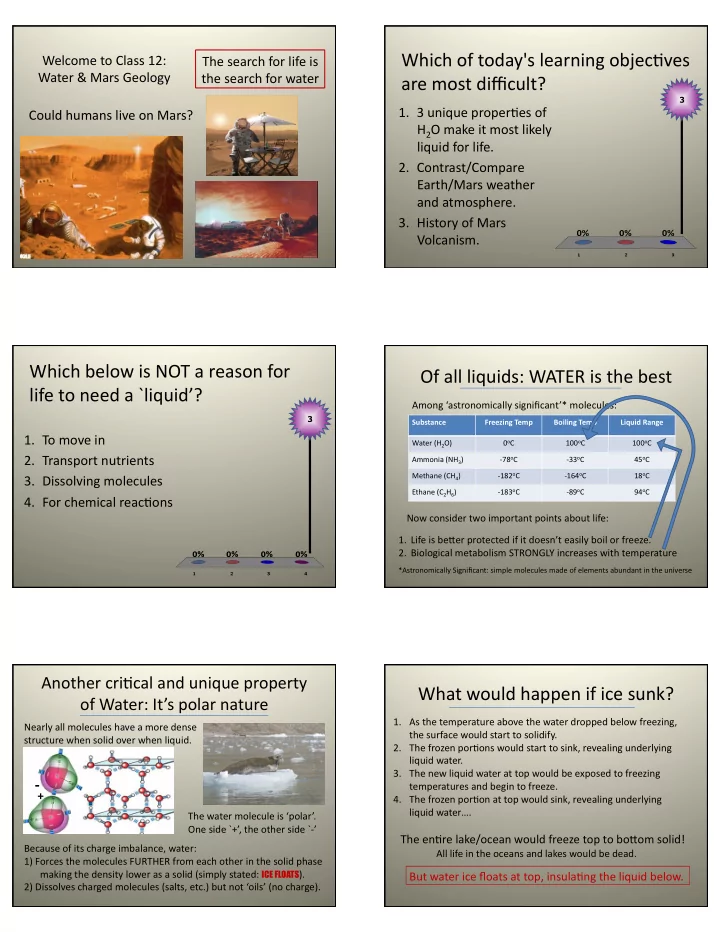
Could ¡humans ¡live ¡on ¡Mars? ¡ Welcome ¡to ¡Class ¡12: ¡ ¡ Water ¡& ¡Mars ¡Geology ¡ The ¡search ¡for ¡life ¡is ¡ the ¡search ¡for ¡water ¡

Which ¡of ¡today's ¡learning ¡objecBves ¡ are ¡most ¡difficult? ¡

3

  • 1. 3 ¡unique ¡properBes ¡of ¡

H2O ¡make ¡it ¡most ¡likely ¡ liquid ¡for ¡life. ¡ ¡

  • 2. Contrast/Compare ¡

Earth/Mars ¡weather ¡ and ¡atmosphere. ¡ ¡

  • 3. History ¡of ¡Mars ¡
  • Volcanism. ¡

Which ¡below ¡is ¡NOT ¡a ¡reason ¡for ¡ life ¡to ¡need ¡a ¡`liquid’? ¡

3

  • 1. To ¡move ¡in ¡
  • 2. Transport ¡nutrients ¡
  • 3. Dissolving ¡molecules ¡
  • 4. For ¡chemical ¡reacBons ¡

Of ¡all ¡liquids: ¡WATER ¡is ¡the ¡best ¡

Substance ¡ Freezing ¡Temp ¡ Boiling ¡Temp ¡ Liquid ¡Range ¡ Water ¡(H2O) ¡ 0oC ¡ 100oC ¡ 100oC ¡ Ammonia ¡(NH3) ¡

  • ­‑78oC ¡
  • ­‑33oC ¡

45oC ¡ Methane ¡(CH4) ¡

  • ­‑182oC ¡
  • ­‑164oC ¡

18oC ¡ Ethane ¡(C2H6) ¡

  • ­‑183oC ¡
  • ­‑89oC ¡

94oC ¡

Among ¡‘astronomically ¡significant’* ¡molecules: ¡ Now ¡consider ¡two ¡important ¡points ¡about ¡life: ¡

  • 1. Life ¡is ¡becer ¡protected ¡if ¡it ¡doesn’t ¡easily ¡boil ¡or ¡freeze. ¡
  • 2. Biological ¡metabolism ¡STRONGLY ¡increases ¡with ¡temperature ¡

*Astronomically ¡Significant: ¡simple ¡molecules ¡made ¡of ¡elements ¡abundant ¡in ¡the ¡universe ¡

Another ¡criBcal ¡and ¡unique ¡property ¡ ¡

  • f ¡Water: ¡It’s ¡polar ¡nature ¡

Nearly ¡all ¡molecules ¡have ¡a ¡more ¡dense ¡ structure ¡when ¡solid ¡over ¡when ¡liquid. ¡ Because ¡of ¡its ¡charge ¡imbalance, ¡water: ¡ 1) ¡Forces ¡the ¡molecules ¡FURTHER ¡from ¡each ¡other ¡in ¡the ¡solid ¡phase ¡ making ¡the ¡density ¡lower ¡as ¡a ¡solid ¡(simply ¡stated: ¡ICE FLOATS). ¡ 2) ¡Dissolves ¡charged ¡molecules ¡(salts, ¡etc.) ¡but ¡not ¡‘oils’ ¡(no ¡charge). ¡ ¡ ¡

+ ¡

  • ­‑

The ¡water ¡molecule ¡is ¡‘polar’. ¡ One ¡side ¡`+’, ¡the ¡other ¡side ¡`-­‑’ ¡

What ¡would ¡happen ¡if ¡ice ¡sunk? ¡

All ¡life ¡in ¡the ¡oceans ¡and ¡lakes ¡would ¡be ¡dead. ¡

  • 1. As ¡the ¡temperature ¡above ¡the ¡water ¡dropped ¡below ¡freezing, ¡

the ¡surface ¡would ¡start ¡to ¡solidify. ¡

  • 2. The ¡frozen ¡porBons ¡would ¡start ¡to ¡sink, ¡revealing ¡underlying ¡

liquid ¡water. ¡

  • 3. The ¡new ¡liquid ¡water ¡at ¡top ¡would ¡be ¡exposed ¡to ¡freezing ¡

temperatures ¡and ¡begin ¡to ¡freeze. ¡

  • 4. The ¡frozen ¡porBon ¡at ¡top ¡would ¡sink, ¡revealing ¡underlying ¡

liquid ¡water…. ¡ ¡ ¡ ¡The ¡enBre ¡lake/ocean ¡would ¡freeze ¡top ¡to ¡bocom ¡solid! ¡

But ¡water ¡ice ¡floats ¡at ¡top, ¡insulaBng ¡the ¡liquid ¡below. ¡

slide-2
SLIDE 2

List ¡the ¡unique ¡properBes ¡of ¡water ¡ that ¡make ¡it ¡the ¡most ¡likely ¡liquid ¡ for ¡life ¡in ¡the ¡universe. ¡

1) ¡It ¡is ¡in ¡a ¡liquid ¡state ¡over ¡a ¡very ¡WIDE ¡range ¡of ¡temperatures. ¡ ¡ 2) ¡The ¡liquid ¡state ¡of ¡water ¡is ¡at ¡much ¡higher ¡temperatures ¡than ¡

  • ther ¡molecules. ¡

3) ¡Because ¡of ¡its ¡overall ¡charge ¡structure, ¡it ¡is ¡less ¡dense ¡as ¡a ¡ solid ¡than ¡a ¡liquid ¡(ice ¡floats). ¡ ¡ 4) ¡It ¡dissolves ¡charged ¡molecules ¡well ¡(like ¡salts, ¡Na+Cl-­‑, ¡good ¡for ¡ chem ¡rxns) ¡but ¡NOT ¡cell ¡walls ¡(‘oil’ ¡based). ¡ 1) ¡It ¡is ¡in ¡a ¡liquid ¡state ¡over ¡a ¡very ¡WIDE ¡range ¡of ¡temperatures. ¡ ¡ 2) ¡The ¡liquid ¡state ¡of ¡water ¡is ¡at ¡much ¡higher ¡temperatures ¡than ¡

  • ther ¡molecules. ¡

3) ¡Because ¡of ¡its ¡overall ¡charge ¡structure, ¡it ¡is ¡less ¡dense ¡as ¡a ¡ solid ¡than ¡a ¡liquid ¡(ice ¡floats). ¡ ¡

BUT ¡WHAT ¡ARE ¡THE ¡BIOLOGICAL ¡ IMPLICATIONS ¡OF ¡THESE ¡ PROPERTIES? ¡

LIFE ¡CAN’T ¡SO ¡EASILY ¡FREEZE ¡OR ¡BOIL ¡AWAY! ¡ METABOLISM ¡INCREASES ¡WITH ¡HIGHER ¡TEMPERATURE ¡ OCEANS ¡WON’T ¡FREEZE ¡SOLID ¡KILLING ¡ALL ¡LIFE ¡

4) ¡It ¡dissolves ¡charged ¡molecules ¡well ¡(like ¡salts, ¡Na+Cl-­‑, ¡good ¡for ¡ chem ¡rxns) ¡but ¡NOT ¡cell ¡walls ¡(‘oil’ ¡based). ¡CRITICAL ¡FOR ¡EARTH-­‑BASED ¡LIFE ¡

Which ¡is ¡NOT ¡one ¡of ¡the ¡three ¡ requirements ¡for ¡life? ¡

  • 1. Source ¡of ¡energy. ¡
  • 2. Source ¡of ¡moBon. ¡
  • 3. A ¡liquid ¡medium. ¡
  • 4. A ¡source ¡of ¡molecules ¡

(raw ¡materals) ¡to ¡build ¡

  • cells. ¡

If ¡given ¡the ¡opportunity ¡(and ¡you ¡might ¡ not ¡return ¡alive) ¡would ¡you ¡want ¡to ¡visit ¡ Mars? ¡

3

Remember ¡to ¡set ¡your ¡channel ¡to ¡80! ¡

  • 1. YES ¡
  • 2. NO ¡

Let’s ¡compare ¡Mars ¡to ¡Earth ¡

Mars ¡ Earth ¡ Average ¡Distance ¡ from ¡Sun ¡ 142 ¡million ¡miles ¡ 93 ¡million ¡miles ¡ RadiaCon ¡Levels ¡ VERY ¡HIGH ¡ Moderate ¡ Diameter ¡ 4,220 ¡miles ¡ 7,926 ¡miles ¡ Tilt ¡of ¡Axis ¡ 25 ¡degrees ¡ 23.5 ¡degrees ¡ Length ¡of ¡Year ¡ 687 ¡Earth ¡Days ¡ 365.25 ¡Days ¡ Length ¡of ¡Day ¡ 24 ¡hours ¡37 ¡minutes ¡ 23 ¡hours ¡56 ¡minutes ¡ Gravity ¡ .375 ¡that ¡of ¡Earth ¡ 2.66 ¡Bmes ¡that ¡of ¡ Mars ¡ Temperature ¡ Average ¡-­‑81 ¡degrees ¡F ¡ Average ¡57 ¡degrees ¡F ¡ Atmosphere ¡ mostly ¡CO2 ¡some ¡ water ¡vapor, ¡1/100th ¡ pressure ¡of ¡Earth ¡ nitrogen, ¡oxygen, ¡ argon, ¡water ¡vapor, ¡

  • thers ¡

# ¡of ¡Moons ¡ 2 ¡ 1 ¡

< ¡½ ¡the ¡solar ¡radiaBon ¡ Significance ¡for ¡human ¡life? ¡ ½ ¡Diameter, ¡¼ ¡Volume ¡ Similar ¡seasons ¡ Longer ¡seasons ¡ Nice ¡for ¡humans ¡ You ¡can ¡walk ¡with ¡that ¡ heavy ¡space ¡suite ¡ You’ll ¡need ¡a ¡space ¡suit ¡ You’ll ¡need ¡a ¡space ¡suit ¡ 2x ¡more ¡romanBc ¡nights ¡ You’ll ¡need ¡a ¡space ¡suit ¡

What ¡is ¡the ¡greatest ¡challenge ¡to ¡humans ¡ living ¡safely ¡LONG ¡TERM ¡on ¡Mars? ¡

3

  • 1. Cold ¡temperatures. ¡
  • 2. Lack ¡of ¡Oxygen. ¡
  • 3. Low ¡Pressure. ¡
  • 4. Lack ¡of ¡MagneBc ¡field ¡
  • 5. UV ¡radiaBon. ¡ ¡
slide-3
SLIDE 3

The ¡‘seasons’ ¡on ¡Mars ¡and ¡Earth ¡

Earth’s ¡seasons ¡are ¡caused ¡by ¡the ¡Blt ¡

  • f ¡its ¡rotaBonal ¡axis ¡– ¡(almost) ¡ONLY ¡

On ¡Mars, ¡there ¡is ¡a ¡similar ¡Blt, ¡but ¡the ¡

  • rbit ¡is ¡not ¡very ¡circular ¡or ¡even. ¡

Mars ¡is ¡closer ¡to ¡sun ¡during ¡Northern ¡

  • Winter. ¡

The ¡Northern ¡seasons ¡are ¡milder ¡while ¡ Southern ¡seasons ¡are ¡more ¡extreme. ¡

Daily ¡temperature ¡changes ¡are ¡extreme ¡(here ¡ changing ¡100F ¡from ¡day ¡to ¡night) ¡because ¡of ¡the ¡ thin ¡atmosphere ¡(weak ¡greenhouse ¡effect). ¡ ¡The ¡ atmosphere ¡on ¡Mars ¡is ¡1/100th ¡that ¡of ¡Earth! ¡

What ¡drives ¡Earth’s ¡Weather? ¡

The ¡same ¡thing ¡that ¡drives ¡ Mars’ ¡weather: ¡ ¡The ¡Sun! ¡

Equatorial ¡regions ¡on ¡Earth ¡heat ¡up, ¡driving ¡hot ¡ expanding ¡air ¡up ¡word. ¡ ¡But ¡meanwhile, ¡the ¡ Earth ¡rotates. ¡ ¡This ¡moves ¡global ¡flows ¡ depending ¡on ¡the ¡laBtude. ¡ ¡ ¡At ¡our ¡laBtude, ¡our ¡ ‘weather’ ¡comes ¡from ¡the ¡West ¡(westerlies). ¡ On ¡MARS, ¡the ¡long ¡summers ¡melt ¡ONE ¡polar ¡ CO2 ¡caps. ¡This ¡INCREASES ¡pressure ¡overhead ¡as ¡ more ¡air ¡enters ¡the ¡atmosphere. ¡ At ¡the ¡same ¡Bme, ¡the ¡other ¡polar ¡cap ¡is ¡so ¡cold, ¡the ¡atmosphere ¡above ¡it ¡is ¡freezing ¡out! ¡ This ¡sets ¡up ¡a ¡huge ¡pressure ¡difference ¡pole ¡to ¡pole, ¡driving ¡strong ¡winds ¡and ¡dust ¡ storms ¡back ¡and ¡forth, ¡responding ¡to ¡the ¡freeze/thaw ¡of ¡Mars’ ¡polar ¡ice ¡caps ¡each ¡year. ¡ ¡ ¡

What ¡color ¡is ¡the ¡MarBan ¡sky ¡(as ¡ seen ¡from ¡its ¡surface)? ¡

3

  • 1. Black ¡
  • 2. Blue ¡
  • 3. Green ¡
  • 4. Orange ¡

Like ¡on ¡Earth, ¡the ¡color ¡of ¡Mars’s ¡sky ¡depends ¡on ¡ weather ¡and ¡Bme ¡of ¡day ¡

On ¡the ¡web ¡you ¡will ¡find ¡many ¡sites ¡who ¡claim ¡NASA ¡ has ¡deliberately ¡set ¡the ¡colors ¡to ¡make ¡the ¡sky ¡look ¡ red-­‑pink ¡(and ¡that ¡its ¡true ¡color ¡is ¡blue). ¡ NASA ¡does ¡this, ¡presumably, ¡to ¡hide ¡that ¡the ¡images ¡ were ¡taken ¡in ¡Arizona ¡(standard ¡conspiracy ¡theory). ¡ NASA ¡Photo ¡ Normally, ¡the ¡dusty ¡air ¡casts ¡a ¡brown-­‑orange ¡color. ¡ ¡If ¡dust ¡content ¡is ¡low, ¡the ¡sky ¡may ¡appear ¡ blue ¡or ¡even ¡greenish, ¡parBcularly ¡when ¡the ¡sun ¡is ¡low. ¡Yes, ¡those ¡are ¡clouds ¡of ¡water ¡vapor. ¡ ¡

In ¡truth: ¡the ¡sky ¡is ¡typically ¡brown-­‑orange, ¡ but ¡can ¡take ¡on ¡a ¡bluish ¡Bnge ¡at ¡sunset. ¡ ¡ ¡

Is ¡Mars ¡Geologically ¡AcBve? ¡

Mars ¡is ¡small, ¡but ¡there ¡is ¡evidence ¡for ¡acBvity: ¡

  • The ¡N. ¡hemisphere ¡is ¡clear ¡of ¡large ¡impact ¡craters. ¡
  • There ¡are ¡features ¡characterisBc ¡of ¡lava ¡flows. ¡
  • There ¡are ¡towering ¡Volcanoes! ¡

4x ¡deeper ¡than ¡Grand ¡Canyon. ¡A ¡good ¡ place ¡to ¡look ¡for ¡MarBan ¡Fossils! ¡

Recall ¡the ¡Hawaiian ¡Island ¡chain. ¡How ¡ would ¡that ¡hotspot ¡look ¡if ¡the ¡upper ¡plate ¡ never ¡moved? ¡

  • 1. It ¡would ¡plug ¡up ¡and ¡

stop ¡producing ¡lava ¡

  • 2. It ¡would ¡simply ¡form ¡a ¡

single ¡normal ¡island. ¡

  • 3. It ¡would ¡form ¡a ¡single ¡

island ¡that ¡was ¡very ¡

  • large. ¡
slide-4
SLIDE 4

Behold! ¡ ¡Olympus ¡Mons! ¡

WHY ¡SO ¡BIG? ¡

1) ¡No ¡plate ¡tectonics. ¡ 2) ¡Gravity ¡on ¡Mars ¡surface ¡ is ¡1/3 ¡that ¡on ¡Earth. ¡ Here ¡is ¡a ¡top ¡view ¡comparison ¡

  • f ¡Olympus ¡Mons ¡vs. ¡the ¡

Hawaiian ¡Islands. ¡ ¡ A ¡26 ¡km ¡high ¡Volcano ¡

  • ­‑ ¡Hawaii, ¡9 ¡km ¡to ¡seafloor ¡
  • ­‑ ¡Mt ¡Everest, ¡8.9 ¡km ¡ ¡

Everest ¡ Hawaii ¡

When ¡you ¡look ¡at ¡Mars’s ¡surface ¡features ¡ what ¡can ¡you ¡already ¡tell? ¡ ¡

  • 1. Life ¡can ¡live ¡there. ¡
  • 2. Its ¡geological ¡acBvity ¡

has ¡declined. ¡

  • 3. There ¡was ¡once ¡

running ¡water ¡on ¡its ¡ surface ¡

  • 4. Liquid ¡water ¡may ¡exist ¡

below ¡the ¡surface ¡

What ¡happened ¡to ¡the ¡Volcanism? ¡

Dark ¡areas: ¡4.6-­‑3.8 ¡B.Y.O. ¡ ¡ ¡ ¡ ¡ ¡ ¡ ¡Pink ¡areas: ¡3.8-­‑1.0 ¡B.Y.O. ¡ ¡ ¡ ¡ ¡ ¡ ¡Tan ¡areas: ¡< ¡1.0 ¡B.Y.O ¡

Surface ¡geology ¡indicates ¡evidence ¡of ¡a ¡decrease ¡in ¡volcanism ¡daBng ¡already ¡by ¡3.5 ¡B.Y.O. ¡ However, ¡MarBan ¡meteorites ¡indicate ¡molten ¡lava ¡~ ¡180 ¡M.Y.A. ¡ ¡Maybe ¡not ¡dead ¡yet. ¡ Surface ¡features ¡

Why ¡did ¡Mars’ ¡overall ¡geological ¡acBvity ¡ decline ¡with ¡Bme? ¡ ¡

  • 1. It ¡lost ¡its ¡magneBc ¡field. ¡
  • 2. Collisions ¡with ¡early ¡small ¡

planets ¡released ¡Mars’ ¡ internal ¡heat. ¡

  • 3. Mars’ ¡small ¡size ¡allowed ¡it ¡

to ¡cool ¡more ¡quickly. ¡

End ¡of ¡class ¡Quiz ¡

  • 1. ¡ ¡Which ¡of ¡water’s ¡unique ¡properBes ¡

increases ¡bio-­‑metabolism? ¡

5

  • 1. The ¡broad ¡range ¡for ¡its ¡

liquid ¡state ¡

  • 2. The ¡high ¡temperature ¡

range ¡for ¡liquid ¡state. ¡

  • 3. Its ¡ability ¡to ¡dissolve ¡
  • salts. ¡
  • 4. Solid ¡ice ¡floats ¡on ¡

liquid ¡ice. ¡ ¡

slide-5
SLIDE 5
  • 2. ¡ ¡In ¡which ¡way ¡are ¡Mars ¡and ¡Earth ¡

similar? ¡

5

  • 1. Number ¡of ¡moons ¡
  • 2. Diameter ¡
  • 3. Chemistry ¡of ¡

atmosphere ¡

  • 4. Tilt ¡of ¡axis ¡
  • 3. ¡ ¡What ¡does ¡it ¡mean ¡if ¡a ¡surface ¡region ¡

lacks ¡impact ¡craters? ¡

5

  • 1. The ¡surface ¡is ¡very ¡old ¡
  • 2. Fewer ¡impact ¡occurred ¡

there ¡

  • 3. The ¡region ¡has ¡been ¡

resurfaced ¡with ¡lava ¡

  • 4. The ¡impacts ¡are ¡too ¡

small ¡to ¡measure ¡

  • 4. ¡Which ¡is ¡NOT ¡evidence ¡of ¡Mars ¡PAST ¡

geological ¡acBvity? ¡

5

  • 1. Volcanoes ¡
  • 2. A ¡magneBc ¡field ¡
  • 3. Lava ¡flows ¡
  • 4. Large ¡regions ¡

lacking ¡impact ¡ craters ¡

  • 5. ¡ ¡Why ¡does ¡Mars ¡have ¡the ¡largest ¡

volcanoes ¡in ¡the ¡Solar ¡System? ¡

5

  • 1. It ¡is ¡a ¡small ¡planet ¡
  • 2. It ¡has ¡two ¡moons ¡
  • 3. The ¡surface ¡gravity ¡

is ¡very ¡low ¡

  • 4. It ¡has ¡no ¡magneBc ¡
  • field. ¡