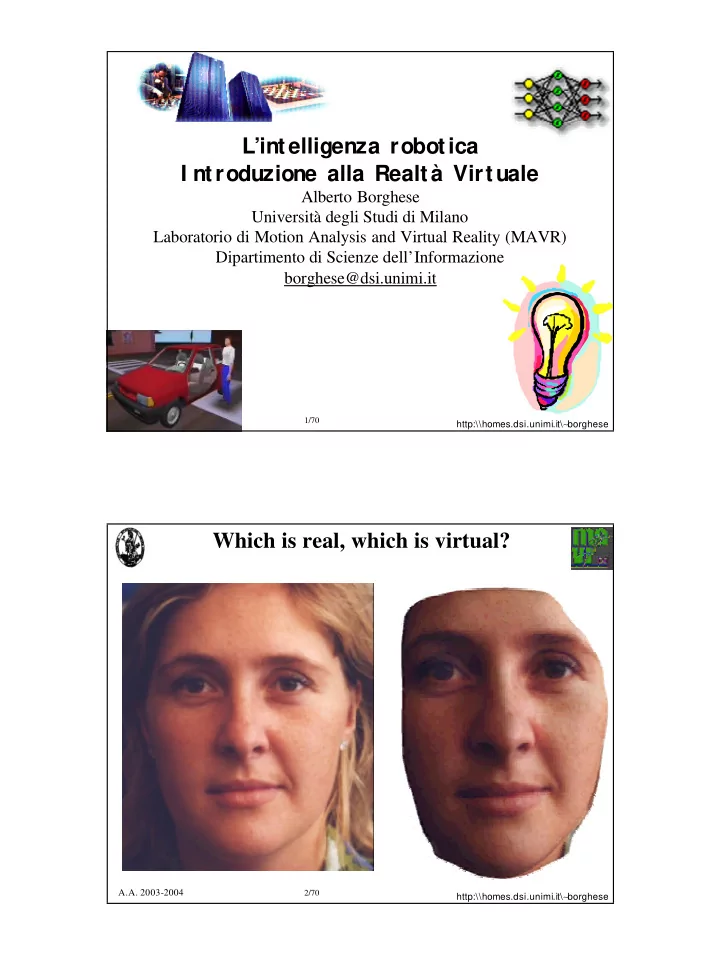
Which is real, which is virtual? A.A. 2003-2004 2/70 - - PDF document

which is real which is virtual
SMART_READER_LITE
LIVE PREVIEW

Which is real, which is virtual? A.A. 2003-2004 2/70 - - PDF document

Lintelligenza robotica I ntroduzione alla Realt Virtuale Alberto Borghese Universit degli Studi di Milano Laboratorio di Motion Analysis and Virtual Reality (MAVR) Dipartimento di Scienze dellInformazione borghese@dsi.unimi.it A.A.


slide-1
SLIDE 1

http:\\homes.dsi.unimi.it\∼borghese

1/70

A.A. 2003-2004

L’intelligenza robotica I ntroduzione alla Realtà Virtuale

Alberto Borghese Università degli Studi di Milano Laboratorio di Motion Analysis and Virtual Reality (MAVR) Dipartimento di Scienze dell’Informazione borghese@dsi.unimi.it

http:\\homes.dsi.unimi.it\∼borghese

2/70

A.A. 2003-2004

Which is real, which is virtual?

slide-2
SLIDE 2

http:\\homes.dsi.unimi.it\∼borghese

3/70

A.A. 2003-2004

Historical Perspective

  • Virtual Worlds or Synthetic Environments
  • Philosophical and Technologial origin.

Philosophical background Ontology and Gnoseology.

  • Plato (world of the ideas) 428-348 a.C.
  • Berkeley (sensorial experience is too limited) 1685-1753.
  • Hegel (“what is rational is real..”) 1770-1831.
  • New age.

http:\\homes.dsi.unimi.it\∼borghese

4/70

A.A. 2003-2004

Historical Perspective (II)

Technological background

  • Philco HMD, 1961.
  • “Ultimate display”, Sutherland, 1970.
  • Data Glove, VPL Research, 1988.
slide-3
SLIDE 3

http:\\homes.dsi.unimi.it\∼borghese

5/70

A.A. 2003-2004

Virtual Reality Systems

Key characteristics are: Immersivity. Interactivity. VR should be able to stimulate the human sensorial systems In a coordinated way.

http:\\homes.dsi.unimi.it\∼borghese

6/70

A.A. 2003-2004

A typical VR system

VR systems are constituted of:

  • Input systems (measure the position in the environment and

force over the environment.

  • World generators (provides a realistic virtual world in which

to act.

  • Graphical engine (computes the output, given the input and

the virtual world).

  • Output systems (outputs sensorial stimuli on the subject.

Vision, sound, force … are generated as if they were provided by the virtual environment.

slide-4
SLIDE 4

http:\\homes.dsi.unimi.it\∼borghese

7/70

A.A. 2003-2004

Components of a VR system

  • Input systems.
  • World generators.
  • Graphical engine.
  • Output systems.

http:\\homes.dsi.unimi.it\∼borghese

8/70

A.A. 2003-2004

Input systems

Measure human actions on the virtual environment.

  • Position. Measure the position of the body segments inside

the virtual environment.

  • Force. Measure the force exerted by the body segments when

in contact with a virtual object.

  • Estimate the motor output of the human muscle-skeleton system.
slide-5
SLIDE 5

http:\\homes.dsi.unimi.it\∼borghese

9/70

A.A. 2003-2004

Position systems

  • Motion capture (batch, complete information on the movement).
  • Real-time trackers (real-time position).
  • Gloves (specialized for hands).
  • Gaze trackers.

Adopted technology

  • Opteolectronics
  • Marker based
  • Computer vision.
  • Magnetical
  • Acoustical
  • Mechanical
  • Measure the position of the body segments inside the virtual

environment.

http:\\homes.dsi.unimi.it\∼borghese

10/70

A.A. 2003-2004

Edgar Muybridge (1896)

slide-6
SLIDE 6

http:\\homes.dsi.unimi.it\∼borghese

11/70

A.A. 2003-2004

Optical systems (computer vision)

  • Advantage: complete freedom of motion to the subjects.

The scene is surveyed by standard videocameras.

  • Disadvantage: ill-posed problems (high sensitivity to

limited resolution, noise and lighting conditions).

  • Solution: hierarchical multi-stage processing.

http:\\homes.dsi.unimi.it\∼borghese

12/70

A.A. 2003-2004

Pipe-line of processing in CV systems

  • First level: Features detection.
  • Background subtraction (Sturmanand Zelter, 1994; Di

Bernardo et al., 1995);

  • Optical flow (Barron et al., 1995);
  • Template matching (Borghese et al., 1990; Tomasi and

Kanade, 1991); Second level: Features matching. (Xu and Ahuja, 1994; Shashua, 1999, Weng, 2000, Gruen, 1985); Reference: Cipolla and Pentland eds., Computer Vision for Human- Machine Interaction, Cambridge University Press, 1998.

slide-7
SLIDE 7

http:\\homes.dsi.unimi.it\∼borghese

13/70

A.A. 2003-2004

Pipe-line of processing in CV systems (II)

  • Third level: 3D Reconstruction.

Fourth level: Model matching.

  • Silhouette matching (Moezzi et al., 1996);
  • 3D polygonal structures
  • Marching cube (Lorensenand Cline, 1987);
  • Snakes (Kass et al., 1988);
  • Matching 3D structures
  • Facial models (Parke, 1996);
  • Superquadrics (Metaxis and Terzopoulos, 1991);

http:\\homes.dsi.unimi.it\∼borghese

14/70

A.A. 2003-2004

Motion Capture live (Jain et al.)

slide-8
SLIDE 8

http:\\homes.dsi.unimi.it\∼borghese

15/70

A.A. 2003-2004

Optical systems – marker based

They are based on modeling human body as a skeleton (Pedotti, 1977). Markered subject 3D model Stick diagram Hidden model

http:\\homes.dsi.unimi.it\∼borghese

16/70

A.A. 2003-2004

Passive optical markers - processing

First step. Detection of the 2D position of the markers. Thresholding (Vicon, Motion Analysis, MacReflex) Correlation (Elite) Second step. Matching the same marker on the different cameras. Third step. Reconstruction of the 3D position of the marker. Fourth step. Classification of the markers according to the model of the subject.

slide-9
SLIDE 9

http:\\homes.dsi.unimi.it\∼borghese

17/70

A.A. 2003-2004

Motion capture based on markers

http:\\homes.dsi.unimi.it\∼borghese

18/70

A.A. 2003-2004

Optical systems – marker based (II)

Advantage: High reliability in the identification of the markers (joints). Disadvantages: Markers have to be attached to the subject before the

  • motion. Wires carried by the subject in case of active markers.
  • Active markers – LED, or magnets, with wires, time

multiplexing, high sampling frequency, with few markers, minimal processing.

  • Passive markers – Small pieces of retro-reflective paper,

Videocameras (video rates), complex data processing from image processing to 3D reconstruction. Active vs. Passive markers technology

slide-10
SLIDE 10

http:\\homes.dsi.unimi.it\∼borghese

19/70

A.A. 2003-2004

Active markers

Magnetic trackers

  • Electromagnetic induction. Magnetic material which is moved

inside an electric field, with variable frequency. Isotrack, FastTrack and Flock of birds.

  • A DSP is incorporated for time filtering.
  • Maximum range: 1m.

Problems

  • Distortions and linearity.
  • Interference of metallic materials.

Optoelectronics active markers

  • LED – Selspot, Watsmart, Optotrack.

http:\\homes.dsi.unimi.it\∼borghese

20/70

A.A. 2003-2004

Motion capture for animation

  • Motion capture
  • Definition of a 3D model.
  • Mapping of the motion onto the 3D model.
  • Animation.
slide-11
SLIDE 11

http:\\homes.dsi.unimi.it\∼borghese

21/70

A.A. 2003-2004

Video by Superfluo

http:\\homes.dsi.unimi.it\∼borghese

22/70

A.A. 2003-2004

Gloves

Monitor fingers position and force. Problems with the motion of the fingers:

  • overlap.
  • fine movements.
  • fast movements.
  • rich repertoire.
slide-12
SLIDE 12

http:\\homes.dsi.unimi.it\∼borghese

23/70

A.A. 2003-2004

Sayre glove (1976)

http:\\homes.dsi.unimi.it\∼borghese

24/70

A.A. 2003-2004

MIT glove (1977)

slide-13
SLIDE 13

http:\\homes.dsi.unimi.it\∼borghese

25/70

A.A. 2003-2004

Digital Data Entry Glove (1983)

http:\\homes.dsi.unimi.it\∼borghese

26/70

A.A. 2003-2004

Data Glove (1987)

slide-14
SLIDE 14

http:\\homes.dsi.unimi.it\∼borghese

27/70

A.A. 2003-2004

Power Glove (1990)

http:\\homes.dsi.unimi.it\∼borghese

28/70

A.A. 2003-2004

Cyber Glove (1995)

slide-15
SLIDE 15

http:\\homes.dsi.unimi.it\∼borghese

29/70

A.A. 2003-2004

Calibration Estimate of the geometrical parameters in the transformation operated by the sensors (e.g. the perspective transformation operated by a video-camera). Estimate of the parameters, which describe distortions introduced by the measurement system. Measurement of a known pattern. From its distortion, the parameters can be computed. Algorithms adopted: polynomial, local correction (neural networks, fuzzy).

http:\\homes.dsi.unimi.it\∼borghese

30/70

A.A. 2003-2004

Haptic displays

Convey to the subject the sensorial information generated in the interaction with the virtual objects: force, material texture… Measure the force exerted by the subject on the virtual environment. Aptic displays provide a mechanical interface for Virtual Reality applications. Most important developments have been made in the robotics field.

slide-16
SLIDE 16

http:\\homes.dsi.unimi.it\∼borghese

31/70

A.A. 2003-2004

Requirements of Haptic displays

  • Large bandwidth.
  • Low intertial and viscosity.

Technological solutions (oggetto intermediario):

  • Direct drive manipulandum (Yoshikawa, 1990),

Phantom (2000).

  • Parallel manipulandum (Millman and Colgate, 1991;

Buttolo and Hannaford, 1995).

  • Magnetic levitation devices (Salcudean and Yan, 1994;

Gomi and Kawato, 1996).

  • Gloves (Bergamasco, 1993).

http:\\homes.dsi.unimi.it\∼borghese

32/70

A.A. 2003-2004

Direct drive manipulandum (phantom)

slide-17
SLIDE 17

http:\\homes.dsi.unimi.it\∼borghese

33/70

A.A. 2003-2004

Parallel manipulandum (schema)

http:\\homes.dsi.unimi.it\∼borghese

34/70

A.A. 2003-2004

Pen Haptic display

slide-18
SLIDE 18

http:\\homes.dsi.unimi.it\∼borghese

35/70

A.A. 2003-2004

Gloves (Blackfinger, 2000)

http:\\homes.dsi.unimi.it\∼borghese

36/70

A.A. 2003-2004

Percro gloves (Begamasco, 1993)

slide-19
SLIDE 19

http:\\homes.dsi.unimi.it\∼borghese

37/70

A.A. 2003-2004

Gaze input

  • Contact lenses carrying magnetic coils.
  • Tvcameras aligned with an IR LED source.
  • Stereoscopic eye-wear.
  • The direction of gaze is decided by measuring the shape of

the spot reflected by the frontal portionof the cornea (Ohshima et al., 1996).

http:\\homes.dsi.unimi.it\∼borghese

38/70

A.A. 2003-2004

Components of a VR system

  • Input systems.
  • World generators.
  • Graphical engine.
  • Output systems.
slide-20
SLIDE 20

http:\\homes.dsi.unimi.it\∼borghese

39/70

A.A. 2003-2004

World generators

Integrated systems for 3D CAD and Animation:

  • Maya (ex-Alias/Wavefront)
  • XSI (ex-Softimage)
  • 3D Studio Max.
  • 3D Structure.
  • Colour and Texture
  • Motion (animation)
  • Rendering (lights, shadows)

http:\\homes.dsi.unimi.it\∼borghese

40/70

A.A. 2003-2004

3D structure

Solid modeling

  • 3D geometric solids: cubes, cylinders, cones…
  • Superquadrics (Terzopoulos and Metaxas, 1991): global

parameters + local parameters.

  • Revolution surfaces.
  • NURBS (Piegle, 1993). CAD, high interactivity.
  • Subdivision surfaces (Schroeder, 1999).

Surface fitting to range data

  • Snakes (Kass et al., 1988). Energy based approach. Best

curves.

  • Kohonen maps (1990).
  • Radial Basis Functions Networks (Poggio and Girosi, 1995;

Borghese and Ferrari, 1998).

slide-21
SLIDE 21

http:\\homes.dsi.unimi.it\∼borghese

41/70

A.A. 2003-2004

3D structure (II)

Linear approximation(mesh):

  • Delauney triangulation (Watson, 1981; Fang and Piegl, 1992). Direct

tessellation.

  • Alpha shapes, ball pivoting (Bernardini et al., 2000). Post processing

to regularize a Delauney tessellation.

  • Polymesh models (Singh et al., 1995).

Finite element models

  • It is a class per sé. Local modeling. Mechnical modeling.
  • Largely used for animation in medicine (facialanimation,

deformationof tissue during surgery). Multi-layer modeling. LOD Modelli a dettaglio e risoluzione diversi.

http:\\homes.dsi.unimi.it\∼borghese

42/70

A.A. 2003-2004

Models from range data

Cyberware whole body scanner, WB4

slide-22
SLIDE 22

http:\\homes.dsi.unimi.it\∼borghese

43/70

A.A. 2003-2004

Models from range data (II)

Cyberware smaller model 3030

http:\\homes.dsi.unimi.it\∼borghese

44/70

A.A. 2003-2004

3D structure from range data (III)

Polhemus hand held laser scanner

slide-23
SLIDE 23

http:\\homes.dsi.unimi.it\∼borghese

45/70

A.A. 2003-2004

Models from range data (IV)

Digibot II.

  • Platform rotates
  • Scanner line translates.

http:\\homes.dsi.unimi.it\∼borghese

46/70

A.A. 2003-2004

Components of a VR system

  • Input systems.
  • World generators.
  • Graphical engine.
  • Output systems.
slide-24
SLIDE 24

http:\\homes.dsi.unimi.it\∼borghese

47/70

A.A. 2003-2004

Graphical representation

Graphical engines represent triangles => Every shape is transformed into triangles.

  • The models created by the scanners are ensembles of triangles

(milions of).

  • Much more than required by applications.

⇓ Mesh compression. Representation of the same geometry/pictorial attributes, with a reduced set of triangles.

http:\\homes.dsi.unimi.it\∼borghese

48/70

A.A. 2003-2004

Gaze directed rendering

slide-25
SLIDE 25

http:\\homes.dsi.unimi.it\∼borghese

49/70

A.A. 2003-2004

The graphical engine (visual computing)

Parallelization (graphical boards, SIMD architectures on Pentium IV). Multiple cache levels. Pipelining (graphical and computational). Look-ahead code optimization (compiler optimization). Hardware acceleration of graphical operations (OpenGL, texture mapping…). Double buffering (for real-time visualization of 3D models).

http:\\homes.dsi.unimi.it\∼borghese

50/70

A.A. 2003-2004

Collision detection

Computational demanding (On2EF). Use of multiresolution models. Hierarchicaldetection. Geometry semplification (axes aligned faces). Check for common volumes. Extraction of the faces belonging to these volumes. Octree of the pairs of candidate faces. Check for intersection.

slide-26
SLIDE 26

http:\\homes.dsi.unimi.it\∼borghese

51/70

A.A. 2003-2004

Animation

  • Key-frame animation.
  • Motion capture.
  • Dynamic animation.

http:\\homes.dsi.unimi.it\∼borghese

52/70

A.A. 2003-2004

Components of a VR system

  • Input systems.
  • World generators.
  • Graphical engine.
  • Output systems.
slide-27
SLIDE 27

http:\\homes.dsi.unimi.it\∼borghese

53/70

A.A. 2003-2004

Output systems

Requirements for the monitor:

  • Large field of view (180o x 150o).
  • High spatial resolution (35 pixels/degree, equivalent to

12,000x12,000 pixels for a 19" display positioned at 70cm from the viewer). Requirements for the world generator:

  • Stereoscopic vision for objects with D < 10m.
  • Monocular cues for objects with D > 10m.
  • Occlusions.
  • Geometrical perspective and a-priori model

knowledge.

  • Shading.
  • Motion.

http:\\homes.dsi.unimi.it\∼borghese

54/70

A.A. 2003-2004

The human eye

Its behavior is very similar to that of a photocamera

slide-28
SLIDE 28

http:\\homes.dsi.unimi.it\∼borghese

55/70

A.A. 2003-2004

Stereo-disparity

Points further away are projected on points closer to the image center. Vergence and focusing are strictly connected.

http:\\homes.dsi.unimi.it\∼borghese

56/70

A.A. 2003-2004

Passive stereo

slide-29
SLIDE 29

http:\\homes.dsi.unimi.it\∼borghese

57/70

A.A. 2003-2004

Stereo image for passive stereo

http:\\homes.dsi.unimi.it\∼borghese

58/70

A.A. 2003-2004

Output devices (eye-glasses)

Semi-immersive: Eye-glasses (video accuracy, but user is not allowed to move, lateral vision is permitted, which limits virtual realism).

slide-30
SLIDE 30

http:\\homes.dsi.unimi.it\∼borghese

59/70

A.A. 2003-2004

HMD (n-vision)

Up to 1280 x 1024, 180Hz. Time multiplexing.

http:\\homes.dsi.unimi.it\∼borghese

60/70

A.A. 2003-2004

Output devices (BOOM HMD)

Up to 1280 x 1024 pixels / eye CRT Technology Head tracking is integrated.

slide-31
SLIDE 31

http:\\homes.dsi.unimi.it\∼borghese

61/70

A.A. 2003-2004

I-glasses (games)

http:\\homes.dsi.unimi.it\∼borghese

62/70

A.A. 2003-2004

Responsive work-bench (Strauss et al., 1995)

Virtual 3D objects are positioned on a working table. They are created projecting the stereo images over the table surface.

slide-32
SLIDE 32

http:\\homes.dsi.unimi.it\∼borghese

63/70

A.A. 2003-2004

CAVE

Room 2.5m x 2.5m with Virtual images (steoscopic) projected

  • nto its walls.

More people and Complete immersivity.

http:\\homes.dsi.unimi.it\∼borghese

64/70

A.A. 2003-2004

Large screen displays Large screen displays

Workwall

slide-33
SLIDE 33

http:\\homes.dsi.unimi.it\∼borghese

65/70

A.A. 2003-2004

Wearable devices

(a) HMD – 320x240 VGA (b) Keyboard on cloth Characteristics: mobile, context sensitive, augmented reality.

http:\\homes.dsi.unimi.it\∼borghese

66/70

A.A. 2003-2004

Physiological problems

  • SIMM and VR sickness limit the exposure time.
  • Size and distances misperception.
  • Limited range in extrapersonal space.
slide-34
SLIDE 34

http:\\homes.dsi.unimi.it\∼borghese

67/70

A.A. 2003-2004

Other output devices

Audio – Stereo, sound spatialization. Force – Same devices which measure the force exerted by the subject.

http:\\homes.dsi.unimi.it\∼borghese

68/70

A.A. 2003-2004

Applications

  • Army
  • Medicine
  • Industry (inspection, virtual prototyping)
  • Chemistry and Physics
  • Virtual theaters and theme parks
  • Enterteinment
  • Comunication
  • Engineering, Ergonomics and Architecture.
  • History.
slide-35
SLIDE 35

http:\\homes.dsi.unimi.it\∼borghese

69/70

A.A. 2003-2004

La città di Giotto

http:\\homes.dsi.unimi.it\∼borghese

70/70

A.A. 2003-2004

La tomba di Nefertari