Where We Are Source code Lexical, Syntax, and if (b == 0) a = b; - - PowerPoint PPT Presentation

where we are
SMART_READER_LITE
LIVE PREVIEW

Where We Are Source code Lexical, Syntax, and if (b == 0) a = b; - - PowerPoint PPT Presentation

Where We Are Source code Lexical, Syntax, and if (b == 0) a = b; Semantic Analysis IR Generation Low-level IR code Optimizations Optimized Low-level IR code Assembly code Assembly code generation cmp $0,%rcx cmovz %rax,%rdx 1 Low IR


slide-1
SLIDE 1

Where We Are

1
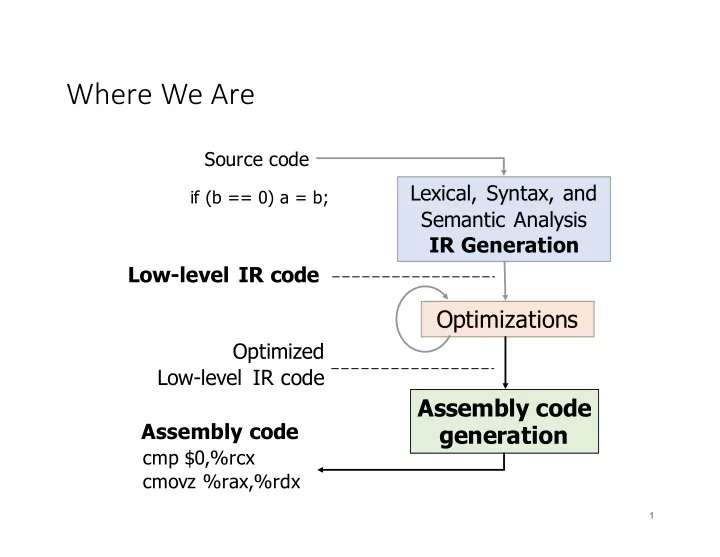
cmp $0,%rcx cmovz %rax,%rdx Source code

Lexical, Syntax, and Semantic Analysis IR Generation

Assembly code generation

Assembly code

if (b == 0) a = b;

Optimizations

Optimized Low-level IR code Low-level IR code

slide-2
SLIDE 2

Low IR to Assembly Translation

  • Low IR code (TAC):
  • Variables (and temporaries)
  • No run-time stack
  • No calling sequences
  • Some abstract set of instructions
  • Translation
  • Calling sequences:
  • Translate function calls and returns
  • Manage run-time stack
  • Variables:
  • globals, locals, arguments, etc. assigned memory location
  • Instruction selection:
  • map sets of low level IR instructions to instructions in the target

machine

2

t3 = this.x t3 = t2 * t3 t0 = t1 + t2 r = t0 t4 = w + 1 k = t4

slide-3
SLIDE 3

x86-64 crash course

  • a.k.a. CS 240 review, upgrade to 64 bits
  • Focus on specific recurring details we need to get right.
  • Calling Conventions
  • Memory addressing
  • Field access
  • Array indexing
  • Wacky instructions
  • Division
  • Store absolute address
  • setCC and movzbq

3

slide-4
SLIDE 4

x86 IA-32: registers

4

%eax %ecx %edx %ebx %esi %edi %esp %ebp %ax %cx %dx %bx %si %di %sp %bp %ah %ch %dh %bh %al %cl %dl %bl

16-bit virtual registers (backwards compatible)

general purpose

accumulate counter data base source index destination index

stack pointer base pointer high/low bytes of old 16-bit registers

slide-5
SLIDE 5

x86-64: more registers

5

Only %rsp is special-purpose. %rax %rbx %rcx %rdx %rsi %rdi %rsp %rbp %eax %ebx %ecx %edx %esi %edi %esp %ebp %r8 %r9 %r10 %r11 %r12 %r13 %r14 %r15 %r8d %r9d %r10d %r11d %r12d %r13d %r14d %r15d 64-bits wide

slide-6
SLIDE 6

Most 2-operand instructions

movq Source, Dest:

  • Get argument(s) from Source (and Dest if, e.g., arithmetic)
  • Store result in Dest.
  • Operand Types:
  • Immediate: Literal integer data, starts with $
  • Examples: $0x400 or $-533 or $foo
  • Register: One of 16 integer registers
  • Examples: %rax
  • r %rsi
  • Memory: 8 consecutive bytes in memory, at address held by register
  • Simplest example: (%rax)
  • Various other “address modes”

7

[AT&T syntax, used in Unix/Linux/Mac OS X land]

slide-7
SLIDE 7

Memory Addressing Modes

  • General Form: D(Rb,Ri,S)

Mem[Reg[Rb] + S*Reg[Ri] + D]

  • D:

Displacement (offset): literal value represented in 1, 2, 4, or 8 bytes

  • Rb:

Base register: Any register

  • Ri:

Index register: Any register except %rsp

  • S:

Scale: literal 1, 2, 4, or 8

  • Special Cases: use any combination of D, Rb, Ri and S

(Rb) Mem[Reg[Rb]] (Ri=0,S=1,D=0) D(Rb) Mem[Reg[Rb] + D] (Ri=0,S=1) (Rb,Ri,S) Mem[Reg[Rb]+S*Reg[Ri]] (D=0) D(,Ri,S) Mem[S*Reg[Ri]+D] (Rb=0) …

8

slide-8
SLIDE 8

Big Picture: Memory Layout

9

Previous fp Local 0 Local n … Global n Global 0 … Param n Param 0 Return address …

Heap variables Global variables Stack variables

slide-9
SLIDE 9

(A) x86 IA-32/Linux St Stack Fr Frames

Return Address Saved Registers + Local Variables … Caller's base pointer Callee Argument n … Callee Argument 0 Base/Frame pointer %ebp Stack pointer %esp Stack Registers Callee Frame High addresses Low addresses Stack Top Caller Frame

slide-10
SLIDE 10

(A) x86 IA-32/Linux St Stack Fr Frames

Return Address Saved Registers + Local Variables Arguments for next call … Caller's base pointer Callee Argument n … Callee Argument 0 Base/Frame pointer %ebp Stack pointer %esp Stack Registers High addresses Low addresses Stack Top Caller Frame Callee Frame

slide-11
SLIDE 11

(B) x86-64 with ol

  • ld-st

style St Stack Fr Frames

Return Address Saved Registers + Local Variables Arguments for next call … Caller's base pointer Callee Argument n … Callee Argument 0 Base/Frame pointer %rbp Stack pointer %rsp Stack Registers Caller Frame High addresses Low addresses Stack Top 16(%rbp) 24(%rbp) 0(%rbp) 8(%rbp) x = 16 + n*8 x(%rbp) Callee Frame

  • 8(%rbp)
  • 16(%rbp)
slide-12
SLIDE 12

(C) x86-64 with ne new-st style Stack Frames

Return Address Saved Registers + Local Variables 128-byte red zone safe between calls … Callee Argument n … Callee Argument 6 Stack pointer %rsp Caller Frame High addresses Low addresses Stack Top Callee Frame

x86-64/Linux ABI No base pointer 1st 6 args in registers Stack access relative to %rsp Compiler knows frame size

slide-13
SLIDE 13

(C) Typical x86-64 ne new-st style Stack

Return Address 128-byte red zone safe between calls Stack pointer %rsp Caller Frame High addresses Low addresses Stack Top Callee Frame

x86-64/Linux ABI No base pointer 1st 6 args in registers Stack access relative to %rsp Compiler knows frame size

slide-14
SLIDE 14

(D) x86-64 with mi mixed-st style St Stack

Return Address Saved Registers + Local Variables Arguments for next call … Callee Argument n … Callee Argument 0 Stack pointer %rsp Caller Frame High addresses Low addresses Stack Top Callee Frame

No base pointer All args on stack Stack access relative to %rsp Compiler knows frame size

slide-15
SLIDE 15

Saving Registers During Function Calls

  • Problem: execution of callee may overwrite necessary values

in registers

  • Possibilities:
  • Callee saves and restores registers
  • Caller saves and restores registers
  • … or both

16

slide-16
SLIDE 16

x86-64/Linux ABI: register conventions

17

%rax %rbx %rcx %rdx %rsi %rdi %rsp %rbp %r8 %r9 %r10 %r11 %r12 %r13 %r14 %r15 Callee saved Callee saved Callee saved Callee saved Callee saved Caller saved Callee saved Stack pointer Caller Saved Return value Argument #4 Argument #1 Argument #3 Argument #2 Argument #6 Argument #5 Only %rsp is special-purpose.

slide-17
SLIDE 17

ICC Calling Convention

  • Always follow x86-64/Linux register save convention.
  • To interface with external code(LIB), use:
  • (C) x86-64/Linux calling convention.
  • To interface with other ICC-generated code, use one of:
  • (B) use frame pointer and stack pointer, all args on stack
  • Easiest, more work to convert if you convert to (C) later.
  • (D) use only stack pointer, all args on stack
  • Moderately easy, easier to convert to (C) later.
  • (C) x86-64/Linux calling convention
  • Harder, requires more register allocation work, more efficient,
  • nly use this later if you have time.

18

slide-18
SLIDE 18

Example (B)

  • Consider call foo(3, 5):
  • %rcx caller-saved
  • %rbx callee-saved
  • result passed back in %rax
  • Code before call instruction:

push %rcx # push caller saved registers push $5 # push second parameter push $3 # push first parameter call _foo # push return address & jump to callee

  • Prologue at start of function:

push %rbp # push old fp mov %rsp, %rbp # compute new fp sub $24, %rsp # push 3 integer local variables push %rbx # push callee saved registers

19

Save only the caller-save registers that are used after the call. Save only the callee-save registers that are

  • verwritten in function
slide-19
SLIDE 19

Example (B)

  • Epilogue and end of function:

pop %rbx

# restore callee-saved registers

mov %rbp,%rsp

# pop callee frame, including locals

pop %rbp

# restore old fp

ret

# pop return address and jump

  • Code after call instruction:

add $16,%rsp

# pop parameters

pop %rcx

# restore caller-saved registers # %rax contains return result

20

You are not likely to need to save/restore registers with the most basic code generation techniques.

slide-20
SLIDE 20

Simple Code Generation (D)

  • Three-address code makes it easy to generate assembly

e.g. a = p+q

movq 16(%rsp), %rax addq 8(%rsp), %rax movq %rax, 24(%rsp)

  • Need to consider many language constructs:
  • Operations: arithmetic, logic, comparisons
  • Accesses to local variables, global variables
  • Array accesses, field accesses
  • Control flow: conditional and unconditional jumps
  • Method calls, dynamic dispatch
  • Dynamic allocation (new)
  • Run-time checks

21

slide-21
SLIDE 21

Division

movq …, %rcx # divisor, any reg. but %rax,%rdx movq …, %rax # dividend cqto # sign-extend %rax into %rdx:%rax idivq %rcx # divide %rdx:%rax by %rcx # quotient in %rax # remainder in %rdx

22

slide-22
SLIDE 22

String Literals, using calling convention (D)

.rodata ... .align 8 .quad 13 strlit3: .ascii "Hello, World!" ... .text ... # t4 = "Hello, World!" # Works on both LLVM/Mac OS X and GCC/Linux: leaq strlit3(%rip), %rax # GCC only: movq $strlit3, %rax movq %rax, 8(%rsp) # Library.println(t4); movq 8(%rsp), %rax movq %rax, -8(%rsp) subq 8, %rsp callq __LIB_println

23

Method vectors/vtables and vtable pointer initialization will be similar.

slide-23
SLIDE 23

cmpq and testq

cmpq %rcx,%rax computes %rax - %rcx, sets CF, OF SF, ZF, discards result testq %rax,%rcx computes %rax & %rcx, sets SF, ZF, discards result Flags/condition codes:

CF: carry flag, 1 iff carry out OF: overflow flag, 1 iff signed overflow SF: sign flag, 1 iff result's MSB=1 ZF: zero flag, 1 iff result=0

Common pattern to test for 0 or <0: testq %rax, %rax

24

slide-24
SLIDE 24

jmp and jCC

25

jCC Condition Jump iff …

jmp 1 Unconditional je, jz ZF Equal / Zero jne, jnz ~ZF Not Equal / Not Zero jg ~(SF^OF)&~ZF Greater (Signed) jge ~(SF^OF) Greater or Equal (Signed) jl (SF^OF) Less (Signed) jle (SF^OF)|ZF Less or Equal (Signed) js SF Negative jns ~SF Nonnegative ja ~CF&~ZF Above (unsigned) jb CF Below (unsigned) Always jump Jump iff condition

slide-25
SLIDE 25

setCC and movzbq

# t7 = t4 <= t9 movq 72(%rsp), %rdx # %rdx = t9 cmpq 32(%rsp), %rdx # set flags: t9 – t4 setle %al # set byte to 0x00 or 0x01 # based on condition le: <= # as in %rdx <= %rcx movzbq %al, %rax # move, zero-extend byte to quad # (Extend to 64 bits.) movq %rax, 56(%rsp) # t7 = result

26

Set has all the same flavors as conditional jump.

slide-26
SLIDE 26

27

slide-27
SLIDE 27

Accessing Heap Data

  • Heap data allocated with new (Java) or malloc (C/C++)
  • Allocation function returns address of allocated heap data
  • Access heap data through that reference
  • Array accesses in Java
  • access a[i] requires:
  • computing address of element: a + i * size
  • accessing memory at that address
  • Indexed memory accesses do it all
  • Example: assume size of array elements is 8 bytes, and local variables a, i

(offsets –8, -16) a[i] = 1 mov –8(%rbp), %rbx (load a) mov –16(%rbp), %rcx (load i) mov $1, (%rbx,%rcx,8) (store into the heap)

28

slide-28
SLIDE 28

Run-time Checks

  • Run-time checks:
  • Check if array/object references are non-null
  • Check if array index is within bounds
  • Example: array bounds checks:
  • if v holds the address of an array, insert array bounds checking code for v

before each load (…=v[i]) or store (v[i] = …)

  • Array length is stored just before array elements:

29

cmp $0, -24(%rbp)

(compare i to 0)

jl ArrayBoundsError

(test lower bound)

mov –16(%rbp), %rcx

(load v into %ecx)

mov –8(%rcx), %rcx

(load array length into %ecx)

cmp –24(%rbp), %rcx

(compare i to array length)

jle ArrayBoundsError

(test upper bound)

...

v[0] v[1] v[2] len=3 v

slide-29
SLIDE 29

Object Layout

  • Object consists of:
  • Methods
  • Fields
  • Layout:
  • Pointer to VT, which contains pointers to methods
  • Fields.

30

vptr

x y getx gety

(static data) (code)

getx code gety code

layout

p

(stack)

slide-30
SLIDE 30

Field Offsets

  • Offsets of fields from beginning of object known statically,

same for all subclasses

31

class Shape { Point LL /* 8 */ , UR; /* 16 */ void setCorner(Point p); } class ColoredRect extends Shape { Color c; /* 24 */ void setColor(Color c); }

color: int setColor LL: Point UR: Point vptr setCorner LL: Point UR: Point vptr setCorner

slide-31
SLIDE 31

Field Alignment

  • In many processors, a 32-bit load must be to an address divisible by 4,

address of 64-bit load must be divisible by 8

  • x86: unaligned access typically permitted, but slower
  • Fields should be aligned

32

struct { int x; char c; int y; char d; int z; double e; }

x c y d z e

slide-32
SLIDE 32

VTable Lookup

33

class A { void f() {...} 0 } class B extends A { void f() {…} 0 void g() {…} 1 void h() {…} 2 } class C extends B { void e() {…} 3 }

C <: B <: A

A f B f,g,h C f,g,h,e

slide-33
SLIDE 33

VTable Layouts

34

A B C B::h B::f B::g C::e B::h B::f B::g A::f 2 1 3 2 1

  • Index of f is the same in any
  • bject of type T <: A
  • To execute a method m:
  • Lookup entry m in vector
  • Execute code pointed to by

entry value

slide-34
SLIDE 34

Code Generation: Virtual Tables

  • Statically allocate one vtable per class

35

.data ListVT: .quad _List_first .quad _List_rest .quad _List_length

slide-35
SLIDE 35

Method Arguments

  • Receiver object is (implicit) argument to method

36

class A { int f(int x, int y) { … } } int f(A this, int x, int y) { … }

compile as

slide-36
SLIDE 36

Code Generation: Method Calls

  • Pre-function-call code:
  • Save registers
  • Push parameters
  • call function by its label
  • Pre-method call:
  • Save registers
  • Push parameters
  • Push receiver object reference
  • Lookup method in vtable

37

slide-37
SLIDE 37

Example

  • .foo(2,3);

38

foo foo code rax rbx [rbx+8] push $3 push $2 push %rax mov (%rax), %rbx call *8(%rbx) add $24, %rsp (object) (VT) (code)

compiler knows offset

  • f foo in table
slide-38
SLIDE 38

Interfaces, Abstract Classes

  • Interfaces
  • no implementation
  • no dispatch vector info
  • (slow lookup a la SmallTalk)
  • Abstract classes are halfway:
  • define some methods
  • leave others unimplemented
  • no objects (instances) of abstract class
  • Can construct vtable- just leave abstract entries "blank"

39

slide-39
SLIDE 39

Code Sharing

40

color: int setColor LL: Point UR: Point vptr setCorner LL: Point UR: Point vptr setCorner Machine code for Shape.setCorner

  • Don’t actually

have to copy code...

slide-40
SLIDE 40

Code Generation: Library Calls

  • Pass params in registers
  • %rdi for first param
  • %rsi for second param
  • Return result is in %rax
  • Warning: library functions

may modify caller save registers

41

movq $100, %rdi call __LIB_printi

... movq $20, %rdi call __LIB_random movq %rax, -32(%rbp)

slide-41
SLIDE 41

Code Generation: Allocation

  • Heap allocation: o = new C()
  • Allocate heap space for object
  • Store pointer to vtable into newly allocated memory

42

movq $32, %rdi # 3 fields + vptr call __LIB_allocObject leaq _C_VT(%rip), %rdi movq %rdi, (%rax)

slide-42
SLIDE 42

43