Today Recall Branching Programs and Width BP = DAG, with one - - PDF document

today recall branching programs and width bp dag with one
SMART_READER_LITE
LIVE PREVIEW

Today Recall Branching Programs and Width BP = DAG, with one - - PDF document

Today Recall Branching Programs and Width BP = DAG, with one source, two sinks Barringtons theorem and Ben-Or+Cleve labelled 0/1, non-sink vertices labelled with Proof. variables, and having out-degree 2. Circuit complexity lower


slide-1
SLIDE 1

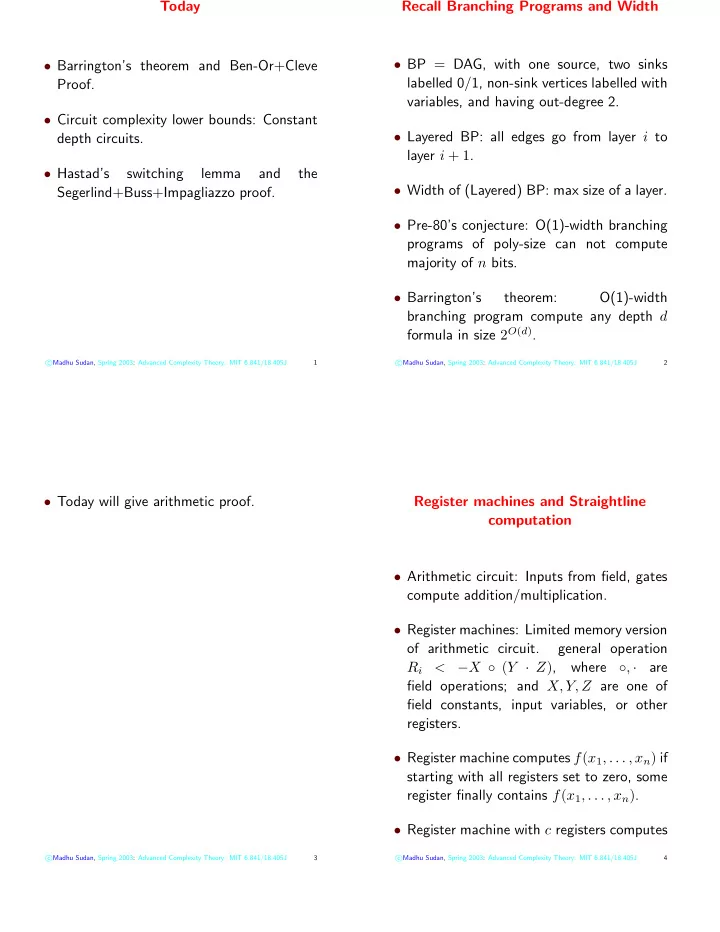
Today

  • Barrington’s theorem and Ben-Or+Cleve

Proof.

  • Circuit complexity lower bounds: Constant

depth circuits.

  • Hastad’s

switching lemma and the Segerlind+Buss+Impagliazzo proof.

c Madhu Sudan, Spring 2003: Advanced Complexity Theory: MIT 6.841/18.405J 1

Recall Branching Programs and Width

  • BP = DAG, with one source, two sinks

labelled 0/1, non-sink vertices labelled with variables, and having out-degree 2.

  • Layered BP: all edges go from layer i to

layer i + 1.

  • Width of (Layered) BP: max size of a layer.
  • Pre-80’s conjecture: O(1)-width branching

programs of poly-size can not compute majority of n bits.

  • Barrington’s

theorem: O(1)-width branching program compute any depth d formula in size 2O(d).

c Madhu Sudan, Spring 2003: Advanced Complexity Theory: MIT 6.841/18.405J 2

  • Today will give arithmetic proof.

c Madhu Sudan, Spring 2003: Advanced Complexity Theory: MIT 6.841/18.405J 3

Register machines and Straightline computation

  • Arithmetic circuit: Inputs from field, gates

compute addition/multiplication.

  • Register machines: Limited memory version
  • f arithmetic circuit.

general operation Ri < −X ◦ (Y · Z), where

  • , ·

are field operations; and X, Y, Z are one of field constants, input variables, or other registers.

  • Register machine computes f(x1, . . . , xn) if

starting with all registers set to zero, some register finally contains f(x1, . . . , xn).

  • Register machine with c registers computes

c Madhu Sudan, Spring 2003: Advanced Complexity Theory: MIT 6.841/18.405J 4

slide-2
SLIDE 2

f over F2, then f can be computed with width 2c.

c Madhu Sudan, Spring 2003: Advanced Complexity Theory: MIT 6.841/18.405J 5

Ben-Or+Cleve Theorem

  • If f can be computed by depth d arithmetic

formula, then f can be computed by 3- register machine with length 2O(d).

  • Implies width eight braching program for

all poly-sized formulae.

c Madhu Sudan, Spring 2003: Advanced Complexity Theory: MIT 6.841/18.405J 6

Proof

  • Inductive

claim: If f has depth d, and R1, R2, R3 are arbitrarily initialized, then can leave register machine in state (R1, R2, R3 + f(x1, . . . , xn) · R2 in length 22·d.

  • Base Case trivial.
  • Induction: If f = f1+f2, then draw picture.
  • Induction: If f = f1∗f2, then draw complex

picture.

  • Verify lengths.

c Madhu Sudan, Spring 2003: Advanced Complexity Theory: MIT 6.841/18.405J 7

Summary on branching programs

  • Major open questions:

− Are O(1)-width poly-sized branching programs equal to unbounded width poly- sized branching programs? − Give ”explicit” function with super-poly branching program size.

  • Till date no success except by limiting

width/length.

  • Till recently, no technique for even super-

linear depth. Recent progress: There exists an explicit function that takes super-linear depth, if size is 2ǫn. [Ajtai].

c Madhu Sudan, Spring 2003: Advanced Complexity Theory: MIT 6.841/18.405J 8

slide-3
SLIDE 3
  • Won’t cover this result; but will encounter

a uniform version with simple proof.

c Madhu Sudan, Spring 2003: Advanced Complexity Theory: MIT 6.841/18.405J 9

Circuit complexity

  • Most

general model

  • f

non-uniform computing.

  • Not suprisingly little known for unrestricted

case.

  • Restricted cases:

− Monotone circuits: Exponential lower bounds known. − Bounded depth, unbounded fan-in OR/AND (known as AC0): exponential lower bounds known.

  • In these lectures:

− Combinatorial proof of AC0 lower bound.

c Madhu Sudan, Spring 2003: Advanced Complexity Theory: MIT 6.841/18.405J 10

− Algebraic proof of AC0 lower bound. − Connections between circuit depth and communication complexity.

c Madhu Sudan, Spring 2003: Advanced Complexity Theory: MIT 6.841/18.405J 11

AC0 lower bounds for parity Defn: (x1, . . . , xn) = n

i=1 xi( mod 2).

Theorem: Parity of n bits requires exponential size for O(1) depth circuits.

  • First super polynomial bounds established

by Furst, Saxe and Sipser and independently by Ajtai.

  • Exponential bounds given later by Yao.
  • Hastad gave a clean exponential lower

bound, highlighting the role

  • f

the switching lemma.

  • Razborov-Smolensky

later gave an algebraic proof.

c Madhu Sudan, Spring 2003: Advanced Complexity Theory: MIT 6.841/18.405J 12

slide-4
SLIDE 4

Switching lemma k-DNF is an OR of terms, where each term is AND of at most k literals. k-CNF is an AND of clauses, where each clause is the OR of at most k literals. Random restriction with parameter p: Set each variable to 0/1 w.p. (1 − p)/2 each and leaves it unset with probability p. Does this independently for each variable. Hastad’s Switching lemma: Random restriction of k-CNF with parameter p ≤ 1/7 yields a ℓ-DNF with probability at least 1 − (7pk)ℓ.

c Madhu Sudan, Spring 2003: Advanced Complexity Theory: MIT 6.841/18.405J 13