
SLIDE 1
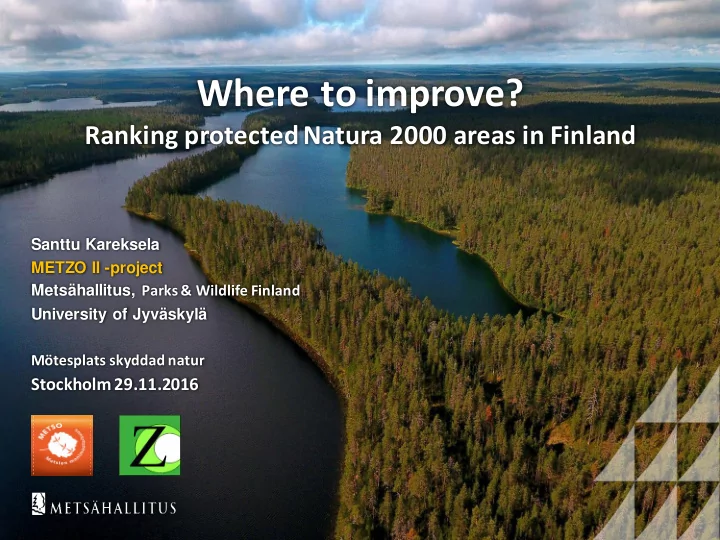
Where to improve?
Ranking protected Natura 2000 areas in Finland
Santtu Kareksela METZO II -project Metsähallitus, Parks & Wildlife Finland University of Jyväskylä Mötesplats skyddad natur
Stockholm 29.11.2016
Where to improve? Ranking protected Natura 2000 areas in Finland - - PowerPoint PPT Presentation
Where to improve? Ranking protected Natura 2000 areas in Finland Santtu Kareksela METZO II -project Metshallitus, Parks & Wildlife Finland University of Jyvskyl Mtesplats skyddad natur Stockholm 29.11.2016 Why do we need systematic
Santtu Kareksela METZO II -project Metsähallitus, Parks & Wildlife Finland University of Jyväskylä Mötesplats skyddad natur
Stockholm 29.11.2016
To avoid harmful opportunism in decision-making To define and recognize opportunities To find the balance!
Mapping restoration potential Prioritizing N2K areas for restoration based on their potential Identifying low hanging fruits conceptually and on the map COST-EFFECTIVELY IMPROVE THE PERSISTENCE OF BIODIVERSITY
100 habitat experts working group defining: Current methods Effects of the methods Costs of the methods
Fine scale geographic information for 67 N-habitat types + threatened species + current state for each habitat patch from the Parks & Wildlife habitat database How good they will be How much they are improved
Ranks areas (pixels to any size planning units) according to their conservation value, based on:
– Aims to maximize ecological value of the solution (set of areas) considering simultaneously data for multiple habitats and species – Complementarity (identifying what is missing or poorly represented) – Connectivity, Condition, Cost-effectiveness
Conservation planning software
Kareksela et al. 2013 Conservation Biology
Produces data for trade-off evaluation (how the solution changes / area / costs)
Identify a set of areas with habitat and species combinations That best complements what is already in good state That emphasizes areas/habitats where recovery is realistically achievable That has a high and ecologically relevant overall effect of improvement
AVOIDING HARMFUL OPPORTUNISM: RARE vs COMMON EXPENSIVE vs CHEAP
Low potential High potential Already good condition 20 km
Low potential High potential Already good condition 20 km
Areas not to be improved Areas for improvement
Graphical analysis of the performance COMPARING TRADE-OFFS
Total area included in the analysis = protected N2K areas in Finland
The overall representation level of natura habitats on protected N2K sites
Representativenes of habitats at the analysis area Average across habitats
Areas not to be improved Areas for improvement Total area included in the analysis = protected N2K areas in Finland
The overall representation level of natura habitats on protected N2K sites
Representativenes of habitats at the analysis area
Graphical analysis of the performance COMPARING TRADE-OFFS
Areas not to be improved Areas for improvement Total area included in the analysis = protected N2K areas in Finland
The overall representation level of natura habitats on protected N2K sites
Representativenes of habitats at the analysis area
Graphical analysis of the performance COMPARING TRADE-OFFS
Areas not to be improved Areas for improvement Total area included in the analysis = protected N2K areas in Finland
The overall representation level of natura habitats on protected N2K sites
Representativenes of habitats at the analysis area
Graphical analysis of the performance COMPARING TRADE-OFFS
With the current techniques we can perform analyses that consider both the outcome and the amount of improvement simultaneously balancing both of them with costs. Quite nice! Proper analyses also enable proper investigation of the trade-offs, which helps to implement the solutions! Perspective differences between scales: Counties/regions/provinces vs National scale vs EU scale With the help of proper systematic analyses: Possibilities to make ecologically significant improvements cost-effectively
Kotiaho, Atte Moilanen, Ninni Mikkonen, Niko Leikola
More information Presented analyses and Zonation: me, santtu.kareksela@metsa.fi Zonation method: Atte Moilanen, atte.moilanen@helsinki.fi Our prioritization project, (http://www.metsa.fi/web/en/zonation)