
SLIDE 1
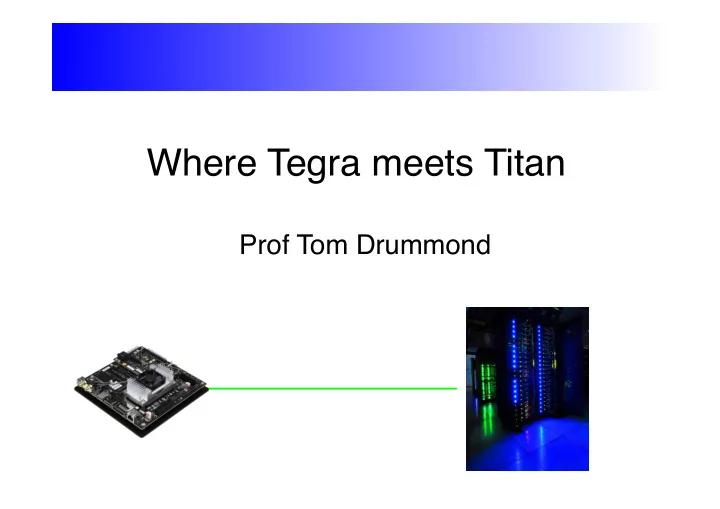
Where Tegra meets Titan Prof Tom Drummond Computer vision is easy! - - PowerPoint PPT Presentation
Where Tegra meets Titan Prof Tom Drummond Computer vision is easy! But first a diversion to 10 th Century Persia and the first recorded game of chess The rice and the chessboard The
But first a diversion to 10th Century Persia …
First half of the chessboard: 100 tons of rice
First half of the chessboard: 100 tons of rice Second half of the chessboard: 400 billion tons
= 1000 years of production
1974: ¡Intel ¡8080 ¡ (6,000 ¡transistors) ¡ ¡ 1978: ¡Intel ¡8086 ¡ (29,000 ¡transistors) ¡ ¡ 1982: ¡Intel ¡80286 ¡ (134,000 ¡transistors) ¡ ¡ 1993 ¡Intel ¡Pen:um ¡ (3,000,000 ¡transistors) ¡ ¡ 2004 ¡P4 ¡Intel ¡Presco> ¡ (125,000,000 ¡transistors) ¡
1974: ¡Intel ¡8080 ¡ (6,000 ¡transistors) ¡ ¡ 1978: ¡Intel ¡8086 ¡ (29,000 ¡transistors) ¡ ¡ 1982: ¡Intel ¡80286 ¡ (134,000 ¡transistors) ¡ ¡ 1993 ¡Intel ¡Pen:um ¡ (3,000,000 ¡transistors) ¡ ¡ 2004 ¡P4 ¡Intel ¡Presco> ¡ (125,000,000 ¡transistors) ¡ ¡ This ¡notebook ¡ > ¡2 ¡trillion ¡transistors ¡ 2004: ¡Nvidia ¡NV40 ¡ (222,000,000 ¡transistors) ¡ ¡ 2006: ¡Nvidia ¡G80 ¡ (484,000,000 ¡transistors) ¡ ¡ 2008: ¡Nvidia ¡GT200 ¡ (1,400,000,000 ¡transistors) ¡ ¡ 2010: ¡Nvidia ¡GF104 ¡ (1,900,000,000 ¡transistors) ¡ ¡ 2012: ¡Nvidia ¡GK104 ¡ (3,540,000,000 ¡transistors) ¡ ¡ 2015: ¡Nvidia ¡GM200 ¡ (8,000,000,000 ¡transistors) ¡
mobile ¡ server ¡
Obtain ¡ sensor ¡ data ¡ Extract ¡ summary ¡ informa:on ¡ Compute ¡ accurate ¡ solu:on ¡ Compute ¡ approximate ¡ solu:on ¡ Compare ¡ Calculate ¡
Update ¡ local ¡model ¡ Bring ¡ correc:on ¡ up ¡to ¡date ¡ Calculate ¡ and ¡send ¡ correc:on ¡ Compute ¡ approximate ¡ solu:on ¡
TX1 ¡ TX1 ¡ TX1 ¡ K40 ¡ K40 ¡ K40 ¡ K40 ¡ K40 ¡ K40 ¡ K40 ¡ K40 ¡ CPU ¡ CPU ¡
Extract ¡ landmarks ¡ CCTV1 ¡ Build ¡Image ¡ Pyramid ¡ Build ¡ Descriptors ¡ Index ¡ Match ¡ Extract ¡ landmarks ¡ CCTV2 ¡ Build ¡Image ¡ Pyramid ¡ Build ¡ Descriptors ¡ Index ¡ Match ¡ Extract ¡ landmarks ¡ Robot ¡ Build ¡Image ¡ Pyramid ¡ Build ¡ Descriptors ¡ Compute ¡1 ¡ Compute ¡ Robot ¡pose ¡
==3031== NVPROF is profiling process 3031, command: ./ComputeOrb 1 Frame# 1 Elapsed time : 5.955523 ms Frame Elapsed time : 7.765627 ms numCorners: 28304, nmsnumCorners: 5073 ==3031== Profiling application: ./ComputeOrb 1 ==3031== Profiling result: Time(%) Time Calls Avg Min Max Name 57.18% 3.2379ms 1 3.2379ms 3.2379ms 3.2379ms OrbDescriptors(…) 30.57% 1.7312ms 1 1.7312ms 1.7312ms 1.7312ms (…) 4.29% 242.92us 1 242.92us 242.92us 242.92us fastcorner(…) 4.00% 226.31us 1 226.31us 226.31us 226.31us harris(…) 1.46% 82.553us 1 82.553us 82.553us 82.553us NMS(…) 0.73% 41.458us 1 41.458us 41.458us 41.458us cleansweep(…)
Timing Results:
Inverse Additive
Inverse Compositional 367 Ours
Extract ¡ image ¡patch ¡ Camera ¡1 ¡ Find ¡ landmarks ¡ Compute ¡ matrix ¡ Compute ¡1 ¡ Camera ¡2 ¡ Extract ¡ image ¡patch ¡ Find ¡ landmarks ¡ Compute ¡sub-‑pixel ¡correspondence ¡
Compute ¡sub-‑pixel ¡correspondence ¡
int array[30]; // very slow global memory
int array; // there are 32 of these in a warp ... // find the first entry in array that is > thresh int pq = __ffs(__ballot(array > thresh)); ...
1 ¡ 2 ¡ 4 ¡ 5 ¡ 9 ¡ 11 ¡ 13 ¡ 15 ¡
array: ¡
0 ¡ 1 ¡ 2 ¡ 3 ¡ 4 ¡ 5 ¡ 6 ¡ 7 ¡
thread: ¡ new_value: ¡
8 ¡ 8 ¡ 8 ¡ 8 ¡ 8 ¡ 9 ¡ 11 ¡ 13 ¡ 15 ¡
ship ¡value: ¡
8 ¡ 8 ¡ 8 ¡ 8 ¡ 9 ¡ 11 ¡ 13 ¡
shuffle: ¡ (each ¡thread ¡sees ¡this ¡value) ¡ =max(new_value,array) ¡ Write ¡new ¡value ¡if ¡less ¡than ¡array ¡
1 ¡ 2 ¡ 4 ¡ 5 ¡ 8 ¡ 9 ¡ 1 ¡ 13 ¡
array: ¡
8 ¡ 8 ¡ 8 ¡ 8 ¡ 8 ¡ 8 ¡ 8 ¡