When We Need Audit Logs Computer forensics in courts - - PDF document

when we need audit logs
SMART_READER_LITE
LIVE PREVIEW

When We Need Audit Logs Computer forensics in courts - - PDF document

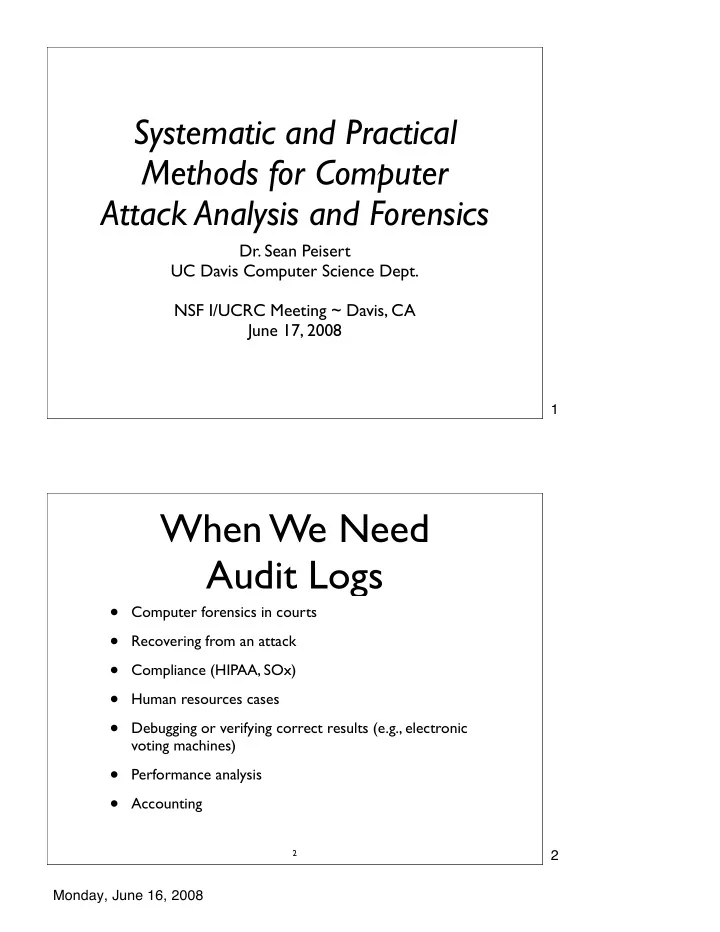
Systematic and Practical Methods for Computer Attack Analysis and Forensics Dr. Sean Peisert UC Davis Computer Science Dept. NSF I/UCRC Meeting ~ Davis, CA June 17, 2008 1 When We Need Audit Logs Computer forensics in courts


slide-1
SLIDE 1

Systematic and Practical Methods for Computer Attack Analysis and Forensics

  • Dr. Sean Peisert

UC Davis Computer Science Dept. NSF I/UCRC Meeting ~ Davis, CA June 17, 2008

When We Need Audit Logs

  • Computer forensics in courts
  • Recovering from an attack
  • Compliance (HIPAA, SOx)
  • Human resources cases
  • Debugging or verifying correct results (e.g., electronic

voting machines)

  • Performance analysis
  • Accounting

2

1 2 Monday, June 16, 2008

slide-2
SLIDE 2

We’re terrible analyzing events on computers Audit data is usually...

  • overwhelming
  • free-form
  • useless
  • misleading (easily altered)

4

3 4 Monday, June 16, 2008

slide-3
SLIDE 3

We’re collecting too much bad information...

5

...and using it in courts and elections.

6

5 6 Monday, June 16, 2008

slide-4
SLIDE 4

We need to...

  • understand what the purpose of the analysis is
  • understand what data can answer that

purpose, with X% accuracy, and under a set of Y assumptions

  • log the data
  • give tools and techniques to an analyst to

analyze that data

7

How is computer forensics done now?

  • file & filesystem analysis (Coroner’s Toolkit,

Sleuth Kit, EnCase, FTK)

  • syslog, tcpwrappers
  • process accounting logs
  • IDS logs
  • packet sniffing

8

7 8 Monday, June 16, 2008

slide-5
SLIDE 5

What do we need? What are we missing?

9

A Systematic Approach is Better

10

9 10 Monday, June 16, 2008

slide-6
SLIDE 6

Forensic Art & Science

  • But computer science can only answer part of it.
  • Forensic analysis is an art, but there are scientific
  • components. What are they?
  • Determining what to log
  • Determining relevance of logged data
  • what is relevant?
  • what is not relevant?
  • under what circumstances something might be

relevant?

  • Using the results to constrain and correlate data.
  • This can be measured, systematized and automated.

11

Measurement Example: Empirical Study of Firewall Rules

  • How are firewalls configured?
  • How should firewalls be configured?
  • What are the top, known vulnerabilities?
  • What are the top, known attacks?
  • What are we missing? Is that OK?

12

11 12 Monday, June 16, 2008

slide-7
SLIDE 7

Laocoön: A Model of Forensic Logging

  • Attack graphs of goals.
  • Goals can be attacker goals or defender goals (i.e., “security

policies”)

  • Pre-conditions & post-conditions of those goals.
  • Method of translating those conditions into logging

requirements.

  • Logs are in a standardized and parseable format.
  • Logged data can be at arbitrary levels of granularity.

13

Attack Graphs

  • Intruder goals can be

enumerated.

  • Vulnerabilities, attacks,

and exploits cannot (or in many cases, we would patch them).

  • Defender goals can also

be enumerated. They are called security polices.

... ... ... ... ... ... ...

a b c d start of attack intermediate steps (too many!) end goals of intruder

14

13 14 Monday, June 16, 2008

slide-8
SLIDE 8

Security Policies

  • Security policies can be reverse-engineered
  • r enforced, automatically.
  • Policies can be binary (block access) or

flexible (log something).

  • Policies can be static (always do this) or

dynamic (uh oh—an intruder)

15

Applying Security Policies

  • Applying Laocoön to security policies guides

where to place instrumentation and what to log.

  • The logged data needs to be correlated with a

unique path identifier.

  • Branches of a graph unrelated to the attack can

be automatically pruned.

  • Avoid recording data where events can be

recreated because they are deterministic.

16

15 16 Monday, June 16, 2008

slide-9
SLIDE 9

Pruning Paths

A B C D start of attack intermediate steps end goals of intruder A B C D start of attack intermediate steps end goals of intruder

17

What are the assumptions for using current forensic tools?

18

  • Often that there’s only one person who

had access to the machine.

  • Often that the owner of the machine was

in complete control (as opposed to malware).

  • Probably a lot of other assumptions that

we have no clue about.

17 18 Monday, June 16, 2008

slide-10
SLIDE 10

Summary: we can do better

  • Forensics, attack analysis, logging, and

auditing are broken.

  • We seek to work on real-world problems

with real-world data to construct and implement useful, usable, real-world software solutions.

19

Proposed Project

  • Research practicality and tradeoffs in conditional access

control (e.g., allow & log vs. block)

  • Implement conditional access control with several

countermeasures, including logging.

  • For the logging portion, implement forensic logging of

system & function calls, and analysis tools to correlate and prune data unrelated to the end goals that an analyst is concerned with.

  • If there is time, attempt to do this via virtual machine

introspection.

20

19 20 Monday, June 16, 2008

slide-11
SLIDE 11

Selected Recent Publications

  • S. Peisert, M. Bishop, and K, Marzullo, "Computer Forensics In Forensis," Proc. of the

3rd Intl. IEEE Wkshp. on Systematic Approaches to Digital Forensic Engineering, May 2008.

  • S. Peisert, M. Bishop, S. Karin, and K. Marzullo, "Analysis of Computer Intrusions

Using Sequences of Function Calls," IEEE Trans. on Dependable and Secure Computing (TDSC), 4(2), Apr.-June 2007.

  • S. Peisert and M. Bishop, "How to Design Computer Security Experiments," Proc. of

the 5th World Conf. on Information Security Education, June 2007.

  • S. P. Peisert, "A Model of Forensic Analysis Using Goal-Oriented Logging," Ph.D.

Dissertation, UC San Diego, Mar. 2007.

  • S. Peisert, M. Bishop, S. Karin, and K. Marzullo, "Principles-Driven Forensic Analysis,"
  • Proc. of the New Security Paradigms Workshop (NSPW), Sept. 2005.

21

Questions?

  • Dr. Sean Peisert
  • Email: peisert@cs.ucdavis.edu
  • More information and recent publications:
  • http://www.sdsc.edu/~peisert/

22

21 22 Monday, June 16, 2008