When, How, and Where to Get Services Dean E. Barley Ph.D. Licensed - - PDF document

when how and where to get services dean e barley ph d
SMART_READER_LITE
LIVE PREVIEW

When, How, and Where to Get Services Dean E. Barley Ph.D. Licensed - - PDF document

When, How, and Where to Get Services Dean E. Barley Ph.D. Licensed Psychologist Director BYU Comprehensive Clinic 801.422.7818 Dean_Barley@byu.edu When do I need counseling? When I m starting to feel like a danger to myself or others. When


slide-1
SLIDE 1

Page 1 of 4

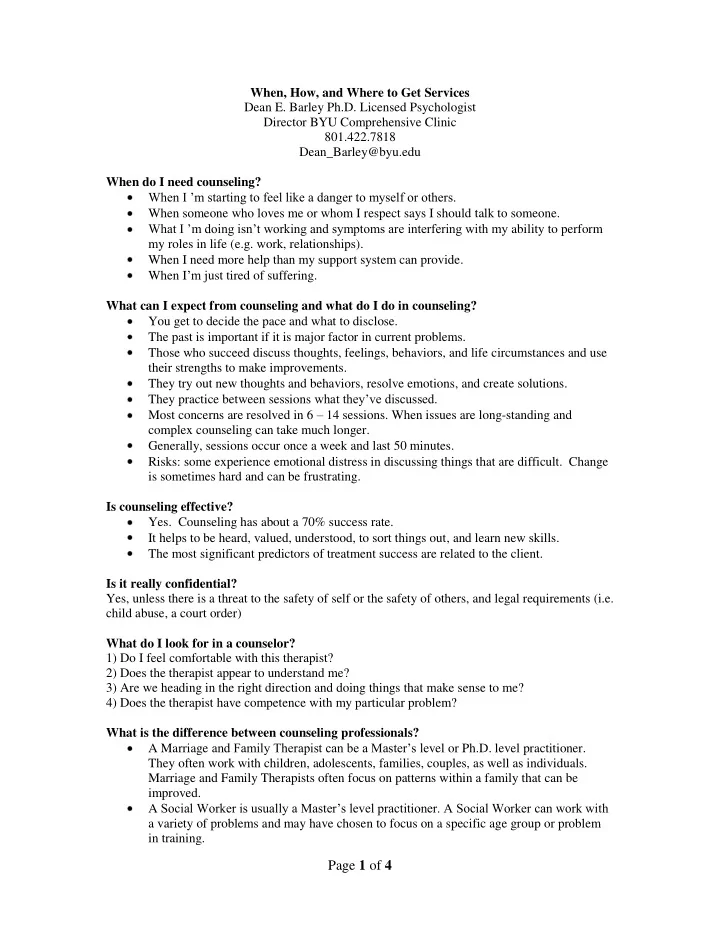
When, How, and Where to Get Services Dean E. Barley Ph.D. Licensed Psychologist Director BYU Comprehensive Clinic 801.422.7818 Dean_Barley@byu.edu When do I need counseling? When I ’m starting to feel like a danger to myself or others. When someone who loves me or whom I respect says I should talk to someone. What I ’m doing isn’t working and symptoms are interfering with my ability to perform my roles in life (e.g. work, relationships). When I need more help than my support system can provide. When I’m just tired of suffering. What can I expect from counseling and what do I do in counseling? You get to decide the pace and what to disclose. The past is important if it is major factor in current problems. Those who succeed discuss thoughts, feelings, behaviors, and life circumstances and use their strengths to make improvements. They try out new thoughts and behaviors, resolve emotions, and create solutions. They practice between sessions what they’ve discussed. Most concerns are resolved in 6 – 14 sessions. When issues are long-standing and complex counseling can take much longer. Generally, sessions occur once a week and last 50 minutes. Risks: some experience emotional distress in discussing things that are difficult. Change is sometimes hard and can be frustrating. Is counseling effective?

  • Yes. Counseling has about a 70% success rate.

It helps to be heard, valued, understood, to sort things out, and learn new skills. The most significant predictors of treatment success are related to the client. Is it really confidential? Yes, unless there is a threat to the safety of self or the safety of others, and legal requirements (i.e. child abuse, a court order) What do I look for in a counselor? 1) Do I feel comfortable with this therapist? 2) Does the therapist appear to understand me? 3) Are we heading in the right direction and doing things that make sense to me? 4) Does the therapist have competence with my particular problem? What is the difference between counseling professionals? A Marriage and Family Therapist can be a Master’s level or Ph.D. level practitioner. They often work with children, adolescents, families, couples, as well as individuals. Marriage and Family Therapists often focus on patterns within a family that can be improved. A Social Worker is usually a Master’s level practitioner. A Social Worker can work with a variety of problems and may have chosen to focus on a specific age group or problem in training.

slide-2
SLIDE 2

Page 2 of 4

A Licensed Professional Counselor is a Master’s level practitioner who also works with a variety of problems. A LPC may also have developed specific competencies in training. A Licensed Psychologist is a Ph.D. level practitioner. Licensed Psychologists work with a variety of problems and populations in therapy. They also perform psychological testing to clarify a diagnosis. A Psychiatrist is a medical doctor who prescribes medication to help with emotional difficulties. What about meds? Counseling succeeds for over 2/3 of people. When symptoms (anxiety, depression) persist, meds help about 60% of those. It is wise to use all strength and resources: social, personal strengths, spiritual avenues, behavioral, and medical options until things are at optimal functioning. Places to get help paying for medications: http://togetherrxaccess.com/ http://www.pparx.org/ http://www.freemedicineprogram.org/ http://www.freemedicinefoundation.com/ http://www.healthassistrx.com/ http://freemedicine.com/ How do I get someone to participate in mental health services? Listen to their objections. What would make you feel comfortable to go? The gap: How would you like your life to be? Are you there yet? If you continue doing what you are doing now, will it get you where you want to go? How might counseling help you to get where you want to be? Social leveraging: (He just won’t listen to me). Who will s/he listen to? Who is best to give the message? Is there someone else they might listen to other than you (ecclesiastical leader, favorite teacher, sibling, aunt or uncle, someone they look up to)? Money: (cheaper) Counseling is cheaper than a divorce. Short-term outpatient treatment now is cheaper than more extensive and expensive interventions later. (Investment ) You’re investing and saving for many things (retirement, vacations, major purchases) Counseling is an investment in your own emotional well-being. How much are you willing to invest into your marriage, happiness, or career? It will help others: It will be better for the family for you to participate. It will help those you love. You’ll be a better father, mother, employee, and so forth. Pink Spoon: Give it 3 – 4 sessions and make up your own mind without a commitment. Triage by Funding Insured: Insurance usually has a co-pay of $25-35/session, deductibles at first of the year. Call the insurance company. They will give you several clinicians. Call them to see if they have experience with the presenting problem. Some employers have employee assistance programs such as ten free visits with a

  • counselor. Call your benefits or human resources office.

Primary care physician may have a few therapists they trust and can refer you to. Ecclesiastic authorities often have counselors whom they trust. Word of mouth: ask friends and people you trust Clinicians and school personnel are good resources

slide-3
SLIDE 3

Page 3 of 4

Medicaid or Medicaid-eligible – Wasatch Mental Health Center for all services (801) 373-4760 Problems getting qualified? Family Resource Facilitator- Brenda Chabot: (801) 427- 9111. If adults with severe and chronic conditions won’t cooperate, call Brian Butler of Wasatch Mental Health outpatient unit (801) 373-7394. Mental Health Court may be able to help. If a family member has a severe and chronic condition, the rest of the family may benefit from information from the National Alliance on Mental Illness – NAMI. Call Robert Chabot (801) 224-0594 Uninsured 2-1-1 United Way Information and Referral to find services. Or check unitedwayuc.org. Help Me Grow is a subset of 211 - information on services for children from ages 0 – 8 Triage by type of crisis: Crisis: Emotionally distraught: call Utah County Crisis Line: (801) 226 – 4433 Can’t be kept safe: call 9-1-1 for police support and transport to hospital. Child abuse: call 9-1-1 or DCFS 1-855-323-3237 to report it. Sexual abuse assessment and treatment: Children’s Justice Center (801) 851-8554 Family Support and Treatment Center for treatment (801) 229-1181 Domestic Violence: 9-1-1, police and involve the victims advocate Center for Women and Children in Crisis: 801-377-5500 Triage by age and diagnosis School age children needing services: call school district: testing, counseling, tutoring Pervasive Development Disorders: Autism and Asperger’s Disorder: 2-1-1 and ask for Help Me Grow. Kids Who Count – Salem (801) 423-3000 Provo Early Intervention Program (801) 852-4525 Kids on the Move – (801) 221-9930 Children and ungovernable teens: Vantage Point (801) 373-2215 through Wasatch Mental Health provides short-term shelter and time-out placement as well as crisis intervention and family

  • counseling. For youth age 12 to 17. Services are FREE.

Youth substance abuse: Utah County Youth Assessment and Treatment Services. (801) 851-

  • 7128. If the youth won’t cooperate, call the police and get the youth involved in the Juvenile

Court System. Unwed Teen LDS Family Services

  • American Fork: (801) 216-8000
  • Provo: (801) 422-7620
  • Springville: (801) 489-9721
  • Pregnancy Resource Center: (801) 221.2591 Non-profit faith-based organization

that helps to meet the needs of unplanned pregnancies. Free urine pregnancy tests, counseling, free clothing. College Students: Career Counseling, personal counseling, assessment for learning disabilities. UVU (801) 863-8425 BYU (801) 422-3035

slide-4
SLIDE 4

Page 4 of 4

Veteran: Individual, couple and some group counseling options. Provo Vet Center (801) 377-1117 Adult Substance Abuse Utah County Substance Abuse Assessment Center (801) 851-7128 AA (801) 375-8620. Narcotics Anonymous (801) 373-7060 LDSFS Addictions Recovery Program (801) 422-7620 BYU Comprehensive Clinic ccmh.byu.edu (801) 422-7759 $15/session or discounted for financial need. Services are provided by graduate interns supervised by experienced licensed

  • faculty. Often have openings for Spanish speakers and other languages. Provides child, family,

couple, and individual counseling; parent training or coaching; and a variety of groups. Also

  • ffers psychological assessments for learning disabilities, attention deficit/hyperactivity disorder,

and many other psychological or emotional disorders ($50). Neuropsychological assessments ($400, can be reduced for financial need). Autism and Asperger’s Disorder assessments ($500). Therapists cannot see clients with severe risk for suicide or self injury, drug abuse or addiction, violence, severe and chronic conditions that will require long term therapy, or with court

  • involvement. Sessions are videotaped for supervision purposes.

Division of Rehabilitation Services: http://www.usor.utah.gov/division-of-rehabilitation- services (801) 374-7724 Offices in Provo, American Fork, and Payson. For those with a medical

  • r emotion/mental disability that prevents them from obtaining or maintaining employment; can

help with job training, education, and treatment. Family Support and Treatment Center in Orem http://utahvalleyfamilysupport.org/ (801) 229- 1181 Treatment for children, adults, and families whose lives have been affected by abuse or neglect, parenting classes. 24 hour free crisis respite nursery. LDS Family Services– Locations in American Fork, Provo, and Springville. $70 /session. Do not need a bishop’s referral. Will take insurance. Individual, couple, and family therapy. Unplanned pregnancy and adoption services. Can refer to mental health professionals in the

  • community. Also run a variety of groups.

Mountainlands Family Health Center http://pfhc.org/ (801) 374-9660 $10/session for

  • counseling. Locations in Provo and Payson. Services provided by a Licensed Psychologist or

Ph.D Psychology Graduate Interns. Spanish speakers, must make Mountainlands FHC their “medical home.” Can also manage many psychiatric medications. Turning Point – http://www.uvu.edu/turningpoint/ (801) 863-7580 Groups/classes in anger management, successful life management, managing life transitions, tools for teens, marriage and pre-marriage workshops. Individual and couple counseling available to those who are in groups. Sliding fee scale. Located at UVU campus. Wasatch Mental Health Wellness Recovery Center: (801) 852-3789 The Wellness Recovery Clinic is a no-fee clinic that provides short-term mental health services to individuals in need who do not have mental health insurance coverage. Intake Screenings/Assessments, Group therapy, limited individual/couples/family therapy, Case Management, Psychiatric Evaluations/Meds Management, Medication Assistance.