When Doctors Dont Listen Listen and What Patients Can Do About It - - PDF document

when doctors don t listen listen
SMART_READER_LITE
LIVE PREVIEW

When Doctors Dont Listen Listen and What Patients Can Do About It - - PDF document

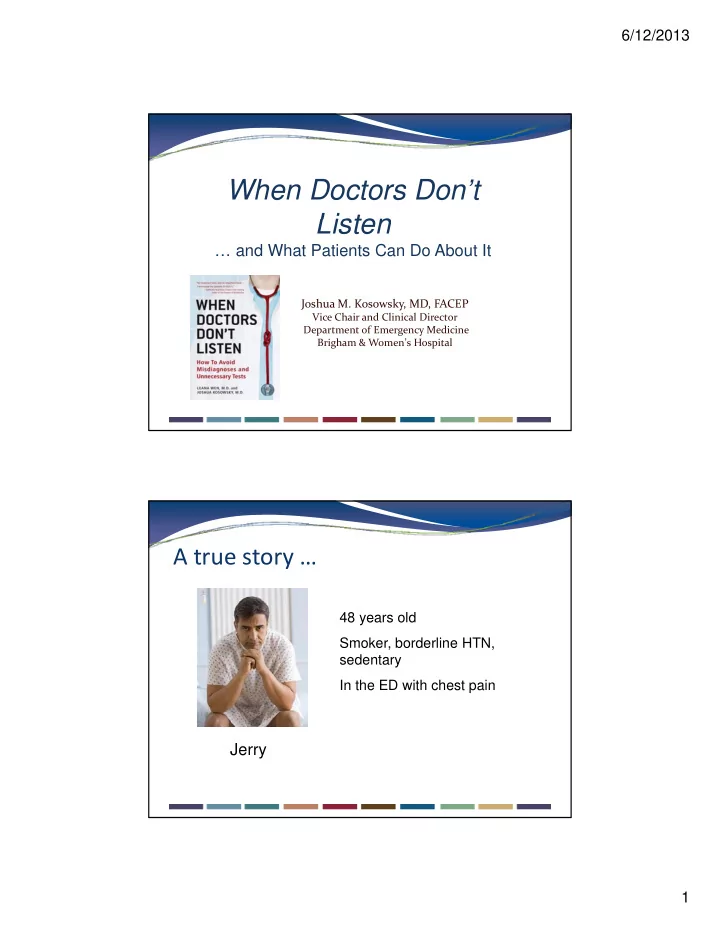
6/12/2013 When Doctors Dont Listen Listen and What Patients Can Do About It Joshua M. Kosowsky, MD, FACEP Vice Chair and Clinical Director Department of Emergency Medicine Brigham & Women s Hospital A true story 48 years old


slide-1
SLIDE 1

6/12/2013 1

When Doctors Don’t Listen

Joshua M. Kosowsky, MD, FACEP

Vice Chair and Clinical Director

Listen

… and What Patients Can Do About It

Department of Emergency Medicine Brigham & Women’s Hospital

A true story …

48 years old Smoker, borderline HTN, sedentary In the ED with chest pain

Jerry

slide-2
SLIDE 2

6/12/2013 2

Does diagnosis matter?

 Centuries‐old debate over whether diagnosis

Centuries old debate over whether diagnosis

  • r treatment is more important

 No one questions that the right treatment

depends on the correct diagnosis

 Most of our quality measures assume that

diagnosis is right in the first place diagnosis is right in the first place

Misdiagnosis

 Incidence of misdiagnosis estimated to be 10% to 20%1  Among malpractice claims, diagnostic errors are the

g p , g most common, most costly and most dangerous

 An estimated 500,000 missed diagnostic opportunities

  • ccur each year in the U.S. at primary care visits alone1

 Schiff et al2 found that 28 percent of diagnostic errors

reported anonymously by doctors were life‐threatening

  • r resulted in death or permanent disability

 Leape et al3 estimated that diagnostic errors account for

Leape et al estimated that diagnostic errors account for 40,000 to 80,000 deaths per year

slide-3
SLIDE 3

6/12/2013 3

An “orphan” issue

 Largely unrepresented in the current quality framework

 National Quality Strategy focuses almost exclusively on

management

 In IOM report To Err Is Human, the phrase medication error is used

70 times while diagnostic error occurs twice

 Lack of obvious solutions

 Wrong‐site surgery and wrong‐dose medication errors are

amenable to systems solutions (time‐outs, computerized order entry, etc.)

 Diagnostic errors seem intensely personal: the “system” appears to  Diagnostic errors seem intensely personal: the system appears to

be the physician, and his or her own knowledge, skills, values, and behaviors

 General tendency to perceive that diagnostic errors are made by

someone else (someone less careful or skillful!)

Lack of data

 No national or system‐wide campaign to collect accurate

data on diagnostic error g

 Doctors often don't know they've gotten it wrong  Diagnostic errors are a leading cause of malpractice

litigation, but the vast majority do not result in legal action

 Difficulty understanding and measuring diagnostic errors  Little evidence that decision‐support tools actually reduce

diagnostic error diagnostic error
slide-4
SLIDE 4

6/12/2013 4

Roots of the problem

 Growing complexity of medicine  Increasing fragmentation of the health‐care system  Increasing fragmentation of the health care system  Relentless time pressures  Excessive reliance on electronic data  Expensive, high‐tech tests supplanting traditional

hands‐on skills of physical diagnosis

 Learning by algorithm rather than by time‐honored  Learning by algorithm rather than by time‐honored

apprenticeship model

Solutions

 Medical education

 Interventions to improve physician knowledge and

p p y g experience (simulation training, improved feedback)

 Improve clinical reasoning and decision‐making skills

(critical thinking, meta‐cognition training)  Change in healthcare delivery systems

 Financial incentives for safer, higher‐quality diagnosis

f d

 Patient‐focused interventions

 Improved communication: 80% (or more) of diagnosis

is predicated upon patient history

slide-5
SLIDE 5

6/12/2013 5

Something patients can do …

8 Pillars to Better Diagnosis

#1. Tell your whole story

 Provide narrative, not just a list of symptoms  Use chronology and context  Share your impressions  Express your concerns  Practice makes perfect

Practice makes perfect

slide-6
SLIDE 6

6/12/2013 6

#2. Participate in your diagnosis

 Think of diagnosis as a journey rather than a

destination

 Ask what your doctor is thinking  Understand the concepts of “differential

diagnosis” and “working diagnosis”

#3. Understand what tests are for

 Every test should be done for a specific reason  Every test has potential harms  Ask:

 What are we looking for?  How will the results change things?

How will the results change things?

 What are the alternatives?

slide-7
SLIDE 7

6/12/2013 7

#4. Get answers before you leave

 Come prepared with questions:

 What is my diagnosis?  What can I expect?  What can I do to get better?  What are some warning signs to watch for?

g g

 If something doesn’t seem right, ask!

Back to Jerry …

Reassured about chest pain Understands his cardiac risk Motivated to improve his health

slide-8
SLIDE 8

6/12/2013 8

Conclusions

 Avoiding misdiagnosis is critical to quality

Avoiding misdiagnosis is critical to quality

  • utcomes

 Doctors cannot rely exclusively on technology or

algorithmic reasoning

 Patients can and should be encouraged to take an

active role in the diagnostic process

References

1.

Saber Tehrani AS, et al.. 25‐Year summary of US malpractice , 5 y p claims for diagnostic errors 1986‐2010: an analysis from the National Practitioner Data Bank. BMJ Qual Saf. 2013 Apr 22

2.

Schiff GD, et al. Diagnostic error in medicine; analysis of 583 physician‐reported errors. Arch Intern Med. 2009;169(20):1881.

3.

Leape L, Berwick D, Bates D. Counting deaths from medical errors [letter reply]. JAMA. 2002;288:2405

slide-9
SLIDE 9

6/12/2013 9

Questions?

Joshua M. Kosowsky, MD, Department of Emergency Medicine Brigham & Women’s Hospital jmkosowsky@partners.org www.whendoctorsdontlisten.com