SLIDE 1
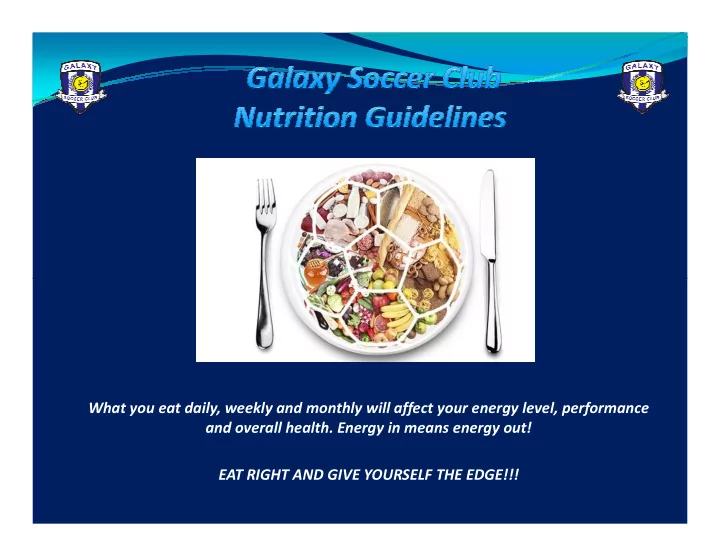
What you eat daily, weekly and monthly will affect your energy level, performance and overall health. Energy in means energy out! EAT RIGHT AND GIVE YOURSELF THE EDGE!!!
SLIDE 2
- Nutrition needs to be a priority of any athlete’s
- training. What they eat daily, weekly and monthly
will affect your energy level, performance and overall health.
- Energy in means energy out! It is so important that
- Energy in means energy out! It is so important that
soccer players eat a well balanced diet high in complex carbohydrates and low in fats
- Proper nutrition not only benefits an athlete
physically, but also mentally and that is half the battle on the field.
- If the brain is not well fed, then the player will not
play to the best of their ability. Without the right food, a player can suffer from the inability to concentrate.
SLIDE 3 Nutrition Information: When people think about being a good soccer player, they tend to talk about an individual’s
- abilities. Can he or she dribble well? Is he or she fast? Do they have a knack for scoring goals?
What most people forget is that for any individual at any level, being a good soccer player starts with being healthy and eating right. Energy – required by the body for all sorts of functions (especially when playing soccer) Nutrients – substances that provide nourishment essential for growth and maintenance
Carbohydrates – the body’s preferred method of receiving food and turning it into energy Protein – the building blocks for the human body Fats – an essential nutrient, often confused with obesity and chronic health issues
SLIDE 4
Recovery: the 3 R’s of Recovery Rehydrate – do not stop drinking water when practice or a game ends, the body needs fluids Nutrition is an important part of living a healthy lifestyle. There is no golden ticket when it comes to nutrition and eating right. Every player has their own unique challenges that must be addressed. practice or a game ends, the body needs fluids after exercise Refuel – eat certain foods an hour after exercise because muscles during exercise use fuel and that fuel needs to be replenished Rebuild – muscles during exercise get fatigued and damaged, you need protein to help them rebuild
SLIDE 5
- Dairy
- Meat
- Vegetables
- Fruit
- Grain
SLIDE 6
- Protein- although the body requires the intake of protein, carbohydrates and fats, the
component most athletes need to focus on and make sure they have enough of is protein.
- Why??? Protein is a part of every cell in your body. It is arguably the most important
nutrient you need to keep you functioning and healthy.
- The body uses protein to produce hormones and chemicals that help support the
- verall function of the body, such as building bones, muscles, cartilage, skin and blood.
All in all, protein is a pretty great thing for our bodies.
SLIDE 7 Good protein choices:
- Fresh Meat (chicken, turkey, pork and beef)
- Fresh Fish (cod or salmon)
- Animal Products (milk, cheese, eggs and
yogurt) Bad protein choices:
- Processed Meats (turkey, ham, chicken,
sausages and burgers)
- Vegetable Product (tofu, soy protein, soy milk,
legumes, lentilsand nuts)
SLIDE 8 Think of carbohydrates as energy. Like proteins, they are essential to your body. However things get a little trickier here: for every good carbohydrate there are hundreds of bad carbohydrate choices. Good Carbs vs. Bad Good Carbs vs. Bad
- Good carbs (whole/simple) provide the
body with the fuel it needs for energy. Your body needs them to function.
- Bad carbs (refined/complex) are easily
- spotted. Typically anything that has been
processed or is not in its natural state. Additives, preservatives, or flavorings are not what you need.
SLIDE 9
- Why bad carbs are bad….. They spike your body’s blood sugar/glucose levels.
Sugar is enemy #1
Processed Foods Enemy #2
- Most contain lots of sugar,
- We all have blood sugar
levels in our bodies. If, over a period of time, we raise
body releases insulin.
blood sugar levels back too low, thus making the body hungry and fatigued.
- Most contain lots of sugar,
harmful chemicals, additives, preservatives, etc.
- If you can drive-thru it, then
DRIVE THROUGH IT! Pick out the fast food restaurants with no drive thru, as they are usually healthier
SLIDE 10
Fats are absolutely essential to our body. The take home message is when introducing fat into your diet make sure it is the good fat and not the bad fat. Eat good fat= burn fat. Eat bad fat = store fat. Good Fat Choices: Nuts (almonds, cashews, peanuts, pecans) Bad Fat Choices: Butter and lard Processed meat Vegetable Oils (olive oil, canola oil, peanut oil) Peanut butter, almond butter, cashew butter Fish (salmon, herring, sardines, trout) **high in good omega-3 fatty acids Seeds (sunflower, pumpkin, sesame) Avocado Processed meat Fried chicken Palm oil, palm kernel oil Dairy foods (cheese, butter, milk, cream, ice cream) **skimmed is fine Cookies, cakes, pies, pastries and fast food
SLIDE 11 In general, most fast food restaurants are dangerous places for our bodies. Why? Because they typically specialize in all of the bad things discussed earlier. Bad fats, bad carbs, processed foods with high levels of additives, and typically terrible protein: fat ratios.
- Do they taste great? Absolutely!
- Is it convenient, or the easy way? Absolutely!
- Is it inexpensive? Absolutely!
Is it for someone who wants to take care of his or her body, has a healthy life, and/or is a stud Is it for someone who wants to take care of his or her body, has a healthy life, and/or is a stud athlete? Absolutely not!! Interesting Facts…
- 2/3 Americans are obese or over weight.
- Each day 1 in 4 Americans eat fast food
- Only 7 items on McDonald’s menu contains no sugar
- You would have to walk 7 hours straight to burn off a large Coke, Big Mac & fries
SLIDE 12
WHAT SHOULD MY MEAL LOOK LIKE???
US Soccer recommend 55% of your meal to be carbs, 25% protein, and meal to be carbs, 25% protein, and 20% fat. “Whether you are a junior athlete, professional athlete, or don’t take part in any sport, it is important to make sure you are getting the proper energy, nutrients, and minerals daily”.
SLIDE 13
As you can see, you get more than 100 percent of calories from fat than you do from carbohydrate and protein. That is why if your diet is made up of mainly fat you would probably have excessive energy intake, which could lead to weight gain and health issues. Research has shown that soccer players can use around 300 calories for every 30 minutes of training or playing.
SLIDE 14 Water- Water is the most abundant substance in the human body. Water makes up approximately 75% of your mass and, like protein, is a major component of every cell. Under
- ptimal conditions, the body can survive 30 days without food but only 4-10 days without
water. Consuming water provides several advantages:
- Water fills you up without calories
- Staying hydrated improves your body’s ability to exercise and burn calories
- Water increases your body’s ability to build and repair muscles
- Water speeds up your metabolism.
Water Challenge: Try to go 1 week without drinking anything but water- and the occasional cup of coffee (if you need it). Try it! NO. POP. NO JUICE. NO SPORTS DRINK.
SLIDE 15 Players should consider these tips for recovering Rehydration should begin as soon as play ends. Players should not stop drinking water when practice or a game ends. In fact, this is a very important time to drink because the body is no longer sweating and losing fluids as rapidly as during play. When a player is dehydrated, it affects his or her performance and the ability to regulate body temperature. Players should consider these tips for recovering proper hydration levels:
- Water is the best drink to rehydrate. Avoid
carbonated beverages and caffeine.
- Urine color test.
- Drink 16-ounces of water for each pound lost
during play. That’s a pint per pound.
SLIDE 16
Before Activity: Consume 16 ounces of fluid 2 hrs prior to competition. Hydration during Activity: Athletes should start drinking before sensing thirst and continue to drink at regular intervals. Water, sports drinks, carbohydrate consumption. 6-8 fluid ounces should be consumed when Water, sports drinks, carbohydrate consumption. 6-8 fluid ounces should be consumed when possible. Hydration after Activity: It is vital after high intensity exercise that you replace all water lost through sweating. To ensure adequate fluid intake it is recommended that 16 - 20 ounces of fluid is consumed. This amount will ensure rehydration has occurred. Water, sports drinks are good sources of fluid intake.
SLIDE 17 The “good” of Gatorade
Water is the most logical form of
- hydration. However, sports drinks like
Gatorade contain sugar and electrolytes like sodium and potassium. Sports drinks can help replace what we lose during longer duration exercise, especially in the heat.
The “bad” of Gatorade
A 12-ounce serving of Gatorade’s Thirst Quencher contains 21 grams of
- sugar. But because a regular bottle of
Gatorade contains 32 ounces, you’re actually getting 56 grams of sugar. While that’s still less sugar per ounce the heat. Electrolytes and carbohydrates help athletes refuel and rehydrate. Electrolytes help regulate the body’s fluid balance while the carbs provide energy. While that’s still less sugar per ounce than your average soda, it’s not exactly healthy.
SLIDE 18 Night before Event:
The night before a game, pasta is always a good choice along with:
- Salad (very little dressing), Vegetables (fresh, frozen, or steamed)
- Rice (steamed or boiled) cooked dried peas, beans or lentils, lean meat, cheese & crackers, fish,
fresh or dried fruit, poultry (not fried), potatoes (not fried), pretzels. It is recommended that players eat 2-3 hours prior to games and exercising.
Day of Event:
- Eat food you know you will digest and settle well.
- Pay attention to your fluid needs.
- Don’t try anything new.
- Eat a balanced meal of carbohydrates, protein, and fat.
Pregame snacks 30 minutes prior to the game may include protein/granola bars, Gatorade chews, small piece of fruit.
SLIDE 19 During Event
- Eat foods that can be quickly digested Ex:
fruit, gel or energy chews.
- Avoid protein bars with a lot of fat/fiber
because they are more work for body to because they are more work for body to digest.
- Parents who bring half time snacks: Orange
- r apple slices, peanut butter sandwiches cut
into quarters, string cheese, whole-grain crackers, trail mix made with whole-grain cereal, nuts and dried fruit along with fruit juice are good choices.
SLIDE 20
Post Event (REFUEL) The body refuels with carbohydrates. Muscles burn through fuel quickly during the strenuous activity of a game. In order to replenish the body’s high-performance fuel — carbohydrates — it is important to eat foods that are good sources of carbs. To do this quickly, eat these foods within an HOUR after the game, because muscles refill carbs fastest immediately after exercise. Good carbohydrate food sources: Banana = 20-30g Energy/Cereal Bar = 20-40g Bowl of Oatmeal = 25-30g Bowl of Cereal = 20-30g Tuna Sandwich = 20-30g Chicken Sandwich = 20-30g Carb Calculator: To calculate how many grams of carbohydrates a player needs for speeding recovery in the hour after a game, divide their weight by two. The number equals how many grams of carbs they should eat, i.e.: 160 pound player = 80 grams of carbs
SLIDE 21 Post Event (REBUILD) The body rebuilds with protein. Muscles are mostly made of protein. During exercise, muscles get fatigued and damaged. Replacing proteins is imperative to allow muscles to rebuild
- themselves. Eating more protein also gives undamaged muscles more building material, helping
them become stronger over time. High protein food sources: Milk (one cup, low fat) = 13g Soy Milk (one cup) = 13g Greek Yogurt (non-fat) = 6-8g Eggs = 6g Nuts (handful) = 6-8g Tuna Sandwich = 25-30g Chicken Sandwich = 25-30g Protein Predictor: Here are two tips to make sure there is enough protein on a player’s dinner plate: Eat 20-25 grams of high-quality protein each meal Meals should be at 3-4 hour intervals