
SLIDE 1
July 17, 2020
Nursing Simulation:
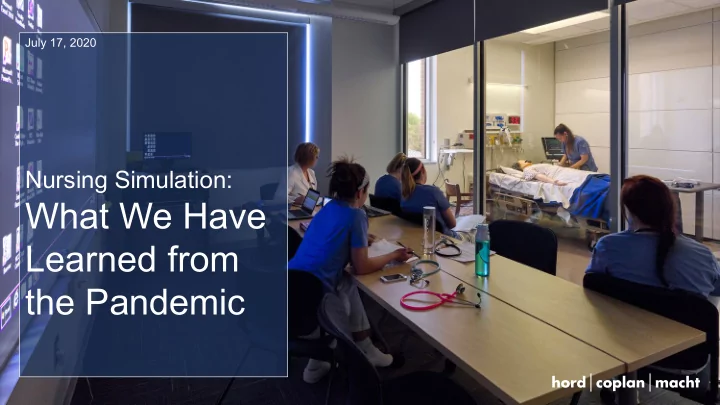
What We Have Learned from the Pandemic NURSING SIMULATION: What - - PowerPoint PPT Presentation
July 17, 2020 Nursing Simulation: What We Have Learned from the Pandemic NURSING SIMULATION: What We Have Learned from the Pandemic PAMELA R. JEFFRIES CRYSTEL L. FARINA PAUL LUND PAMELA SLAVEN-LEE George Washington University George
July 17, 2020
Nursing Simulation:
PAUL LUND
Hord Coplan Macht
PAMELA R. JEFFRIES
George Washington University School of Nursing
KELLIE BRYANT
Columbia University School of Nursing
CAROL F. DURHAM
The University of North Carolina at Chapel Hill
CRYSTEL L. FARINA
George Washington University School of Nursing
SHARON DECKER
Texas Tech University Health Sciences Center
PAMELA SLAVEN-LEE
George Washington University School of Nursing
NURSING SIMULATION:
What We Have Learned from the Pandemic
Pamela R. Jeffries PhD, RN, FAAN, ANEF
Professor and Dean George Washington University School of Nursing
During this unprecedented time teaching, planning, and leading during a global pandemic, these are lessons learned:
Lesson #1: The Necessity of Communication and Transparency Lesson #2: The Value of Collaboration Lesson #3: Change can occur quickly when needed Lesson #4: Greater Possibilities and Opportunities Together Lesson #5: Art of creativity and out-of-the-box thinking Lesson #6: An attitude of gratitude
Pamela Slaven-Lee
DNP, FNP-C, FAANP, CHSE Clinical Associate Professor and Senior Associate Dean for Academic Affairs George Washington University School of Nursing
Timely and Accurate Messaging Mission Critical Information
Communication Tracker
Anticipate Questions
Simulation
methods
Communication
received and/or understood
match the intent
Adaptability and being comfortable with the unknown
Kellie Bryant DNP, WHNP, CHSE
Executive Director of Simulation and Assistant Professor Columbia University School of Nursing
Importance of preparing our students for covid-19 Innovative uses of video conferencing software
COVID 19
simulation programs
review of skills
Telehealth Standardized Patient Scenarios
Challenges
Think “outside –the-box” - Flexible
Communication
Fiscal Responsibility
Sharon Decker
PhD, RN, FSSH, ANEF, FAAN Associate Dean for Simulation, Professor in the School of Nursing, Executive Director for TTUHSC Simulation Program Texas Tech University Health Sciences Center
Working with industry Online consultation internationally Research (Questions to address?)
1. “What constitutes “simulation” in the virtual world? 2. “What is the impact on the learners skills development and competencies when these are taught online? 3. What is the right mix (percentage)
simulation-based activities?
Challenges Provide Opportunities
Carol F. Durham
EdD, RN, ANEF, FAAN, FSSH
Professor, Director of Interprofessional Education & Practice and Director of Education-Innovation-Simulation Learning Environment The University of North Carolina at Chapel Hill
Remote training of psychomotor skills What? and How? LOGISTICS
Haptics Staging and storage Dishwashers – who knew?
VIRTUAL CLINICAL
Importance of Messaging Critical thinking Thriving
RETURN TO LAB
Decreasing student density Impact on workload and timeline
Disruptive Innovations – What will we keep?
Crystel L. Farina PhD(c), RN, CNE, CHSE
Assistant Professor, Director of Simulation and Experiential Learning George Washington University School of Nursing
ROOMS FURNITURE SPACE Flexibility
Question surveys Thermometers Qualtrex QR Codes
Operationalizing Screening for COVID-19 1 2 3 4
Virtual content creation Haptics for fully immersive VR experience Real patient / human unpredictability 5 year growth VR / AR & AI Multipurpose space conversion
Different uses – simulation, interactive group experiences, event, experimental layouts, etc.
More collaboration & small spaces
huddle rooms, conference rooms, pods/carrells
Content creation spaces & maker spaces
Paul R. Lund AIA, LEED AP BD+C
Principal Hord Coplan Macht
1 2 3 4 5 6 7 8
Storage, PPE, shipping, manikins
Nursing Simulation:
What We Have Learned from the Pandemic
PAUL LUND
Hord Coplan Macht 202.552.7615 plund@hcm2.com
PAMELA R. JEFFRIES
George Washington University School of Nursing 202.994.8429 Pjeffries@email.gwu.edu
KELLIE BRYANT
Columbia University School of Nursing 212.305.2982 Kdb2146@cumc.columbia.edu
CAROL F. DURHAM
The University of North Carolina at Chapel Hill, School of Nursing 919.966.1753 carol_durham@unc.edu
CRYSTEL L. FARINA
George Washington University School of Nursing 571.553.0115 cfarina@email.gwu.edu
SHARON DECKER
Texas Tech University Health Sciences Center 806-281-8044 Sharon.Decker@ttuhsc.edu
PAMELA SLAVEN-LEE
George Washington University School of Nursing 571.553.6885 pamelaslavenlee@gwu.edu
NURSING SIMULATION:
What We Have Learned from the Pandemic