What Theatre Teaches - Storytelling & Authenticity in Art Our - - PDF document

what theatre teaches
SMART_READER_LITE
LIVE PREVIEW

What Theatre Teaches - Storytelling & Authenticity in Art Our - - PDF document

933 San Mateo NE,#500-221 Albuquerque New Mexico 87108 nmhsmta.org info @ nmhsmta.org The New Mexico High School Musical Theatre Awards, also known as the Enchantment Awards, recognizes individual artistry in theatrical


slide-1
SLIDE 1

933 San Mateo NE,#500-221 • Albuquerque • New Mexico • 87108 • nmhsmta.org • info@nmhsmta.org The New Mexico High School Musical Theatre Awards, also known as the Enchantment Awards, recognizes individual artistry in theatrical performance, and honors teachers and their schools’ commitment to performing arts education. This program presents these talented young performers with a unique opportunity to advance their education and careers in musical theatre, all while supporting the inclusion of musical theatre performance in our state's high schools. We know that high school musical theatre productions offer lifelong memories to those who

  • participate. What's more, it helps students succeed academically, individually and socially. Students

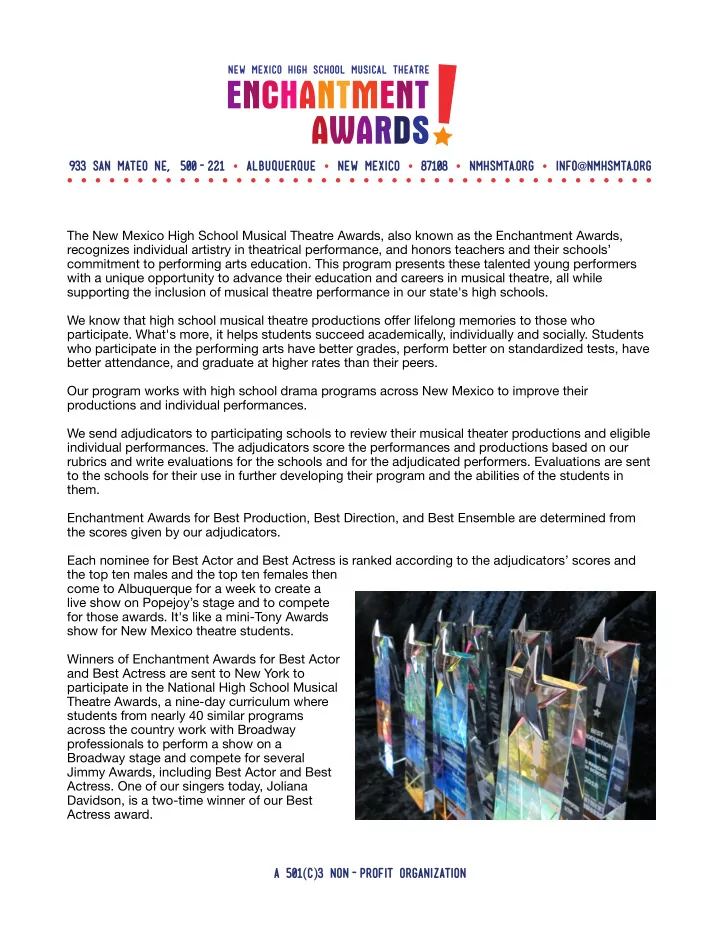
who participate in the performing arts have better grades, perform better on standardized tests, have better attendance, and graduate at higher rates than their peers. Our program works with high school drama programs across New Mexico to improve their productions and individual performances. We send adjudicators to participating schools to review their musical theater productions and eligible individual performances. The adjudicators score the performances and productions based on our rubrics and write evaluations for the schools and for the adjudicated performers. Evaluations are sent to the schools for their use in further developing their program and the abilities of the students in them. Enchantment Awards for Best Production, Best Direction, and Best Ensemble are determined from the scores given by our adjudicators. Each nominee for Best Actor and Best Actress is ranked according to the adjudicators’ scores and the top ten males and the top ten females then come to Albuquerque for a week to create a live show on Popejoy’s stage and to compete for those awards. It's like a mini-Tony Awards show for New Mexico theatre students. Winners of Enchantment Awards for Best Actor and Best Actress are sent to New York to participate in the National High School Musical Theatre Awards, a nine-day curriculum where students from nearly 40 similar programs across the country work with Broadway professionals to perform a show on a Broadway stage and compete for several Jimmy Awards, including Best Actor and Best

  • Actress. One of our singers today, Joliana

Davidson, is a two-time winner of our Best Actress award. a 501(c)3 non-profit organization

slide-2
SLIDE 2

1

933 San Mateo NE, 500-221 • Albuquerque • New Mexico • 87108 • nmhsmta.org • info@nmhsmta.org

What Theatre Teaches

  • Storytelling & Authenticity in Art
  • Our artists teach us as a society through the stories they tell. Today’s most successful

marketers are those who tell stories best.

  • Self-Confidence
  • Taking risks in class and performing for an audience teach students to trust their ideas

and abilities. This confidence will apply in nearly every aspect of their future.

  • Empathy & Tolerance
  • Acting roles from different situations, time periods, and cultures promotes compassion

and tolerance for others.

  • Cooperation & Collaboration
  • Theatre combines the creative ideas and abilities from all its participants.
  • Concentration & Memory
  • Playing, practicing, and performing develop a sustained focus of mind, body, and voice

which helps with other areas of life including school. Rehearsing and performing the words, movements, and cues strengthen the memory like a muscle.

  • Communication Skills
  • Drama enhances verbal and nonverbal expression of ideas. It improves voice projection,

articulation, fluency of language, and persuasive speech.

  • Problem Solving & Imagination
  • Students learn to communicate the who, what, where, when, and why to the audience.

Improvisation fosters quick-thinking solutions, which leads to greater adaptability in life. In a world addicted to technology, theatre provides an outlet for making creative

a 501(c)3 non-profit organization

2

slide-3
SLIDE 3

choices, thinking new ideas, and interpreting the material in expressive ways that are the essence of drama and story.

  • Fun
  • Theatre brings play, humor, and laughter to learning; this improves motivation

and reduces stress.

  • Trust
  • The social interaction and risk taking in drama develop trust in self, others, and the

process.

  • Inclusion
  • Theatre teaches that anyone can make a worthy contribution and their effort improves

your own. Exclusion deprives one of opportunities for success and greater achievement.

  • Social Awareness
  • Legends, myths, poems, stories, and plays used in drama teach students about social

issues and conflicts from cultures past and present that will inform the future they

create.

  • Aesthetic Appreciation
  • Participating in and viewing theatre raise appreciation for the art form. It is important to

raise a generation that understands, values, and supports culture’s place in society.

Lessons Theatre Reinforces

  • Algebra & Geometry
  • You can’t design, build, or paint a set without these.
  • Language Arts
  • Reading for comprehension, using language for persuasion, articulation, different styles
  • f writing
  • Physics
  • Designing and running lights or sound
  • History
  • Plays are always explorations and/or artifacts of the past
  • Sociology & Social Interaction

3

slide-4
SLIDE 4
  • Characters in plays display various behaviors that students study in detail.

Students of every shape and persuasion are welcome and asked to contribute equally.

  • Psychology
  • Inner motivations and emotional issues are explored in the playing of

characters for each story.

  • Business Math
  • Necessary when running a box office or managing a production
  • Marketing
  • When selling tickets and program ads, or selling anything in fundraisers
  • Storytelling
  • Every actor, director, and designer has to know how they contribute to telling the story
  • f the

play

  • Vocabulary
  • Almost every play offers new vocabulary that actors must know the meaning of and

know how to pronounce

  • Technology
  • Computers are used in nearly every aspect of modern theatre, from file sharing to

design work to running lights and sound to balancing the box office receipts.

Theatre: Problem-Based Learning

  • Each new play or musical offers new challenges for actors and the entire artistic team.

Theatre: Problem-Based Learning

  • Combines knowledge learned in other classes with research found on the Internet

Theatre Forges Citizens

  • Theatre demands participation from all who come to it: performers, designers, directors,

and audience. These students learn the relationships between all those who enter the theatre and how they are all truly interdependent.

4

slide-5
SLIDE 5

1

933 San Mateo NE, 500-221 • Albuquerque • New Mexico • 87108 • nmhsmta.org • info@nmhsmta.org

Notes from Drama Teaches Around the State of New Mexico on Funding and Their Successes Compiled by the New Mexico High School Musical Theatre Awards Funding Other than my salary, my drama department receives $1,000 of operational money every year. That is also the budget I use to supply my classroom, but I have been getting all of my classroom supplies myself so far so I can use my operational money for the shows. We then also receive subsidy money when we have it to travel. This year we were guaranteed $6,000, but I believe when all was said and done we got $8,500. Last year I received $4,000. That amount changes from year to year depending

  • n the economy of the town from the previous year. That subsidy money is given to us exclusively to

use to travel to the two drama festivals we go to each year. Last year our money only covered one

  • trip. This year it covered both. All of the other funds we use are raised by the group from fundraisers

and proceeds from ticket sales. I receive zero dollars in funding from my school. All funding for my program must be attained through fundraising (including box office and concessions at our plays). We get about $600 for supplies - just like every other teacher in our school. The rest is fundraising through performances. The past couple of Fall semesters, Administration has asked me to make requests for items needed for the program. I believe the most I have ever received was in the vicinity of around $700 (for scripts, tools, paint, etc). I have occasionally received Instructional Funds to pay royalties for musicals (about $100 per performance). Apart from these instances, our program receives no regular, set amount of funding. We are mostly left to fend for ourselves in terms of raising the money to produce shows and to pay registration and travel fees for our competitions. [Our program] does not get any money to run our Theater program, except for my teacher salary and a $3,500 stipend a year. There is an option to charge students a class fee each year, but I do not do

  • that. There is also $1,500 allocated for a teacher's assistant, but the money is in the principal's

discretionary fund and our principal has made it clear that we cannot use that money for an assistant. This year, the district allocated $4,000 for the Fine Arts Department at my school, to be divided among the six of us: Band, Ceramics, Photo, Art, Digital Media, and Drama. That math means I got $666 from the district. The majority of our purchases came from our activities fund, where proceeds from fundraisers and shows go. By the end of the school year, that balance should be $4,000, thanks to the hard work of my students! An $850 annual stipend was discontinued four years ago. a 501(c)3 non-profit organization

5

slide-6
SLIDE 6

The district pays for bus and hotel for state competition but only after begging. This coming year I don't expect them to since I have extra money from fundraising

  • The district fine arts pays for registration for state. This will happen again.
  • We pay for our own food and any other trips through fundraising.
  • I was given $500 for supplies this year (this is new)
  • I was given $1,500 for travel this year (this is new and may not come back for next

school year)

  • I am given nothing beyond this and all shows, trips, etc are expected to be paid with

fundraising which we constantly do. For the past two years, drama has received NO money from the district, although the principal does allow us to do fundraisers to help supplement our income, as we are a small program and do not raise enough money via ticket sales to cover all of our expenses, especially if we desire to attend drama conferences or festivals, such as George Nason. I receive about $300 of department money for my program. I also use student fees. Each student is charged $35 to take my class. This can be an issue, because the band and art fees are $35 as well. So if a Cibola student takes art, band and drama they have to pay $105. For some students this is a

  • challenge. I have spent hundreds dollars from my own paycheck on the Cibola drama program.

[Our] program receives no money from its district. It is funded with student fees ($20 per student) and a nominal ticket charge ($3-$5 per person) for play productions. I do not receive any funding from my school at all. Students do have a class fee of $20 per semester; however most of them (probably 80%) do not pay the course fee. Successes Michelle Gammill, Los Lunas High School I have a student with dyslexia. Drama has made him a different person. His confidence has soared. He learned that he can memorize. He now helps other students with lines. He directed a one-act play in the fall, and has volunteered at Albuquerque Little Theatre. He now has a place to belong, with people who support and care for him. This place of belonging and learning to dream big are only part of what drama does for students. They learn to work as a team to achieve something big and beautiful that none of them could do

  • alone. They learn that their ideas are important, and they find creative ways to solve problems.

Cole Raison, Eldorado High School, Albuquerque Clay Space is now a working tv and film actor and producer thanks to his exposure to acting and directing at Eldorado. There are many other stories of students working in the field. Miriam Kirkbride, Moriarty High School In addition to Drama classes, Moriarty High School has an after school Drama Club that also produces plays. From these programs over the course of my last 5 years as the Drama instructor, I have had 5 students go on to major in theatre at UNM, ENMU, and SFUVA. I have had two additional students become involved in local theatre companies and productions. We have received high marks for performance and productuon at the ENMU Drama Festival three years in a row. There they learn technique, bond with other drama peers, and foster professional networking relationships with college students and professors. Many students report that they have learned tolerance, teamwork, communication, and professionalism in Drama. Also, parents have stated that their children are more confident, outgoing, and goal-oriented as a direct result of being involved with Drama.

6

slide-7
SLIDE 7

Darin Cabot, Centennial High School, Las Cruces (Excerpts of letters from students, many being graduating seniors): "(Theatre has) inspired me to inspire." "(Theatre) helped me through so much and (has) encouraged me to go big on everything and to always work hard..." "...you have truly inspired my creative side." "(Theatre) helped encourage me to continue my passion... try new things and to get out

  • f my comfort zone."

"...you exposed us to some amazing plays that I never would have seen otherwise." "...in the production class, I got to experience what it was like to be behind the scenes and work with a team." "...I feel confident in these roles, which is something priceless." "Thank you for helping me get out of my shell... I can honestly say that you are the only teacher who has changed my life for the better... with your help I really feel like I can do big things." "...that monologue sparked my passion for performing. That's what I am, a performer." "(Theatre has) always encouraged me to leave my comfort zone and work for what I want." "Theatre is my passion, my refuge, my escape, and I am so grateful that you have poured your heart and soul into our little program, to create such a wonderful, safe, inviting place for me to take shelter through the terrifying journey that was high school.” Galadriel Thompson, Valley High School, Albuquerque One of my seniors comes to mind. She is an A student, but struggles deeply with anxiety, OCD and

  • ther health issues. As a sophomore she was in my Stagecraft class, loved theater and wanted to

participate in shows but was too shy and anxious to do stuff. Slowly I encouraged her learn how to be a Stage Manager with a friend of hers that was in the class. For each production she took on more responsibility and independence. Now she manages 50 people shows, with big set changes all by herself. She worked as a Production Assistant on a film crew this summer, to rave reviews and even tried acting in a lead role this year, which she also rocked. She has become a very confident young lady who knows how to manage her anxiety and OCD. She might pursue a professional career as an assistant director for film or stage manager for theater. She is realizing all of her potential and her future looks very bright. I also have numerous stories about students who gain literacy skills, social skills, leadership skills, stay in school (instead of dropping out) and generally improve academically. These skills are gained by general education students, gifted students, special education students with learning disabilities, autism, intellectual disabilities, and so on. Caitlin Reardon, Rio Grande High School, Albuquerque I don't know that I can pick out just one student or one success story. Drama means so much to so many of the kids in my program at Rio Grande HS: a safe place to have lunch, a newfound family, a reason to stay in school, a teacher to come out as trans to, a place to be silly and be yourself. I guess that last reason, to me, is the most important. Our students should have more chances to be themselves.

7

slide-8
SLIDE 8

Jill Hare, Silver High School, Silver City For 14 years, the first semester of this class has been one of inclusion with the "D" level Life Skills students. An annual production that is a student written adaptation of a well- known story or movie (we have done everything from West Side Story to Willy Wonka and the Chocolate Factory to Sleeping Beauty, and most recently, Cinderella) brings students together in a meaningfully inclusive way. The impact these totally student- produced shows have on the actors goes beyond the stage as peers and faculty watch these students — who are too many times seen through a single lens of disability — creating characters, memorizing lines, and most importantly, performing before 200+ audience members. Carol Stokes, Valencia High School, Los Lunas I currently have several students who desire to pursue a career in the theater arts, and two of my graduating seniors will be participating in theater programs at their chosen universities next year. To me, one of the most rewarding aspects of drama at the high school level is that so many students have never seen a live production before, and so their first experience to the theatre is via their high school drama program. We just recently finished a production of a one act play called "Fighting Demons" about ten teens struggling with issues such as divorce of parents, OCD, abuse, bulimia, depression, and drug use. It was a really powerful play and many students were moved to tears by

  • it. Students came up to both myself and the actors afterwards and said that they could relate to the

struggles of one or more the characters; some thought back to a student we lost by suicide just a year ago; and one said that it helped to know that others struggle with the same issues and that it was possible to overcome these problems. This is the power of theater. This is the power of story

  • telling. This is the power that changes lives . . . and it comes from the investment of society in the

schools to allow drama programs to exist. Candice Neu, West Mesa High School, Albuquerque I have a lot of stories, most with similar patterns—that kid who doesn’t fit in and who is generally an

  • utcast finds a home and sanctuary here with a family of other misfits. It gives them purpose, a place
  • f refuge, and a group of friends that don’t judge them, in addition to the chance to step out of their
  • wn skin and shine on a stage.

Three years ago, that was Haley. She came from a severely broken home with an alcoholic mother and a father who had to work long days to barely make ends meet. Her and her two siblings and parents were only able to afford a 2 bedroom apartment in one of Albuquerque’s worst

  • neighborhoods. She was an angry girl, hated pretty much everybody and everything. I somehow

convinced her to stage manage my fall production and she found herself in a new world. The confidence and skills she gained running backstage helped her to get on top of her academics, gave her a constructive outlet for her anger and pain and gave her a safe place away from the chaos of her home. She became close friends with the rest of the theatre kids and her attitude changed. She even found her inner actress and stepped into her last high school show as Aida, the lead in the spring musical. She is graduating with academic honors and thespian honors, and has learned to make peace with her mother and be an example to her younger siblings. Two quotes from Lev Vygotsky (educational psychology god pretty much) regarding the value of drama in education: “Drama is the most syncretic mode of creation, that is, it contains elements of the most diverse forms of creativity.” “In drama, the child’s creation is in the nature of synthesis—his intellectual, emotional, and volitional powers are activated directly by the force of life itself, without any excess stress to his psyche.” From Lev Vygotsky’s “Imagination and Creativity in Childhood” (1967)

8

slide-9
SLIDE 9

Melissa Souers, Piedra Vista High School, Farmington I have a ton of kids who have benefited. I have only taught at PV for 4 years. But quite a few of my students have gone on to continue theatre in college. I have multiple kids who were very depressed and suicidal even trying to kill themselves that have found a home and family in theatre and don't feel this way anymore.

9