An Overview of Classical Theatre An Overview of Classical Theatre - - PowerPoint PPT Presentation

an overview of classical theatre an overview of classical
SMART_READER_LITE
LIVE PREVIEW

An Overview of Classical Theatre An Overview of Classical Theatre - - PowerPoint PPT Presentation

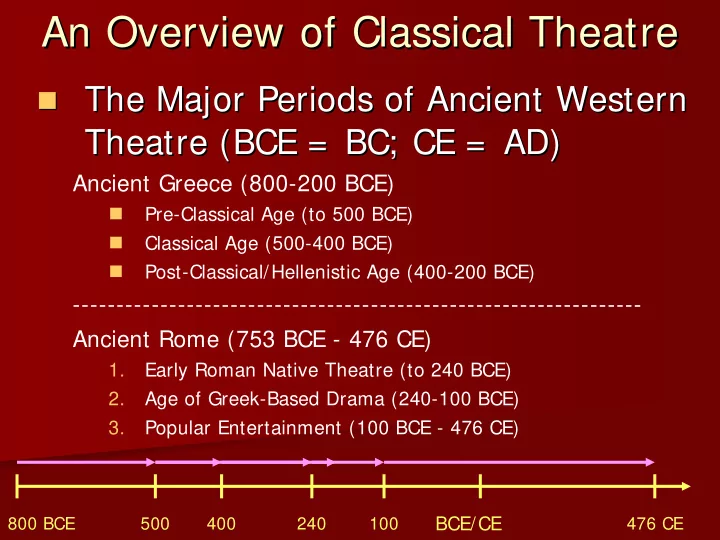
An Overview of Classical Theatre An Overview of Classical Theatre The Major Periods of Ancient Western The Major Periods of Ancient Western Theatre (BCE = BC; CE = AD) Theatre (BCE = BC; CE = AD) Ancient Greece (800-200 BCE)


slide-1
SLIDE 1

An Overview of Classical Theatre An Overview of Classical Theatre

  • The Major Periods of Ancient Western

The Major Periods of Ancient Western Theatre (BCE = BC; CE = AD) Theatre (BCE = BC; CE = AD)

Ancient Greece (800-200 BCE)

  • Pre-Classical Age (to 500 BCE)
  • Classical Age (500-400 BCE)
  • Post-Classical/Hellenistic Age (400-200 BCE)
  • Ancient Rome (753 BCE - 476 CE)

1. Early Roman Native Theatre (to 240 BCE) 2. Age of Greek-Based Drama (240-100 BCE) 3. Popular Entertainment (100 BCE - 476 CE)

500 400 240 100

BCE/CE

476 CE 800 BCE

slide-2
SLIDE 2

An Overview of Classical Theatre An Overview of Classical Theatre

Greek Theatre in the Pre-Classical Age

3000-800 BCE: Egyptian Civilization 800 BCE: Pre-Classical Greek Civilization

800-700 BCE: Homer and Epic Poetry (Iliad, Odyssey) 700-550 BCE: Lyric Poetry (Sappho) 550-529 BCE: The Tyrant Pisistratus rules Athens 534 BCE: The Inauguration of the City Dionysia 529-512 BCE: Pisistratus’ son Hippias rules Athens 512-508 BCE: Exile of Hippias and Political Chaos in Athens 508 BCE: Birth of Athenian Democracy

500 400 240 100

BCE/CE

476 CE 800 BCE

slide-3
SLIDE 3

An Overview of Classical Theatre An Overview of Classical Theatre

Greek Theatre in the Classical Age

500-479 BCE: Early Classical Age

490; 481-479 BCE: The Persian Wars 486 BCE: Comedy premieres at the Dionysia

479-431 BCE: The Pentakontaetia

472 BCE: Aeschylus produces The Persians 460-429 BCE: Pericles leads Athens

  • ca. 463-405 BCE: Sophocles’ career as a playwright

431-404 BCE: The Peloponnesian War

455-406 BCE: Euripides’ career as a playwright 427-386 BCE: Aristophanes writes Old Comedy

500 400 240 100

BCE/CE

476 CE 800 BCE

slide-4
SLIDE 4

An Overview of Classical Theatre An Overview of Classical Theatre

Greek Theatre in the Post-Classical and Hellenistic Age

404-338 BCE: Greek Civil War

371 BCE: Thebes defeats Sparta at Leuctra 360-336 BCE: Philip II rules Macedonia 385-325 BCE: Middle Comedy

338-323 BCE: Alexander the Great

338 BCE: Philip defeats Greek at Chaeronea 336-323 BCE: Alexander conquers much of the ancient world

322-200’s BCE: The Hellenistic Age

423-391 BCE: Menander writes New Comedy

500 400 240 100

BCE/CE

476 CE 800 BCE

slide-5
SLIDE 5

An Overview of Classical Theatre An Overview of Classical Theatre

Roman Theatre in the Early Republic

753-510 BCE: Early Roman Kingdom

600-510 BCE: Etruscans rule Rome (gladiators) 510 BCE: Founding of the Roman Republic

510-264 BCE: Romans conquer Italy

400’s and 300’s BCE: Early Italian Drama

Atellan Farce, Fescennine Verse, phlyax plays, hilarotragodiae

264-241 BCE: The First Punic War (Carthage)

241 BCE: Livius Andronicus translates The Odyssey in Latin

500 400 240 100

BCE/CE

476 CE 800 BCE

slide-6
SLIDE 6

An Overview of Classical Theatre An Overview of Classical Theatre

Roman Theatre in the Later Republic (The Age of Greek-Based Drama)

241-202 BCE: Early Roman Greek-Based Drama

218-202 BCE: The Second Punic War (Hannibal)

202-100 BCE: The Romans conquer Greece

205-186 BCE: Plautus writes Roman Comedy (palliatae) 166-160 BCE: Terence writes Roman Comedy 100’s BCE: Pacuvius and Accius write Roman tragedy 133-123 BCE: The Gracchi lead a revolt against the increasingly corrupt Senate

500 400 240 100

BCE/CE

476 CE 800 BCE

slide-7
SLIDE 7

An Overview of Classical Theatre An Overview of Classical Theatre

Roman Theatre in the Empire (The Age of Popular Entertainment)

100-44 BCE: The Rise of Generals

Marius, Sulla, Pompey and Caesar

44-31 BCE: Civil War between Octavian (later Augustus) and Mark Antony

31 BCE: Octavian defeats Antony at the Battle of Actium

31 BCE - 476 CE: The Roman Empire

  • ca. 50-65 CE: “Seneca” writes only extant Roman tragedy

Gladiators, chariot races, blood sports, mime, pantomime, ...

500 400 240 100

BCE/CE

476 CE 800 BCE