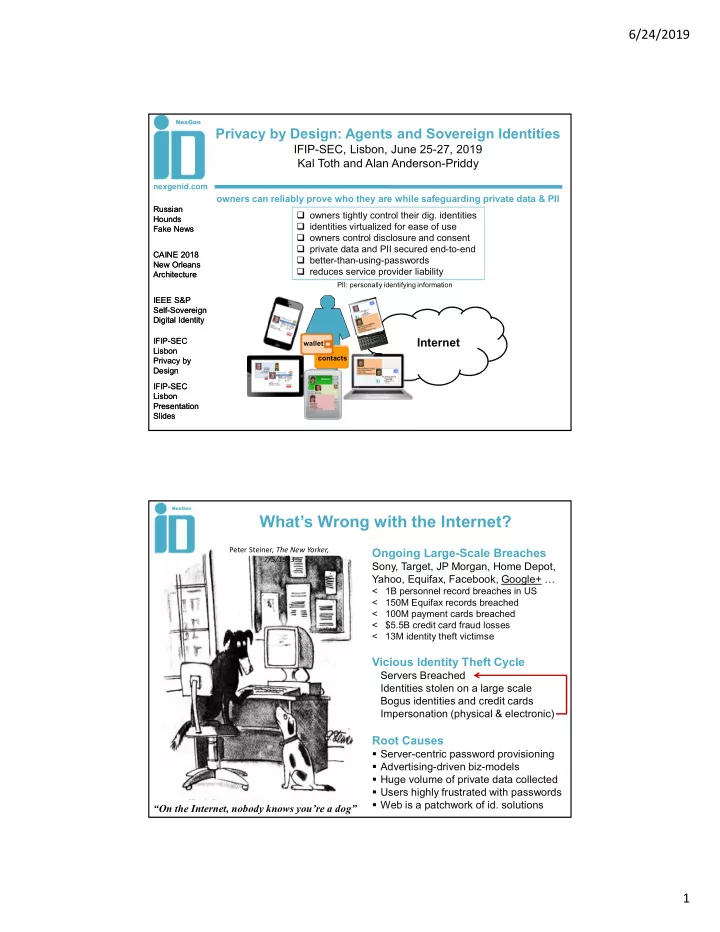
Whats Wrong with the Internet? Peter Steiner, The New Yorker, - - PDF document

what s wrong with the internet
SMART_READER_LITE
LIVE PREVIEW

Whats Wrong with the Internet? Peter Steiner, The New Yorker, - - PDF document

6/24/2019 Privacy by Design: Agents and Sovereign Identities IFIP-SEC, Lisbon, June 25-27, 2019 Kal Toth and Alan Anderson-Priddy nexgenid.com owners can reliably prove who they are while safeguarding private data & PII Russian Russian


slide-1
SLIDE 1

6/24/2019 1 Privacy by Design: Agents and Sovereign Identities

IFIP-SEC, Lisbon, June 25-27, 2019 Kal Toth and Alan Anderson-Priddy

 owners tightly control their dig. identities  identities virtualized for ease of use  owners control disclosure and consent  private data and PII secured end-to-end  better-than-using-passwords  reduces service provider liability

nexgenid.com Russian Hounds Fake News Russian Hounds Fake News CAINE 2018 New Orleans Architecture CAINE 2018 New Orleans Architecture IEEE S&P Self-Sovereign Digital Identity IEEE S&P Self-Sovereign Digital Identity IFIP-SEC Lisbon Privacy by Design IFIP-SEC Lisbon Privacy by Design IFIP-SEC Lisbon Presentation Slides IFIP-SEC Lisbon Presentation Slides

  • wners can reliably prove who they are while safeguarding private data & PII

PII: personally identifying information

Internet

contacts wallet

Peter Steiner, The New Yorker, 7/5/1993

“On the Internet, nobody knows you’re a dog”

Ongoing Large-Scale Breaches

Sony, Target, JP Morgan, Home Depot, Yahoo, Equifax, Facebook, Google+ …

< 1B personnel record breaches in US < 150M Equifax records breached < 100M payment cards breached < $5.5B credit card fraud losses < 13M identity theft victimse

What’s Wrong with the Internet?

Root Causes

  • Server-centric password provisioning
  • Advertising-driven biz-models
  • Huge volume of private data collected
  • Users highly frustrated with passwords
  • Web is a patchwork of id. solutions

Vicious Identity Theft Cycle

Servers Breached Identities stolen on a large scale Bogus identities and credit cards Impersonation (physical & electronic)

slide-2
SLIDE 2

6/24/2019 2

Diverging Trends … Narrowing the Gap

server-centric solutions:

  • too dependent on web passwords
  • massive collection of private + PII data
  • vulnerable to large scale hacks

risk strength

Our Goal What User Asserts

Claims, Credentials

What Others Assert

Proofing, Attestation

Identity Solution Landscape

What User Knows

Passwords PINs

What User Holds

Personal Devices

pers. ident. info.

Peer-to-Peer Tools

What User Is Biometrics NexGenID

FIDO Cogent Safran Nok Nok Yubico SecureID Enterprise Solutions Banking Systems SecureKey Okta Centrify IAM OpenID

  • Prof. Nets

Federated Id SSO Social Nets Identifying Documents PGP Threema WhatsApp Signal SSB Telegram W3C VCWG

slide-3
SLIDE 3

6/24/2019 3

  • A. Users have digital identities used to

prove who they are; their private, personally identifying information and transactions are reliably protected and secured.

  • B. Trusted agents work on behalf of
  • wners to safeguard and deploy digital

identities, and protect their private and personally identifying information.

Privacy Requirements System Design

Design Validation

Privacy by Design

Privacy by Design

contacts wallet

Trusted Agent

  • wner’s identities

consent tokens apps/ browsers web services

  • ther owners

private data & PII identities of other owners

  • wner
  • user
  • admin
  • wner’s device
  • B. Users’ have devices and trusted agents

safeguarding dig. identities and private data. User Interface Design View

  • users authenticated by multiple factors
  • data and crypto key protection
  • dig. identities virtualized (ease-of-use)
  • dig. identity proofing, attestation

Delegated Consent Design View

  • tokens granted, expired, revoked
  • stakeholders dig. seal consent tokens
  • events logged to enable accountability

Privacy Requirements System Design

Design Validation

Privacy by Design

  • A. Users’ have digital identities proving who

they are while protecting their private data. <a> digital identities intuitive, easy to use <c> selectively disclose identifying info. <d> encrypt priv. data locally, remotely <i> proof, attest, seal digital identities <l> grant access to private data <b> protect identities & identifying info. <h> detect counterfeits, prev. imperson’n <k> request consent to access priv. data <g> prevent surveillance and tampering <j> verify acquired digital identities <m> hold stakeholders accountable <f> collab. securely using dig. identities <e> exchange identities reliably, securely Interoperability Design View

  • integrate with collab. applications
  • secure private data/transactions E2E
  • secure digital identity exchange

Attestation / Verification Design View

  • identities attested, digitally sealed
  • proof of existence identity registry
  • proof of possession/custody
slide-4
SLIDE 4

6/24/2019 4

identity engine

PII

AD

authentication data authenticator (e.g.)

  • password / PIN
  • finger print
  • facial recognition
  • hand geometry
  • iris recognition
  • voice recognition
  • geolocation (GPS)
  • wner

User Interface Design View

  • ther
  • wners

service providers

collaboration

digital identities of others

(public copies: attributes, images, public keys only)

  • wner’s

digital identities

(sovereign images: attributes, images, public/private keys)

digital seals

identity layer application services layer transport layer

device

transport layer services

Internet

authenticator

device

transport layer services authenticator application services application services

event log identity services and protocols

self-sovereign digital identities contacts wallet contacts

event log identity services and protocols

self-sovereign digital identities wallet

Interoperability Design View

authentication data (AD) authentication data (AD)

identity engine identity engine

slide-5
SLIDE 5

6/24/2019 5

Phase 1 Phase 2 Phase 3 Phase 4 symmetrickeys  DH(privkeys2, pubkeys1) symmetrickeys  DH(privkeys1, pubkeys2) use hash of id1 to retrieve

  • wner 1’s public keys

use hash of id2 to retrieve

  • wner 2’s public keys

encrypt and transfer owner 1’s digital identity to owner 2 encrypt and transfer owner 2’s digital identity to owner 1 use hash of id1 to store

  • wner 1’s public keys

use hash of id2 to store

  • wner 2’s public keys

privkeys1 pubkeys1 pubkeys2 privkeys2

  • wner 2
  • wner 1

Digital Identity Exchange Service

id2 id1

  • wner

identity engine

relying party identity registry

verify dig. identities (PoP + PoC) secure transactions (encrypt/sign) proof, attest, seal dig. identities

public keys: private keys: key-pairs

Attestation and Verification Design View

present digital identity

public copy sovereign image

digital identity exchange service exchange issuers: proof, attest, seal verify identity engine

slide-6
SLIDE 6

6/24/2019 6

Jane Alan

Scenario 1: User Collaboration (P2P)

Elevate Identity Assurances

proof, attest, digitally seal

Secure Transactions / Messages

signed and encrypted end-to-end

Verify Identities (options)

  • proof-of-existence
  • proof-of-possession
  • proof-of-custody
  • verify digital seals

identity registry

Delegate Consent

digitally sealed consent tokens

identity registry

Exchange Digital Identities (options)

  • In-the-Clear
  • Legacy Passwords
  • Exchange Service
  • In-Person

DH* identity engine identity engine

Jane

admin

Scenario 2: Online Collaboration

Elevate Identity Assurances

proof, attest, digitally seal

Secure Transactions / Messages

signed and encrypted end-to-end

Verify Identities (options)

  • proof-of-existence
  • proof-of-possession
  • proof-of-custody
  • verify digital seals

identity registry

Delegate Consent

digitally sealed consent tokens

identity registry

Exchange Digital Identities (options)

  • In-the-Clear
  • Legacy Passwords
  • Exchange Service
  • In-Person

DH* identity engine identity engine

USB USB USB USB

USB USB

slide-7
SLIDE 7

6/24/2019 7

identity engine

event log

custodian relying party

  • wner’s

resources

consent handler

  • 1. request
  • 2. request
  • 6. access
  • 5. request
  • 4. grant
  • wner

contacts wallet

Delegated Consent Design View

  • 3. accept

Concluding Remarks

 enables users to reliably prove who they are and safeguard their private data and personally identifying  reduces service provider liability since providers do not need to protect as much private and identifying information  significantly reduces password dependency – both users and service providers benefit (win-win)  much harder for hackers to compromise personally identifying information, one user device at a time

Areas for Further Study Our Solution: Shifts Control from Providers to Users

 adapt / adopt W3C Verifiable Credentials Data Model  harden identity engine, formal methods, trust zones, TEE, TPM, Knox  identity registry - leverage blockchain / distributed ledger technology  strengthen transaction security: adapt Signal’s messaging protocol  reference model, open source development

slide-8
SLIDE 8

6/24/2019 8

Discussion /Q&A

Resources CAINE 2018, IEEE S&P May/June 2019, IFIP-SEC 2019 (paper + slides) commercialization roadmap, white papers, presentations, prototypes three approved patents, one patent pending

nexgenid.com