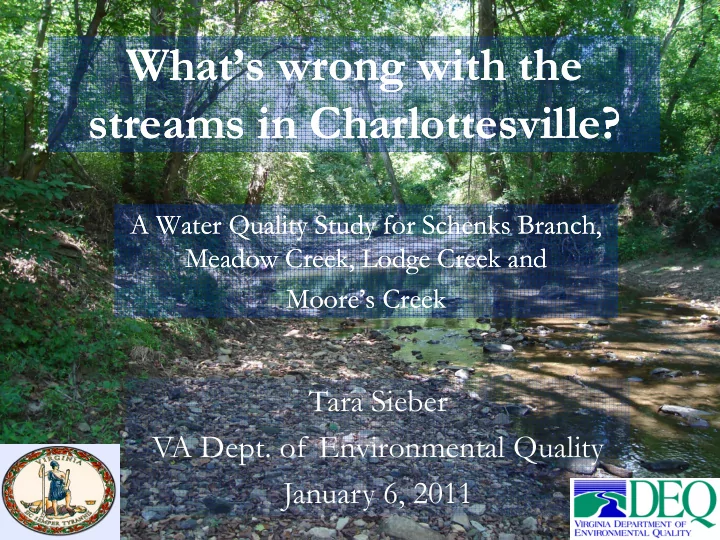
Whats wrong with the What s wrong with the What s wrong with the - - PowerPoint PPT Presentation
Whats wrong with the What s wrong with the What s wrong with the Whats wrong with the streams in Charlottesville? streams in Charlottesville? A Water Quality Study for A Water Quality Study for A Water Quality Study for Schenks A
Why are we here? Why are we here? Why are we here? Why are we here?
What’s wrong with
What’s wrong with
What s wrong with
What s wrong with Charlottesville’s Charlottesville’s Streams? Streams? Streams? Streams?
What’s being done?
What’s being done? Wh d ? Wh d ?
What can you do?
What can you do?
How does this impact
How does this impact the Chesapeake Bay? the Chesapeake Bay?
Exhibits
Exhibits
Lodge Creek
What’s wrong with What’s wrong with Charlottesville’s streams? Charlottesville’s streams?
Meadow Creek
Meadow Creek
Meadow Creek
Meadow Creek and Moore’s and Moore’s Creek have too Creek have too Creek have too Creek have too much bacteria much bacteria
Do not meet
Do not meet
Do not meet
Do not meet water quality water quality standards = standards = standards = standards = “impaired impaired”
What has been done? What has been done? What has been done? What has been done?
Source: Rivanna River Bacteria TMDL
Meadow Creek was
Meadow Creek was included in the included in the included in the included in the Rivanna Rivanna River River Bacteria water Bacteria water Bacteria water Bacteria water quality study quality study (TMDL) completed (TMDL) completed (TMDL) completed (TMDL) completed in 2008 in 2008-
- 2009
2009
What has been done? What has been done? What has been done? What has been done?
Moore’s Creek had a water quality
Moore’s Creek had a water quality study/TMDL for bacteria completed in 2002 study/TMDL for bacteria completed in 2002
Implementation Plan completed in 2005
Implementation Plan completed in 2005 p p p p
S r M r ’ Source: Moore’s Creek Bacteria TMDL
What’s wrong with What’s wrong with Charlottesville’s streams? Charlottesville’s streams?
Biological monitoring reveals
Biological monitoring reveals g g g g these streams do not support these streams do not support healthy and diverse aquatic healthy and diverse aquatic community community community community
Biologists look at the Benthic
Biologists look at the Benthic Macroinvertebrates = Macroinvertebrates = BUGS BUGS
Numbers and types collected
Numbers and types collected are compared to a healthy are compared to a healthy reference condition reference condition reference condition reference condition
Stream given a Stream
Stream given a Stream Condition Index (SCI) score Condition Index (SCI) score ( ) ( ) SCI of <60 = Aquatic Life SCI of <60 = Aquatic Life (Benthic) Impairment (Benthic) Impairment
Lodge Creek
Why Do We Care About Why Do We Care About “B ”? “B ”? “Bugs”? “Bugs”?
Important food source for fish
Important food source for fish p
Important in cycling nutrients
G
d i di t f p ll t t d G d i di t f p ll t t d
Good indicators of pollutants and
- verall stream health
H l h H l h U h lth U h lth Healthy Healthy Unhealthy Unhealthy
What are the scores for What are the scores for Charlottesville’s streams? Charlottesville’s streams?
100 80 90 100 50 60 70
nia SCI
2‐MSC000.60 2‐XRC001.15 2‐MWC000.60
Moore’s Creek (MSC) Lodge Creek (XRC) Meadow Creek (MWC)
Healthy Unhealthy
20 30 40
Virgi
2 MWC000.60 2‐SNK000.88 2‐XSN000.08 2 XSN000 18
Meadow Creek (MWC) Schenks Branch (SNK) Unnamed Trib (XSN)
10 20 2‐XSN000.18 Jan‐04 Jan‐05 Jan‐06 Jan‐07 Jan‐08 Jan‐09 Jan‐10
Graph Source: VT-BSE 2011
Monitoring Stations Monitoring Stations
Map Source: VT-BSE 2011
What is being done? What is being done? What is being done? What is being done?
A TMDL is formally known as
A TMDL is formally known as A TMDL is formally known as A TMDL is formally known as a a T Total
- tal M
Maximum aximum D Daily aily L Load
- ad
– or the amount of pollution
- r the amount of pollution
p that a stream can receive but that a stream can receive but still maintain water quality still maintain water quality d d d d standards standards
A pollution “diet” or “budget”
A pollution “diet” or “budget” to acco nt for all so rces of to acco nt for all so rces of to account for all sources of to account for all sources of pollution to a stream pollution to a stream
Recommends reductions from
Recommends reductions from Recommends reductions from Recommends reductions from the sources to meet the limit the sources to meet the limit
The TMDL Process The TMDL Process
Total
- Identifies sources of pollution
Total Maximum Daily
Virginia’s process to improve streams
Implementation Plan
- Calculates amounts from each
source
- Estimates necessary pollutant
reductions
y
Load
Study
reductions
- Identifies permit
controls or best t ti
I l i Monitoring Polluted
management practices needed to make necessary pollutant reductions
Implementation Cl
Water quality standards met
Clean
Water quality standards not met
Study Step #1: Study Step #1: What is affecting the bugs? What is affecting the bugs?
Perform a “Stressor Identification Analysis”
Perform a Stressor Identification Analysis
Look at all possible stressors using a weight
Look at all possible stressors using a weight-
- of
- f-
- evidence approach
evidence approach evidence approach evidence approach
Historical and recently collected data
Historical and recently collected data B i h bi li di B i h bi li di
Bug community, habitat, water quality, sediment, etc.
Non stressors Possible Most probable Non-stressors stressors stressors
Non Non-Stressors Stressors Non Non Stressors Stressors
Ammonia
Ammonia
Ammonia
Ammonia
Metals
Metals H
pH
pH
Temperature
Temperature
Total Dissolved
Total Dissolved Solids/Conductivity Solids/Conductivity / y / y
Possible Stressors Possible Stressors Possible Stressors Possible Stressors
Hydrologic
Hydrologic
Hydrologic
Hydrologic Modifications Modifications (Moore’s Creek) (Moore’s Creek) (Moore s Creek) (Moore s Creek)
Nutrients
Nutrients O i M O i M
Organic Matter
Organic Matter
PAHs
PAHs
Toxics
Toxics
Most Probable Stressors Most Probable Stressors Most Probable Stressors Most Probable Stressors
(Preliminary Results – Analysis continuing)
M ' L d M d S h k Hydrologic modification X X X Most Probable Stressor Moore's Creek Lodge Creek Meadow Creek Schenks Branch Sediment X X X X
Why do we care about Why do we care about
Habitat Changes impact aquatic life
Hydrologic Modification? Hydrologic Modification?
Habitat Changes impact aquatic life
Channel Alteration eliminates stream’s natural
Channel Alteration eliminates stream’s natural ability to absorb and recover from impacts (large ability to absorb and recover from impacts (large ability to absorb and recover from impacts (large ability to absorb and recover from impacts (large storms, sewer overflows, pollutants, etc.) storms, sewer overflows, pollutants, etc.)
Source: Flickr
What is the evidence for What is the evidence for H d l i M difi i ? H d l i M difi i ? Hydrologic Modification? Hydrologic Modification?
High percentage
High percentage
High percentage
High percentage
- f impervious
- f impervious
surfaces surfaces surfaces surfaces
- Lodge Creek:
Lodge Creek: 30 7% 30 7% 30.7% 30.7%
- Meadow Creek:
Meadow Creek: 31 9% 31 9% 31.9% 31.9%
- Schenks Branch:
Schenks Branch: 36 2% 36 2% 36.2% 36.2%
Map Source: VT-BSE 2011
What is the evidence for What is the evidence for Hydrologic Modification? Hydrologic Modification?
Channelized stream
Channelized stream
Channelized stream
Channelized stream segments ( segments (Schenks Schenks Branch Branch)
Sewer system
Sewer system
- verflows (Lodge
- verflows (Lodge
www.raleighnc.gov
- verflows (Lodge
- verflows (Lodge
Creek) Creek)
Why do we care about Sediment? Why do we care about Sediment? Why do we care about Sediment? Why do we care about Sediment?
A healthy “bug” community requires a clean stream
A healthy “bug” community requires a clean stream bottom with lots of space between rocks and gravels bottom with lots of space between rocks and gravels bottom with lots of space between rocks and gravels bottom with lots of space between rocks and gravels
Healthy Stream Bottom Excess Sediment
What is the evidence for Sediment? What is the evidence for Sediment? What is the evidence for Sediment? What is the evidence for Sediment?
Channel Erosion Fine sediment on bottom of streams
Study Step #2: Study Step #2: Id tif S Id tif S Identify Sources Identify Sources
Source: Kate Harrigan, DEQ Source: raleighnc.gov
?
What Can You Do to Help? What Can You Do to Help? What Can You Do to Help? What Can You Do to Help?
Participate on the Technical
p Advisory Committee
Group of local citizens,
l d r r iz ti d landowners, organizations, and government entities that will provide input, review and i t t DEQ d assistance to DEQ and contractors during development
- f the TMDL Study
Goal - make sure technical
aspects of the study are accurate as well as acceptable to the community
What Can You Do to Help? What Can You Do to Help? What Can You Do to Help? What Can You Do to Help?
Small Actions make a
Small Actions make a Small Actions make a Small Actions make a BIG Difference! BIG Difference!
Rainbarrels
Rainbarrels
Raingardens
Raingardens
Plant trees along streams
Plant trees along streams & bili b k & bili b k & stabilize banks & stabilize banks
Fence cattle out of
Fence cattle out of streams streams streams streams
Fertilize lawn once a year
Pick up after pets
Pick up after pets
TMDL Timeline TMDL Timeline TMDL Timeline TMDL Timeline
2006
2006-
- 2008
2008 – Streams included on “dirty waters Streams included on “dirty waters list” for aquatic life standard list” for aquatic life standard
October 2010
October 2010 – DEQ and VT begin the TMDL DEQ and VT begin the TMDL Q g Q g process by informing partners process by informing partners
January 6, 2011
January 6, 2011 – First Public Meeting First Public Meeting January 6, 2011 January 6, 2011 First Public Meeting First Public Meeting
Spring 2011
Spring 2011 – – Technical Advisory Committee Technical Advisory Committee Meeting(s) Meeting(s) Meeting(s) Meeting(s)
Summer 2011
Summer 2011 – – Next Public Meeting and start of Next Public Meeting and start of the Clean the Clean up Plan process up Plan process the Clean the Clean-up Plan process up Plan process
How does the Bay TMDL relate to cleaning up cleaning up
- ur local waters?
Low to no dissolved
- xygen in the
yg Bay and tidal rivers every rivers every summer Decreasing SAV Aquatic life “impaired”
28
Chesapeake Bay TMDL
EPA t ll ti di t t t
- EPA sets pollution diet to meet
states’ Bay clean water standards with caps on nitrogen, phosphorus and nitrogen, phosphorus and sediment loads for all 6 Bay watershed states and DC
- States set load caps for point
and non-point sources per major tributaries (e.g., James River)
- Final Bay TMDL issued
December 29, 2010
- 2-year milestones; 60%
achievement by 2017; all practices in place by 2025
29
Bay and Local Pollution Diet Schedule
Major basin jurisdiction loading targets
Oct 2009
Final TMDL Established
December 2010
Bay TMDL Public Meetings
November- December 2009
Divide Target Loads among Watersheds, Counties, Sources
Phase 1 Watershed Implementation
Local Program Capacity/Gap Evaluation
2009 Phase 2 Watershed Implementation Plans:
Sources
p Plans: November 2009 – August 2010
Evaluation
Plans: Jan – Nov 2011
2-year milestones, reporting, modeling
Starting 2011 g
Public Review And Comment
August- October 2010
modeling, monitoring
Virginia “segment-sheds” defined by Chesapeake Bay model Chesapeake Bay model
Each locality will be given “t t l d ” f N P d di t “target loads” for N, P, and sediment in early 2011
Each locality has discretion over how t t th “t t l d ” to meet these “target loads”
WLA = Waste Load Allocations set by permit for dischargers (point WLA = Waste Load Allocations, set by permit for dischargers (point sources such as waste treatment plants, MS4s) LA = Load Allocations (non-point source) reductions achieved through Best Management Practices (BMPs) such as
Virginia’s WIP provides for Virginia s WIP provides for
- Trading between point sources, including between river basins
For example, between the James and York River basins
- Trading between source sectors
g For example, between septic, agricultural, point sources
But …
Local Water Quality Must Be Local Water Quality Must Be Protected or Maintained
Piedmont Regional Pilot Project
for the Chesapeake Bay TMDL (EPA)
- Provide outreach to affected stakeholders:
- Local governments
- Agriculture
- Builders/developers
P it h ld
- Permit holders
- Listen to concerns and obtain feedback
- Ascertain support for developing a local/regional response
- Overwhelming response:
- Support for crafting a local plan
- Readiness to have discussions across source sectors
Supervisor, Nelson County Th N t C Supervisor, Greene County CBP L l G t Ad i
Readiness to have discussions across source sectors
Steering Committee
The Nature Conservancy Rivanna River Basin Commission Southern Environmental Law Center Thomas Jefferson SWCD CBP Local Government Advisory Committee Culpeper SWCD Thomas Jefferson PDC
36
The Chesapeake Bay TMDL (clean up plan) e C esapea e ay (c ea up p a ) will help us improve local water quality.
Resources for complying with Bay TMDL will Resources for complying with Bay TMDL will
positively affect local water quality.
Improvements, upgrades, retrofits locally can all Improvements, upgrades, retrofits locally can all
be “counted” towards local targets.
Charlottesville streams TMDL process and IP
p moves the community forward towards local and Bay water quality goals.
Both allow for the community to identify priorities
for achieving pollution reductions.