Reversing the Decay of American Air Power Roots of the Air Power - - PowerPoint PPT Presentation

reversing the decay of american air power roots of the
SMART_READER_LITE
LIVE PREVIEW

Reversing the Decay of American Air Power Roots of the Air Power - - PowerPoint PPT Presentation

Pierre Sprey Weapons Analyst and Participant in F-16 & A-10 Design Reversing the Decay of American Air Power Roots of the Air Power Rot Wrong Missions : Dominance of Strategic Bombing and Douhet Wrong Aircraft : Too Few, Too


slide-1
SLIDE 1

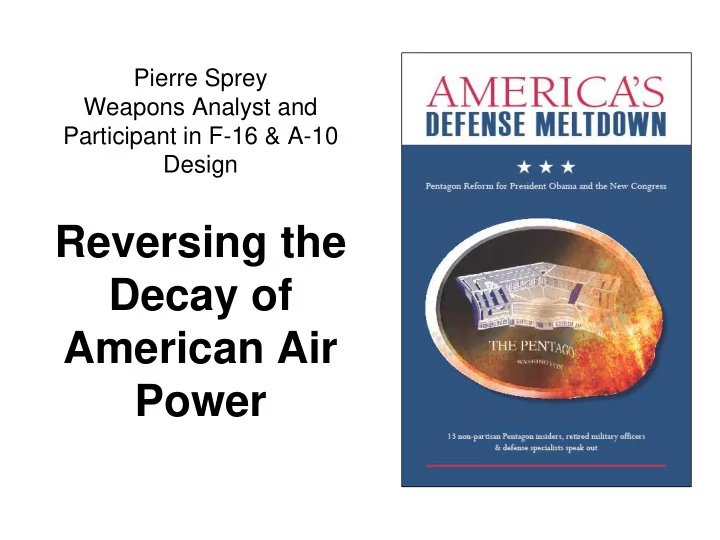
Pierre Sprey Weapons Analyst and Participant in F-16 & A-10 Design

Reversing the Decay of American Air Power

slide-2
SLIDE 2

Roots of the Air Power Rot

  • Wrong Missions: Dominance of Strategic Bombing and

Douhet

  • Wrong Aircraft: Too Few, Too Ineffective, Too

Expensive

  • Wrong Incentive: Maximize Budget

BUSINESS-AS-USUAL WILL LEAD TO TINY, ANTIQUATED, IRRELEVANT FORCES THAT FAIL IN COMBAT. LACK OF MONEY IS NOT THE PROBLEM!

slide-3
SLIDE 3

CURING THE ROT

  • In depth, examine combat results and money spent
  • ver last seventy years
  • Distill what works in combat
  • Design austere aircraft and forces around what works

in combat

RESULT: THE COMBAT HISTORY-BASED FORCE IS ASTONISHINGLY LARGE, EFFECTIVE AND AFFORDABLE

slide-4
SLIDE 4

Combat Results and Costs:

WWII in Europe

  • Douhet and strategic bombing shaped the WWII Air Force
  • 80% spent on bombers, 20% on fighters. Half of war effort

spent on air

  • 8 of 9 strategic bombing campaigns failed (Strategic

Bombing Survey)

  • Allied bombing lost 150,000 airmen (10x the fighter losses)
  • Unescorted bombers failed; German fighters won (Fall 1943)
  • Reversed in Spring 1944: 1100 P-51s gained air superiority

(essential for D-Day landings)

  • Gen. Quesada’s 1200 P-47s in close support saved the

Normandy Beach head

  • Same P-47s proved crucial for St. Lo breakout and Patton’s

plunge across France (600 miles/2 weeks)

slide-5
SLIDE 5

Combat Summary:

WWII in Europe

Overall, strategic bombing stiffened German resolve and strengthened the regime (just like German bombing did to UK)

slide-6
SLIDE 6

Combat Results and Costs:

WWII to Korea

  • USAF bomber generals slashed fighters down to 1000(265

P-47s left out of 16,000 produced) and forced Quesada out

  • Korea 1949: US Army Task Force overwhelmed. USAF sent

90 B-29s yielding 13 “close support” sorties/day

  • USAF deployed a token 150 P-150s: Too vulnerable, huge
  • losses. Gen. Vandenberg refused to replace with survivable

P-47s

  • USMC/USN prop-driven Corsairs and A-1 Skyraiders

provided brilliant close support. Saved Marine division trapped by 7 Chinese divisions at Chosin

  • 1000 Mig-15s cripple B-29 bombing. 90 F-86s gain air

superiority with 10:1 exchange ratio

slide-7
SLIDE 7

Combat Summary:

WWII to Korea

Strategic Bombing Results:

  • Laid waste to every large North Korean

City (with huge bomber losses)

  • Completely failed to prevent resupply
  • Never forced North Koreans to the peace

table

slide-8
SLIDE 8

Combat Results and Costs:

Korea to Vietnam

  • 1950-1960: USAF built 3000 bombers and nuclear

interceptors but slashed fighters to 1000

  • Vietnam air war starts (1964): USAF deployed 227 old F-

100s and 110 F-105s as strategic bombers. Highly vulnerable to AAA and MiGs; Lost 243 F-100s and 397 F- 105s

  • No USAF fighter in production: SECDEF imposed Navy’s F-4

nuclear interceptor on USAF. Equally vulnerable; deployed 285, lost 445

  • Token close support effort in the south (100 sorties/day) but

55 prop-driven A-1s achieved spectacular successes due to pinpoint accuracy of 20mm. 3-4 hr loiter time, invulnerability and slow speed maneuverability. Troops loved the A-1.

slide-9
SLIDE 9

Combat Summary:

Korea to Vietnam

6 years of strategic bombing failed:

  • Did not stop resupply of South
  • Never forced North Vietnam to

negotiating table

  • Stiffened civilian resistance and

strengthened Ho Chi Minh regime

slide-10
SLIDE 10

Combat Costs and Results:

Gulf War

  • Gulf War I: USAF planned 39 day strategic bombing
  • campaign. Predicted surrender in 6 days (DOUHET!)
  • Targeting blunder, killing 300 women/children, ended

Baghdad bombing in 20 days. No effect on Iraqi army in Kuwait

  • 132 A-10s killed more tactical targets than all the 2000 high

speed jets (F-16, F-111, F-15,F-117, etc)

  • 2 A-10s destroyed the spearhead of Iraqi armored invasion
  • f Saudi Arabia. In 2 days, 100s of A-10 sorties mauled the

whole 2 division force

  • After war, USAF bomber generals rewarded A-10s by

mothballing half – simultaneously funding huge over runs for the B-1, B-2 and F-22

slide-11
SLIDE 11

Combat Costs and Results:

Kosovo

  • In Kosovo, USAF planned strategic bombing campaign with

720 NATO planes. Predicted surrender in 2 days

  • 78 days and 38,000 sorties later, only destroyed 3/80 SAM

Sites, 14 armored vehicles and 387 military casualties

  • After 78 days, Serbs, undefeated, accepted better NATO

terms than Serbia wanted before war.

slide-12
SLIDE 12

Combat Costs and Results:

Summary

  • Strategic bombing failed in WW II, Korea, Vietnam, Gulf War

I and Kosovo (and in subsequent wars)

  • Close air support has succeeded, wherever tried, in moving

battles in WW II, Korea, Vietnam, Gulf War I and Afghanistan

  • Air crew and aircraft losses in strategic bombing are huge,

typically 10x the losses in close support. Costs are equally huge: No US air war has spent even 10% on close support

  • Ever since 1949, US airpower has had decreasing effects on

the outcome of each war, applying smaller and smaller forces at higher and higher costs

slide-13
SLIDE 13

Business-as-usual in Procurement

  • Air Force presents an impossibly expensive wish list of

programs (currently $1 Trillion over next 20 years)

  • SECDEF (and Congress) haggle this down, year by year, to

around $12 Billion/year in R&D + Procurement

  • That will buy 50 or less planes per years – mostly for

nuclear or non-nuclear strategic bombing

  • Today’s Air Force: 4,000 aircraft, on average 20 years old
slide-14
SLIDE 14

The Business-as-usual Air Force in 20 years:

2000 aircraft, average 25-30 years

  • ld, and no air power option

except strategic bombing

slide-15
SLIDE 15

An Alternative:

The Effectiveness-based Air Force

Replace “Wish List” with four austere designs based on what works in combat

  • New Close Support A/C: 55% the size of the A-10 and

significantly more lethal/maneuverable/survivable

  • Forward Controller Plane: Lands right next to troops but far

more survivable/maneuverable/long-loitering than helicopter

  • Dirt Strip Airlifter: 5-10 ton emergency resupply to

beleaguered battalions in boonies

  • New Super-agile Dogfighter: 30% smaller than F-16; Far

higher acceleration and turn; all-passive electronics/weapons for real, not “pretend” stealth; out-fights any fighter in the world, including F-22

slide-16
SLIDE 16

An Alternative:

The Effectiveness-based Air Force (con’t)

  • Keep spending same over next 20 years: $12

Billion/year

  • Program and cost out a complete, balanced force:

Fighters, airlift, close support, forward control, tankers

slide-17
SLIDE 17

The Effectiveness-Base Force Delivers

  • 10,000 new aircraft
  • Devastating close support
  • Overwhelming air superiority
  • All available right at the beginning of a

war – a first in US air power history!