Whats new in CRT? Research support VA, AHA, Janssen, Medtronic, - - PDF document

what s new in crt
SMART_READER_LITE
LIVE PREVIEW

Whats new in CRT? Research support VA, AHA, Janssen, Medtronic, - - PDF document

12/3/17 Disclosures Whats new in CRT? Research support VA, AHA, Janssen, Medtronic, Cardiva, AstraZeneca, Boehringer Ingelheim, Apple, Bristol-Myers Squibb MINTU TURAKHIA, MD MAS Associate Professor of Medicine


slide-1
SLIDE 1

12/3/17 1

MINTU TURAKHIA, MD MAS

Associate Professor of Medicine Executive Director, Center for Digital Health Stanford University Director, Cardiac Electrophysiology VA Palo Alto Health Care System mintu@stanford.edu @leftbundle
What’s new in CRT?

§Research support §VA, AHA, Janssen, Medtronic, Cardiva, AstraZeneca, Boehringer Ingelheim, Apple, Bristol-Myers Squibb §Advisor/Consultant/Equity §Abbott, Medtronic, Boehringer Ingelheim, Zipline Medical, Precision Health Economics, AliveCor, Armetheon, Akebia, iBeat, Forward §Lecture honoraria §Medtronic, Abbott

Disclosures

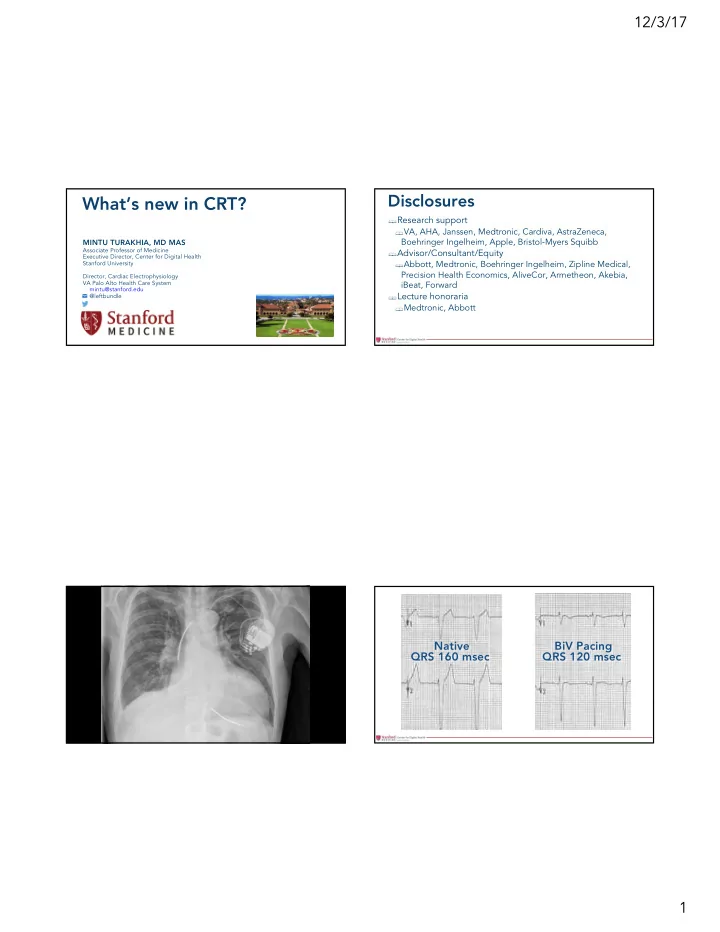
Native QRS 160 msec BiV Pacing QRS 120 msec

slide-2
SLIDE 2

12/3/17 2

§In EF < 35% + optimal medical therapy §Most likely to benefit (Class I) §NYHA class III/IV, LBBB>150 ms §Less likely (Class IIa) §NYHA class II/III/IV, LBBB 120-149 ms §NYHA class III/IV, non-LBBB>150 ms §Nonischemics respond better

Indications for CRT-D

NYHA QRS* Sinus ICD? MIRACLE III, IV ≥130 Normal No MUSTIC SR III >150 Normal No MUSTIC AF III >200† AF No PATH CHF III, IV ≥120 Normal No CONTAK CD II-IV ≥120 Normal Yes MIRACLE ICD II-IV ≥130 Normal Yes PATH CHF II III, IV ≥120 Normal No COMPANION III, IV ≥120 Normal No CARE HF III, IV ≥120 Normal No RETHINQ III < 130 Normal Yes MADIT-CRT I, II ≥130 NSR, AF Yes RAFT II, III ≥120 NSR, AF/L Yes

CRT trials

CRT Improves QOL and NYHA class

QOL Score NYHA Class MIRACLE1 (N=453) ↓ ↓ MIRACLE ICD2 (N=247) ↓ ↓ MUSTIC3 (N=67) ↓ na PATH-CHF4 (N=41) ↓ ↓ CONTAK CD5 (N=203) ↓ ↓ French Pilot6 (N=50) na ↓ InSync–Europe7 (N=103) ↓ ↓ InSync ICD–Europe8 (N=84) ↓ ↓

1. Abraham WT, et al. N Engl J Med. 2002;346:1845-1853. 2. Young JB, et al. JAMA. 2003;289:2685-2894. 3. Cazeau S. N Engl J Med. 2001;344:873-880. 4. Auricchio A. J Am Coll Cardiol 2002;39:1895-1898. 5. Thackery S, et al. Eur J Heart Fail. 2001;3:491-494.

  • 6. Leclercq C. Am Heart J. 2000;140(6):862-870.

7. Gras D. Eur J Heart Fail. 2002; 4 311–320. 8. Kühlkamp V. J Am Coll Cardiol 2002;39:790-797.

Randomized Observational

CRT Improves Exercise Capacity

6-Min Walk Peak VO2 Exercise Time MIRACLE1 (N=453) ↑ ↑ ↑ MIRACLE ICD2 (N=247) ↔ ↑ ↑ MUSTIC3 (N=67) ↑ ↑ na PATH CHF4 (N=41) ↑ ↑ na CONTAK CD5 (N=203) ↑ ↑ na French Pilot6 (N=50) na ↑ na InSync–Europe7 (N=103) ↑ na na InSync ICD–Europe8 (N=84) ↑ na na

Randomized Observational

  • 1. Abraham WT, et al. N Engl J Med. 2002;346:1845-1853.
  • 2. Young JB, et al. JAMA. 2003;289:2685-2894.
  • 3. Cazeau S. N Engl J Med. 2001;344:873-880.
  • 4. Auricchio A, J Am Coll Cardiol. 2002;39:1895-1898.
  • 5. Thackery S, et al. Eur J Heart Fail. 2001;3:491-494.
  • 6. LeclercqaC. Am Heart J. 2000;140(6):862-870.
  • 7. Gras D. Eur J Heart Fail. 2002;4311-4320.
  • 8. Kühlkamp V. J Am Coll Cardiol 2002;39:790-797
slide-3
SLIDE 3

12/3/17 3

CRT Improves Cardiac Structure and Function

1.Yu C-M. Circulation. 2002;105:438-445. 2.St. John Sutton MG. Circulation. 2001;104(suppl 2):II-618 (abstract). 3.Breithardt OA. Am Heart J. 2002;143:34-44. 4.Stellbrink C. J Am Coll Cardiol. 2001;38:1957–1965. 5.Linde C. J Am Coll Cardiol. 2002;40:111-118. 6.Young JB, et al. JAMA. 2003;289:2685-2894.

LVEF MR LVEDV/ LVESV LV Filling Time Queen Mary Hospital1 ↑ ↓ ↓ ↑ MIRACLE2 ↑ ↓ ↓ ↑ PATH CHF3,4 ↑ na ↓ ↑ MUSTIC5 na ↓ na ↑ MIRACLE ICD6 ↔* ↔ ↓ ↑ *Favorable trend, P=0.06

§Conclusion: CRT improves survival

Meta-analysis for mortality

(Wells G, CMAJ 2011)

Absolute risk reduction (unweighted): 4.6%

QRS duration and response

QRS > 150 QRS < 150

(Sipahi I, Arch Int Med, 2011)

§Class I (“is indicated”) §LVEF ≤ 35%; sinus; LBBB QRS ≥ 150, NYHA II-IV §Class IIa (“can be useful”) §LBBB QRS 120-149 §non-LBBB QRS ≥ 150; NYHA III-IV §AF, EF ≤ 35% with near 100% BiV pacing §LVEF ≤ 35% with > 40% RV pacing expected §Class IIb (“may be considered”) §LVEF ≤ 30%, ischemic NYHA I §non-LBBB QRS 120-149; NYHA III-IV §non-LBBB QRS ≥ 150; NYHA II

Guidelines

Epstein AE, et al. 2012 ACCF/AHA/HRS focused update

slide-4
SLIDE 4

12/3/17 4

What about in mild to moderate LV dysfunction?

§AV block with LVEF < 50% §NYHA I-III on optimal medical therapy §CRT-P or CRT-D implanted §Randomized to RV or BiV pacing §40-50% with AF §Time to composite §Death §HF exacerbation §LVESV increase of 15%

BLOCK-HF

(Curtis AB, NEJM 2013) Curtis AB, NEJM 2013

§Time to death or HF exacerbation §HR 0.73 (0.57- 0.92) §Also improvements in reverse remodeling (LVESV

What if my patients has atrial fibrillation?

slide-5
SLIDE 5

12/3/17 5

§Virtually all CRT trials evaluated resychronization of sinus rhythm §AF was a key exclusion §AF is very common HF (~20-30%) §Prevalence of AF increases with increase NYHA severity

CRT trials did not evaluate AF patients

§Change in EF: greater benefit in AF

Improvement in EF

Upadhyay G / Singh J, JACC 2008 Gasparini M, JACC HF, 2013

Reverse remodeling (LVESV)

Benefit of AVN ablation in CRT with AF

Wilton SB / Exner D, Heart Rhythm 2011

slide-6
SLIDE 6

12/3/17 6

Marrouche N, ESC 2017 (unpublished) Marrouche N, ESC 2017 (unpublished)

§In patients with AF, decreased EF, and heart failure, CRT is effective, if… §Virtually 100% BiV pacing (usually permanent AF) §Low threshold for AV Node ablation §Strongly consider restoration of sinus rhythm first (ablation), especially if AF rhythm, not just rate, is HF trigger

AF and CRT: summary New Developments

slide-7
SLIDE 7

12/3/17 7

Nonresponder rate: ~ 30-40% Insights from a CRT clinic

§Phrenic nerve stimulation §LV pacing vector §LV pacing thresholds §Lead stability

LV lead issues

4.7F lead body 4.0F tip S-Curve Optim insulation 5.3F lead body 5.1F “swell” on electrodes 3 curves 5.2F lead body 2.6F tip Asymmetric spacing on spiral

slide-8
SLIDE 8

12/3/17 8

Distal 1 Mid 2 Mid 3 Prox 4 RV Coil

Customizable pacing vectors

LV lead deactivation-free survival

Turakhia M, et al. JACC EP, 2016.

LV lead replacement-free survival

Turakhia M, et al. JACC EP, 2016.

Cumulative Shock Burden

Bipolar at Risk Bipolar Events Quadripolar at Risk Quadripolar Events

slide-9
SLIDE 9

12/3/17 9

Summary: benefits of quadripolar CRT

Implant success rate1,2 95 – 97% Response rate1 71.3% Dislodgement1,2 2.7 – 3.5% Resolution of PNS 100% Reduced fluoroscopic exposure 48% Risk of inactivation 0.62 (0.46-0.84) Risk of replacement HR 0.67 (0.55-0.83) Risk of death HR 0.77 (0.68-0.86) Risk of shocks HR 0.74 (0.57-0.96) Decreased health care utilization

Forleo GB, Heart Rhythm; 2012; Tomassoni G, JCE 2013; Hussain M, PACE 2013; Della Rocca, Int J Card 2012.

Multipoint pacing

Pappone C, Heart Rhythm, 2015

§RCT of 44 patients §LV structural

  • utcome

§No RCT data with clinical

  • utcomes

§What is the optimal programming? §Too many vectors §Symptom-pacing correlation §Still… §Benefits likely to emerge §Most quadrapolar generators support or will support MPP §“Future-proofing” strategy

Multipoint pacing challenging

slide-10
SLIDE 10

12/3/17 10

Can we simplify a little?

§Replicates true physiology §Most efficient way to stimulate the ventricles §Only form of pacing that where activation is physiologic

His bundle pacing: a new paradigm?

9/13/17

56 yo WF with NICM, EF 20%, NYHA III for 2 yrs, prior chemotherapy

9/13/17

Courtesy of Gopi Dandamudi MD

2 weeks later: NYHA class I

Courtesy of Gopi Dandamudi MD

slide-11
SLIDE 11

12/3/17 11

ECG 2 months later (EF 12 months later 50%)

Courtesy of Gopi Dandamudi MD

Permanent His Bundle Pacing for CRT

Ajijola et al., Heart Rhythm April 2017

§HBP successful in 16/21 CRT- eligible patients

Reverse remodeling is sustained

Huang, W et al. J Am Heart Assoc, 2017

§May avoid lead related tricuspid regurgitation

His bundle pacing

Correa et al., Circ AE 2012 Courtesy of Gopi Dandamudi MD

slide-12
SLIDE 12

12/3/17 12

§CRT-D is stable and mature with clear benefit in carefully-selected populations §CRT-P has a role in moderate LV dysfunction with high expected pacing burden §Quadrapolar leads are the standard; multipoint pacing seems promising but how to optimize is unclear §His bundle pacing will continue to gain traction and may replace conventional RV (and BiV) pacing

Summary

Thank you !

mintu@stanford.edu @leftbundle

§Leads §Excessive heating from induced currents §Generator §Modification of pacemaker function §Pacing, shocks §Inappropriate sensing or triggering of the device

Potential effects of MRI on CIEDs

slide-13
SLIDE 13

12/3/17 13

§Generator §Less ferromagnetic material §Improved circuitry protection §No “reed” switch §Leads §Inner coil with two filars rather then four §“Smaller antenna” §Retroactive conditional approval

MRI Conditional Devices

§Yes, most of the time §Caveats

§No uniformly safe MRI protocol §“Absolute contra-indication” is the rule §Not covered by Medicate

§Legal precedent not established §Find a center willing to do this

Are MRIs safe in non-conditional CIEDs?

(Russo RJ, AHA 2014)

slide-14
SLIDE 14

12/3/17 14