
SLIDE 1
Exploring the “Magic” of Algorithmic Predictions
Joyce Lee Sejal Popat Soravis Prakkamakul
UC Berkeley School of Information 2019 MIMS Final Presentation
Exploring the Magic of Algorithmic Predictions Joyce Lee Sejal - - PowerPoint PPT Presentation
Exploring the Magic of Algorithmic Predictions Joyce Lee Sejal Popat Soravis Prakkamakul UC Berkeley School of Information 2019 MIMS Final Presentation Why do we think of technology as magic? "Any sufficiently advanced
Joyce Lee Sejal Popat Soravis Prakkamakul
UC Berkeley School of Information 2019 MIMS Final Presentation
Clarke, A. (1999) [1st pub. 1962, rev. 1973, 1984, 1999]. Profiles of the Future: An Inquiry Into the Limits of the Possible. New York, NY: Holt, Rinehart & Wilson.
Clarke, A. (1999) [1st pub. 1962, rev. 1973, 1984, 1999]. Profiles of the Future: An Inquiry Into the Limits of the Possible. New York, NY: Holt, Rinehart & Wilson.
1
2
Burrell, J. (2016). How the Machine ‘Thinks’: Understanding Opacity in Machine Learning Algorithms. Big Data & Society. https://doi.org/10.1177/2053951715622512.
Astrology Aura Reading Mediumship Numerology Palm Reading Physiognomy Phrenology Psychometry Tarot Card Reading
Can reframing algorithmic predictions with the deliberately mystical lens of divination lead people to reconsider its sense of “magic”?
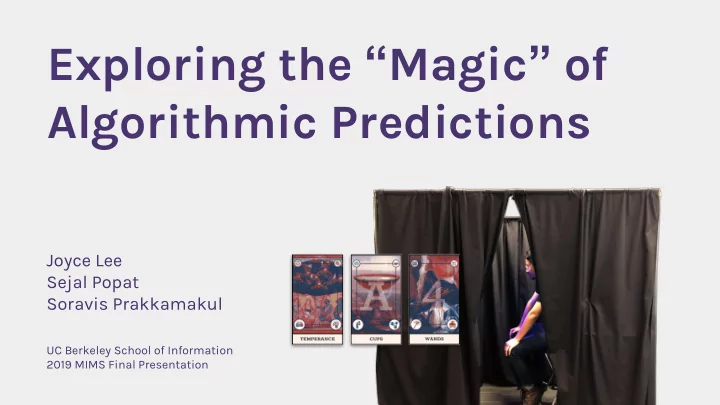
Within the traditions of reflective & speculative design, we develop an interactive installation that enables technology-mediated tarot-card readings.
1
Will people question how algorithmic prediction works in the context of divination?
2
Will people resist sharing personal data for the purpose
Conversational Interface Text Analysis & Visualization Personality Prediction Tarot Card Reading
Topic Visualization Interior Lamp Black Curtains Card Dispensing Slot
Tarot Card Printer Monitor Laptop Microphone Array
Tarot Card Printer Monitor Laptop Microphone Array
Tarot Card Printer Monitor Laptop Microphone Array
Tarot Card Printer Monitor Laptop Microphone Array
Future Prediction Past Prediction Present Prediction
Raw Speech Speech Recognition Intent Recognition Topic Analysis (Empath) Sentiment Analysis MBTI Personality Analysis (SpaCy) Future Prediction Past Prediction Present Prediction Basic Interactions: Skip, Repeat, etc.
Raw Speech Speech Recognition Intent Recognition Topic Analysis (Empath) Sentiment Analysis MBTI Personality Analysis (SpaCy) Future Prediction Past Prediction Present Prediction Basic Interactions: Skip, Repeat, etc.
Raw Speech Speech Recognition Intent Recognition Topic Analysis (Empath) Sentiment Analysis MBTI Personality Analysis (SpaCy) Future Prediction Past Prediction Present Prediction Basic Interactions: Skip, Repeat, etc.
Tarot Card Printer Monitor Laptop Microphone Array
Tarot Card Printer Monitor Laptop Microphone Array
10 Participants
Ages 25-40 50% female
Sample Recruited via Email Self-Guided Tarot Reading Follow-Up Interview
1
Questioning whether or not to share personal data
2
Interrogating underlying technology
1
Questioning whether or not to share personal data
2
Interrogating underlying technology
1
Questioning whether or not to share personal data
2
Interrogating underlying technology
1
Questioning whether or not to share personal data
2
Interrogating underlying technology
1
Will people question how algorithmic prediction works in the context of divination?
2
Will people resist sharing personal data for the purpose
1
Participants were most interested in the process of generating predictions, rather than the
2
Participants felt they had very little agency to control how they were “seen” by the system; many wondered if they were being reflected or led
1
The magical, optimistic presentation of algorithmic predictions may be doing more harm than good
2
We see a need for transparent communication of technology’s inner workings, even if this requires purposeful ambiguity and room for interpretation
Our advisor, Kimiko Ryokai Our research participants Our I School professors & department staff Our friends & family (that’s you!)
Joyce Lee Sejal Popat Soravis Prakkamakul
UC Berkeley School of Information 2019 MIMS Final Presentation