
SLIDE 1
The New Nutrient Management Standard
What It Means for You
Sue Porter, DATCP
(608)224-4605 sue.porter@datcp.state.wi.us
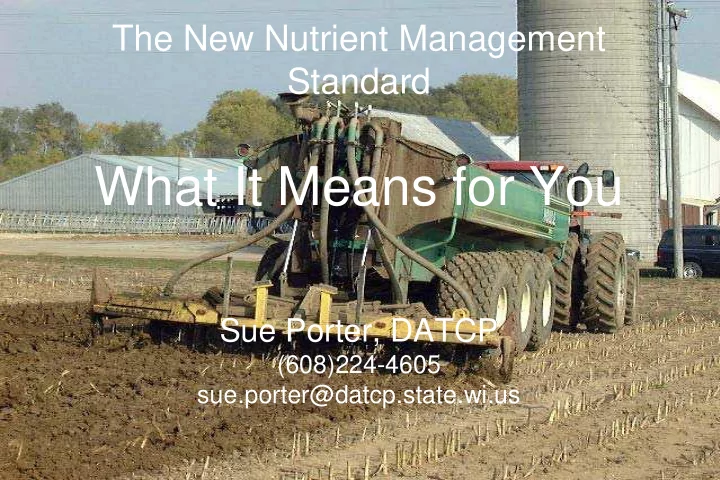
What It Means for You Sue Porter, DATCP (608)224-4605 - - PowerPoint PPT Presentation
The New Nutrient Management Standard What It Means for You Sue Porter, DATCP (608)224-4605 sue.porter@datcp.state.wi.us Non-Point Rule Redesign 1997 Wisconsin Act 27 legislature mandated a redesign of non-point pollution programs
(608)224-4605 sue.porter@datcp.state.wi.us
– legislature mandated a redesign of non-point pollution programs
– DNR set Ag Performance standards (NR 151) – DATCP set technical standards (ATCP 50)
– DATCP develops a statewide nutrient management program (ATCP 50)
– add a P based standard reviewed at public hearing – add manure analysis from laboratories participating in Manure Analysis Proficiency (MAP)
Blue & Brown 303d Gold Outstanding Resource Water Green Exceptional Resource Water Black dots Source Water Protection Area
DNR Bureau
Management April 2003
Effective 2005
document & manage soil nutrient levels to limit or reduce nutrient delivery potential and not alter background water quality
#1 Nutrients shall not runoff the field during application
fields eroding more than “T” (tolerable soil loss)
established concentrated flow channels non-farmed wetlands non-harvested permanent vegetative buffers lands where vegetation is not removed, except
50’ of potable drinking water wells within 200’ upslope of direct conduits to groundwater such as wells, sinkholes, gravel pits, surface fractured bedrock, tile inlets, unless incorporated in 72hrs
Application Restrictions
When frozen or snow covered soil prevents effective incorporation
soils (except for grass pastures & on winter grains)
gallons/ac)
delineated in a conservation plan as contributing runoff directly to surface or groundwater
contoured or contour stripped
Application Restrictions
Use one or more of the following practices:
Application Restrictions
Table 1.
Forms weak ball, breaks easily
7,000 10,000 14,000 20,000
Coarse soil texture Forms a ball, is very pliable, slicks readily
5,000 7,500 10,000 15,000
Medium soil texture Easily ribbons out between fingers has slick feeling
3,000 5,000 6,000 10,000
Fine soil texture
In Field Wet Soil Description Upon Squeezing
<30% >30% <30% >30%
% Crop Residue Cover Wet soil rate gal./ac. Wet soil rate gal./ac. Dry soil rate gal./ac. Dry soil rate gal./ac.
Follow UW soil test recommendations or N uptake by legume crops - It is acceptable for available N to be up to 20% more than the recommended N rate when legumes and manures are used to meet the entire N requirement. Credit all starter N beyond 20 lbs./ac for corn. Limit N applications in the summer and fall on high permeability soils, or soils with less than 20 inches to bedrock, or soils with less than 12 inches to apparent groundwater, and within 1,000 feet of municipal wells Apply remaining crop N need in spring or summer
50ºF or less in the fall -- Limit available manure N to 120 lbs. / ac > 50ºF in the fall -- Pick one
Limit available manure N to 120 lbs. / ac + nitrification inhibitor Limit manure applications to crop N need or 120 lbs. ac + on perennial or fall seeded crops Limit available manure N to 90 lbs. / ac + apply after Sept. 15th
No fall commercial N -- except 30 lbs. / ac or less on fall seeded crops On irrigated fields -- split or delay commercial N to apply majority after crop establishment or use nitrification inhibitor
Where manure, organic byproducts, or fertilizers are applied:
where tests are above non-responsive range for the crop
soil test soil test
concentrated flow identified in conservation plan
Soil Test P Management
– When >100 PPM P apply 25% less than the cumulative crop removal over a maximum of 4 yrs
strips along water ways
P Index
14 7 64 35 188 79 50 230 179 2001 2002 2003 2004 Farms practicing NM & not in programs Cost Sharing Programs WPDES County Ord. in thousands of acres 222 223 117 180 93 116 131
– 1,449 plans
in fertilizer survey – 7% of WI crop acres
total reported acres 302,070 366,581 611,605 650,963
http://www.soils.wisc.edu/Snap-Plus/590Test.html
– Certified soil testing laboratories – Manure Information - manure produced & spreader capacity – Nutrient Management Plan Checklist (March 1999 & July 2002-590 standard versions and Wisconsin Comprehensive NM Plan Checklist )
http://www.datcp.state.wi.us/arm/agriculture/land- water/conservation/nutrient-mngmt/planning.html