What is the LSFY program? Proactive advising and exploration program - - PowerPoint PPT Presentation

what is the lsfy program
SMART_READER_LITE
LIVE PREVIEW

What is the LSFY program? Proactive advising and exploration program - - PowerPoint PPT Presentation

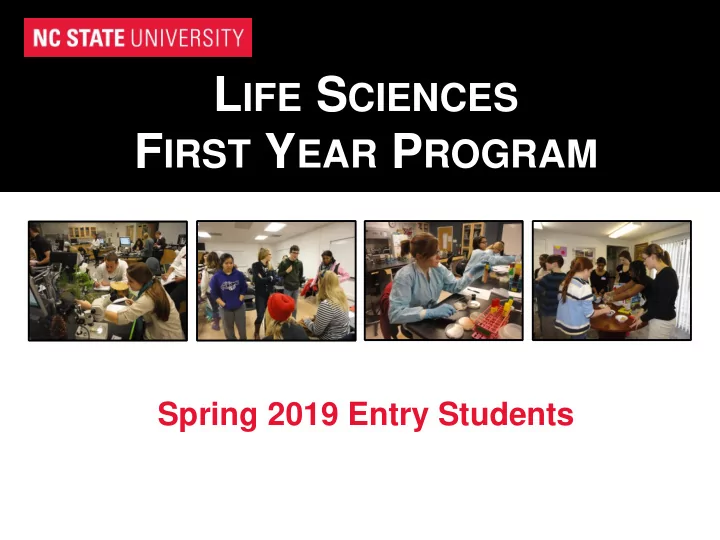
L IFE S CIENCES F IRST Y EAR P ROGRAM Spring 2019 Entry Students What is the LSFY program? Proactive advising and exploration program for: Biochemistry Biological Sciences (BA and BS) Genetics Microbiology Nutrition Science


slide-1
SLIDE 1

Spring 2019 Entry Students

LIFE SCIENCES FIRST YEAR PROGRAM

slide-2
SLIDE 2

What is the LSFY program?

Proactive advising and exploration program for:

  • Biochemistry
  • Biological Sciences (BA and BS)
  • Genetics
  • Microbiology
  • Nutrition Science
  • Plant Biology
  • Zoology
slide-3
SLIDE 3
  • LSFY Academic Advisors

and Faculty focused on student’s first year

  • Exploration of majors
  • Common first year

curriculum

  • LSC 101, LSC 103, and

LSC 170 (optional) with smaller class sizes

  • Peer support programs

Program Features

slide-4
SLIDE 4

What does Spring Entry Mean?

Due to the large number of highly qualified applicants, NC State has chosen to offer spring admissions to allow more students to attend.

  • Students will officially start as full-time students

in Spring 2019.

  • Students may participate in a few special

programs at NC State, such as Summer Start and Prague Connection.

slide-5
SLIDE 5

What is next?

  • Confirm your intent to enroll through your

wolfPAW account by June 1st.

  • Set up your NC State Email Account
  • Complete the New Student Checklist

– https://newstudents.dasa.ncsu.edu/springcon

nection/checklist/

slide-6
SLIDE 6

What can I do in Summer and Fall 2018?

  • Option 1: Work, Internship, Gap Semester
  • Option 2: Attend another institution and

transfer your coursework to NC State

  • Option 3: Participate in one of NC State’s

special programs - Summer Start or Prague Connection

slide-7
SLIDE 7

Summer Start

Deadline: May 9th

  • June 20 – August 1, 2018
  • Live on campus and interact with other students

in a smaller environment

  • Take up to 8 hours at NC State

– Students will be listed as non-degree seeking students meaning they will not be eligible for financial aid.

slide-8
SLIDE 8

Prague Connection

Deadline: June 15th

  • August 22 - Nov 17, 2018
  • Take general education and free elective

courses

  • https://prague.ncsu.edu/terms/prague-

connection/

slide-9
SLIDE 9

Summer/Fall 2018 Advising

Things to consider when selecting fall classes

  • 1. Major of Interest
  • 2. Career Interest
  • 3. AP/IB/Transfer Credits
  • 4. NC State Math and Chemistry Placement

scores

  • We recommend you take these by May 21st.
  • We recommend taking the placement tests

regardless of AP/IB or transfer credits you may have or anticipate having.

slide-10
SLIDE 10

First Year Common Curriculum

Fall Semester Spring Semester

BIO 181: Intro Bio: Ecol, Evol, Biodiversity

  • r

BIO 183: Intro Bio: Cell & Molecular BIO 181: Intro Bio: Ecol, Evol, Biodiversity

  • r

BIO 183: Intro Bio: Cell & Molecular Calculus Calculus ENG 101 or General Education Requirement Chemistry General Education Requirement LSC 101: Critical and Creative Thinking in the Life Sciences LSC 103: Exploring Opportunities in the Life Sciences LSC 170: First Year Seminar (optional) Health & Exercise (optional) Health & Exercise (optional)

Recommended Course Sequence for Spring Connection Students *These courses are listed using NC State’s codes and numbering*

slide-11
SLIDE 11

Summer/Fall 2018 Advising

Please note that we will be using the NC community college course numbers as a reference for the rest of this presentation. All transfer equivalencies can be found here: https://www.acs.ncsu.edu/php/transfer/

slide-12
SLIDE 12

Biology

  • You can take either BIO 111 or BIO 112 - the
  • rder does not matter

NC State Community College

BIO 181: Intro Bio: Ecol, Evol, Biodiversity BIO 112 BIO 183: Intro Bio: Cell & Molecular BIO 111

slide-13
SLIDE 13

Math Sequence

We have two math sequences that will count in the Life Sciences majors. Most students take the first sequence listed. However, if you have any interest in the Physical Sciences, Biochemistry, Engineering, or Math Education, you should take the higher math sequence listed. The higher math sequence will always count for the lower math sequences but not the other way around.

  • Life Sciences Majors:

– MA 107 → MA 131 → MA 231

  • Higher Math - Physical Science, Biochemistry,

Engineering, Math Education: – MA 111 or (MA 107+108) → MA 141 → MA 241

slide-14
SLIDE 14

Math Sequence

Placement NC State: Life Science Sequence Community College NC State: Physical Science/ Engineering Sequence Community College

Pre-Calculus I MA 107 MAT 171 MA 111

  • r

MA 107 + MA 108 MAT 175 Pre-Calculus II MA 108 MAT 172 MAT 171 + MAT 172 Calculus I MA 131 MAT 271 MA 141 MAT 271 Calculus II MA 231 MAT 272 MA 241 MAT 272

  • 1. MA 108 is not needed in the Life Science Sequence but many community

colleges require it before starting Calculus I.

  • 2. Community colleges generally do not offer two math sequences. You may

find those options if you attend another 4-year institution. Pay attention to the course numbering.

1 2

slide-15
SLIDE 15

English

  • ENG 101 is a 4-hour course at NC State
  • Most community colleges will offer ENG 111,

which is 3 hours so you have to also take ENG 112 to transfer credits that will count for ENG 101

– We recommend you take ENG 111 over the summer and ENG 112

in the fall.

– Some community colleges will allow you to take both ENG 111 and

ENG 112 together. Please discuss this with your community college advisor.

NC State Community College

ENG 101 (4) and ENG 1** (2 - free elective) ENG 111 (3) + ENG 112 (3) ENG 1GEP (3 - free elective unless you take ENG 112) ENG 111 (3)

slide-16
SLIDE 16

General Education Requirement

  • Follow the guidelines listed in the next slide to

choose 1-2 general education requirement(s) to add to your schedule.

  • You may cross-reference the GEP Course List

with our transfer course database to find appropriate coursework. https://oucc.dasa.ncsu.edu/general-education- program-gep/gep-course-lists-2/

slide-17
SLIDE 17

General Ed Requirements

  • Humanities (6 hours, Must be in 2 different disciplines):

– Literature, History, Philosophy, Ethics, Religion

  • Social Sciences (6 hours, Must be in 2 different disciplines):

– Anthropology, Sociology, Political Science, Economics, Communication

  • Interdisciplinary (3 hours):

– Covers multiple topics within the same course

  • Additional Breadth (3 hours):

– Additional Humanities, Social Science, or Visual Performing Arts

  • Health and Exercise Studies (2 hours):

– At least one at the 100 level

slide-18
SLIDE 18

Chemistry

  • Chemistry is very challenging and is often the course our

students struggle in the most.

  • We recommend students start chemistry at NC State so

they are prepared for upper-level chemistry courses.

  • If you placed into preparatory chemistry (CH 111) or need

a review, you need to complete the modules so you are ready for CH 101/102 in the Spring semester. – https://moodle- projects.wolfware.ncsu.edu/course/view.php?id=4610 – If you do not complete the modules and start in CH 111 in the Spring, you will be a year behind in chemistry.

slide-19
SLIDE 19

Transfer Course List Database

https://www.acs.ncsu.edu/php/transfer/

  • Make sure the effective date is To Present
  • Prefixes for courses may be different
slide-20
SLIDE 20

Example of a Fall Schedule at a Community College

NC State University

  • BIO 183

4

  • MA 107

3

  • ENG 101 4
  • ANT 252

3

  • HESF (PE) 102

1 Hours: 15

Wake Technical College

  • BIO 111

4

  • MAT 171C3
  • ENG 111 3
  • ANT 220

3

  • PED 120

1 Hours: 14

slide-21
SLIDE 21

Credit Hours

  • If you plan to take a full load, we recommend

you take 14-16 hours.

  • If you are only taking a few courses, we

recommend prioritizing in the following order:

– Math course if you placed into a pre-calculus – Biology course

slide-22
SLIDE 22

Transferring Courses

  • Send us a copy of Transfer Advising Form,

ASAP so we can review the coursework you have selected

  • Be on the lookout for a survey in July to tell us

the official courses you enrolled in

  • By December 20th, send your official

transcript(s) to NC State Admissions – Also, email an unofficial copy of your transcript to LifeSciencesFY@ncsu.edu

slide-23
SLIDE 23

Spring 2019 Enrollment Advising

  • Check your NC State email account regularly
  • Plan to attend the September 21st advising day
  • n campus
  • Watch for an Enrollment Advising email at the

end of September

  • We recommend you review our website:

– https://departments.sciences.ncsu.edu/lsfy/

slide-24
SLIDE 24

Important Dates

  • May 9: Summer Start Application Deadline (Optional)
  • May 18, 10AM: Fall Advising Session (Optional)
  • May 21: Recommended deadline to complete the math and

chemistry placement exams

  • June 1: Confirm Enrollment for Spring 2019
  • June 15: Prague Abroad Application Deadline (Optional)
  • July 13, 1:30PM: Fall Advising Session (Optional)
  • July 15: Submit fall plans and high school transcripts to

Undergraduate Admissions

  • September 21: Spring Connection Preview and Advising Day
  • December 20: Deadline to submit official transcripts from

summer/fall institutions

  • January 3: New Student Orientation
  • January 7: 1st Day of Spring 2019 Classes
slide-25
SLIDE 25

Life Sciences First Year Program LifeSciencesFY@ncsu.edu https://departments.sciences.ncsu.edu/lsfy

Questions?