
SLIDE 1
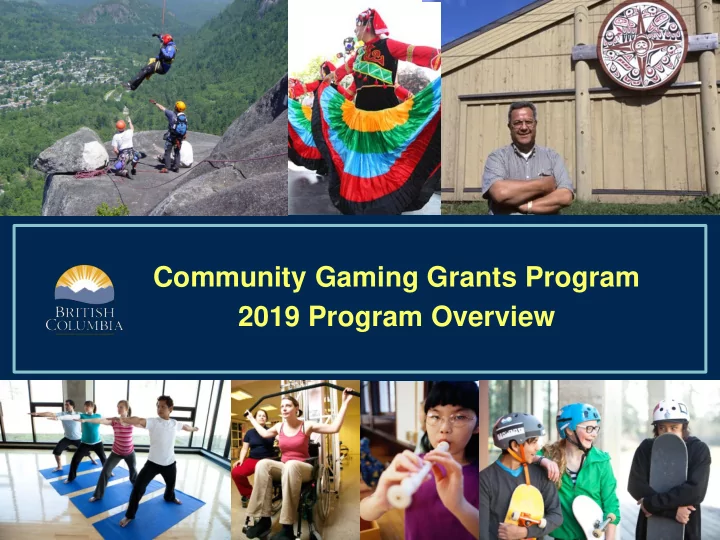
Community Gaming Grants Program 2019 Program Overview Community - - PowerPoint PPT Presentation
Community Gaming Grants Program 2019 Program Overview Community Gaming Grants Program Presentation Overview 1 - Program Essentials 2 - Organization Eligibility 3 - Program Eligibility 4 - Spending the Grant 5 - Financial Eligibility 6 -
New program Guidelines are released every year. All new and returning applicants should review the 2019 Guidelines prior to
$140 MILLION ANNUALLY $135 MILLION for the “Community Gaming Grant Program” to help not- for-profits deliver ongoing programs. $5 MILLION for separate “Capital Project Grant Program” to help not- for-profits with capital projects or acquisitions. Funded with provincial commercial gambling revenue.
Community Gaming Grants 1) Not a competitive grant process. 2) Provide funding to all eligible not-for-profits. 3) Over 90% of applicants receive a grant (2018) 4) Average grant amount is nearly $33,000 (2018) 5) Fund nearly 5000 organizations across the Province.
BC / First Nations Gaming Revenue Sharing
through commercial gambling revenue.
communities will determine their own priorities.
Arts and Culture
galleries, youth arts, fairs and festivals, museums, cultural programs and festivals.
Community Gaming Grants support programming in six unique sectors:
Sport
biking, boating, martial arts), Special Olympics, seniors games.
Environment
education, public education, climate change adaptation, protect domestic animals or wildlife
Human and Social Services
education and outreach, community building, seniors activities and “Service Clubs.”
Public Safety
(biking, hiking, snow trails), disaster relief and emergency preparedness.
PACs and DPACs
Program Delivery Level Maximum Grant Amount Available Per Year Local organizations $100,000 Regional organizations $225,000 Provincial organizations $250,000 Funding levels are not guaranteed The level of funding awarded is based on the size and scope of the programming presented in the application and the demonstrated financial need as shown in the program actuals and budgets.
To be eligible for a grant, an organization must:
Voluntary and broadly-based membership
to board members
2/3 reside in B.C. Volunteers who do not receive remuneration
See Guideline section 3.1 to 3.4 for full eligibility rules.
An organization is ineligible for a grant if it is a:
museums, or recreation centres)
See Guideline section 3.1 to 3.4 for full eligibility rules.
A program is an ongoing service, activity, or series of activities. A program must provide a community benefit, or respond to a community’s needs. A program must be delivered for at least 12 month before it is eligible. Grant funds are not intended to be used for an organization’s core funding.
Eligible programs must: Have been delivered for 12-months. Be directly delivered by the applicant. Be ongoing (not a project) Provide an immediate and direct service. Be accessible Open access where possible Be inclusive No unnecessary restrictions Have a lasting community impact.
Sunshine Arts Council (not-for-profit organization)
Program 2: “Summer Folk Music Festival” Program 1: “Art Display and Gallery Program” Program 3: “Youth Art Lessons”
This example organization has three separate programs; each program has unique activities.
Sunshine Minor Hockey Association (not-for-profit organization)
Program 1: “Amateur Hockey Program (includes all activities and hockey levels provided by organization)”
This example organization includes all their activities in one program, as all program activities are similar.
Include those that:
membership;
funding agreement;
to the community.
See section 4.5 for complete list
Service clubs (Elks, Legions, Kiwanis, Lions, Rotary etc.)
funds to:
Parent Advisory Committees
publications, competitions (writing, debate), societies (drama club), sports equipment, emergency supplies.
Grant funds cover costs essential to the direct delivery of an approved program. Including: Wages of existing paid positions Rent, utilities, and insurance Program supplies, office supplies, internet/phone costs, program advertising Rental or purchase of equipment needed for the direct delivery of the program Travel essential to the direct delivery of the program within B.C.
See section 7.1 to 7.7 for more information
costs (e.g. wages, rent, utilities, supplies) towards a program if the costs are directly related to the program delivery. An employee spends 40% of their time working on an eligible program (museum display), and 60% working on non-eligible programs or
40% of the employee’s wage can be included as a program expense.
Sunshine Arts Council (not-for-profit organization)
Eligible Program 2: “Summer Folk Music Festival” Eligible Program 1: “Art Gallery Program” Eligible Program 3: “Youth Art Lessons” Non-Eligible Core Duties Fundraising, Board work, Grant Writing, Admin Non-Eligible Program “Members-only Lunch”
20% of wage as a program expense. 20% of wage as a program expense. 20% of wage as a program expense.
In addition to regular program funding, you may requests funding for: Minor Capital Project Capital projects under $20,000; Essential for delivery of an approved program; E.G: wheelchair ramp, small renovation. Capital Acquisition Required for delivery of an approved program; Require quotes if over $5000; E.G: computer, equipment, vehicles.
See section 7.2 and 7.3 for more information
Grant funds are deposited into an organization’s “Gaming Account.” – Expenses: All eligible expenses should be paid directly from the Gaming Account.
electronically – from the Gaming Account to the General Account for the reimbursement of eligible program expenses.
– Method: Cheque or board-approved electronic transfer. – Documentation: Invoices and receipts must be retained for five years.
Spending Timelines Forward: Grant funds must be disbursed within 12 months of receipt.
Backward: Grant funds can back-pay expenses incurred in the same fiscal year the grant is received.
Account to the General Account for previously incurred eligible expenses.
See Guideline section 7.7.
Is There a Financial Need?
Grants support stable organizations with a demonstrated financial need to help fund
Applicants must meet specific organization and program financial eligibility criteria to receive a grant. (See Section 5 of the Guidelines) Grant analysts review the organization’s finances - the most recently completed, and current fiscal year - to assess financial need.
An organization is temporarily ineligible for a grant if it:
activities (e.g. 50/50, raffles);
See Section 5.1 for more information
1) Current assets and investments of the organization
2) Divided by (/) previous fiscal year’s operating expenses; multiplied by (x) 100 Equals (=) organization surplus percentage The Branch determines financial need by assessing cash-on-hand proportionate to expenses. The following formula is used to determine available cash-on-hand:
Note:
In addition to organization financials, separate financials are also required for each “program.” Program financial rules:
sources, including
See section 5.2 for more information
The application requires the following financial documents:
Balance Sheet Most Recently Completed Fiscal Year Program Revenue and Expense Statement (Actuals) Most recently completed fiscal year Program Budget Current Fiscal Year
In-Kind (volunteer) Contribution Summary, if applicable
Organization Revenue and Expense Statement (Actuals) Most Recently Completed Fiscal Year Organization Budget Current Fiscal Year
Our website has examples of all five financial documents. This picture shows an example of program financials
Statement (Actuals)
– Revenues clearly identified – In-kind (volunteer) labour included.
In-kind support may be included as part of an organization’s financials. This includes volunteer time, donated labour, equipment, services
expense, so the amounts balance to zero.
contribution summary” (Example on
See section 5.3 for more information
Arts and Culture (new dates)
Environment
Human and Social Services
Sport (new dates)
Public Safety
PACs and DPACs
Apply online on our website Paper applications are not accepted Before Applying Review the Program Guidelines and/or the resources on
Pre-application checklists Sample financial statements Frequently asked questions Application tutorials
conditions in Appendix VIII.
grant application is considered.
assistance provided by the Province in any program materials by displaying the following written acknowledgement: – “We acknowledge the financial support
The key financial reporting tool is the “Gaming Account Summary Report (GASR).”
All organizations that receive Community Gaming Grants, or have previously received a grant and still have money in their Gaming Account, must submit a GASR. Must be submitted within 90 days of the organization’s fiscal year end. The GASR details: “Gaming Account” balance at beginning of fiscal year; grants received; funds disbursed; and balance at end of fiscal year, GASR also requires a 300-word max description of how the community benefited from the programs/services supported by Community Gaming Grants.
“Gaming Account Summary Report (GASR).”
GASRs in order to receive another Community Gaming Grant or Capital Project Grant.
funding is only used on eligible expenses.
Read the most recent Program Guidelines Review the Pre- Application Checklists Save all required information as Word/PDF for easy upload If relevant, read your previous year notification letter If relevant, include a cover letter that addresses the previous notification letter. Apply as early as
are processed in order received.
1) MAH website (http://gov.bc.ca/gaminggrants) 2) Community Gaming Grants Branch
communitygaminggrants@gov.bc.ca, or call 1-800-663-7867
CGGOutreach@gov.bc.ca 3) BCACG – British Columbia Association of Charitable Gaming (http://bcacg.com/) 4) BCAAFC – British Columbia Association of Aboriginal Friendship Centers (https://www.bcaafc.com/)
CCGAs receive grants to help local non-profits Dawson Creek – Northern Lights CCGA
http://northernlightsgaming.ca/
Prince George – Northern Interior CCGA
http://www.northernica.org/
Kelowna – Central Okanagan CCGA
http://cocga.com/
Chilliwack – Fraser Valley CCGA
https://fvccga.com/
Victoria – Charity Works CCGA
http://charityworks.ca/
Comox – Valley CCGA
www.valleycharitablegamingsociety.com
Vancouver – BCACG
http://bcacg.com