
SLIDE 1
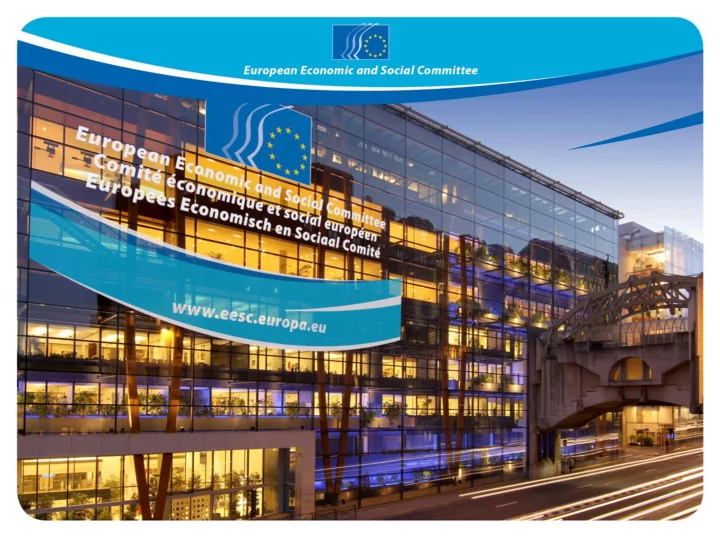
What is the EESC? A consultative body that represents Civil Society - - PowerPoint PPT Presentation
What is the EESC? A consultative body that represents Civil Society The European Parliament, the Council and the Commission shall be assisted by an Economic and Social Committee and a Committee of the Regions acting in an advisory capacity .
A consultative body that represents Civil Society
“The European Parliament, the Council and the Commission shall be assisted by an Economic and Social Committee and a Committee of the Regions acting in an advisory capacity.”
Treaty on European Union, Art. 13
European Commission Council
European Parliament
Treaties
develops the EESC’s role
inspired the Community Charter of Fundamental Social Rights
scope of EESC consultations
the right to be consulted by the European Parliament
range of policy areas on which the EESC must be consulted
democracy alongside representative democracy, the Lisbon Treaty strengthens the EESC's role as intermediary between organised civil society and EU decision-makers.
Number of EESC Members by country
9
acronym of CCMI, Commission consultative des mutations industrielles) examines changes in industry across a wide range of sectors, keeping pace and tackling them according to the values of the European economic and social model.
Coal and Steel Community) when the latter expired on 23 July 2002. It is established as a distinct body within the EESC and has a remit extended to all sectors of industry in both manufacturing and services.
Indigenous coal in the EU energy transition The processing and exploitation, for economic and environmental purposes of the industrial and mining waste deposits from European Union Secondary raw materials Tackling the challenges in commodity markets and on raw materials The raw materials initiative: needs for growth and jobs in Europe Non-energy mining industry in Europe
Opinions of EESC related with the mining policies
Source: European Commission
Share of electricity from coal in the generation fuel mix
Source: Energy Community
National Power System
about 2%
Romania's electricity production
EESC - European Economic and Social Committee
@EU_EESC EurEcoSocCommittee