What is an Operating System? Three views of an operating system - - PowerPoint PPT Presentation

what is an operating system three views of an operating
SMART_READER_LITE
LIVE PREVIEW

What is an Operating System? Three views of an operating system - - PowerPoint PPT Presentation

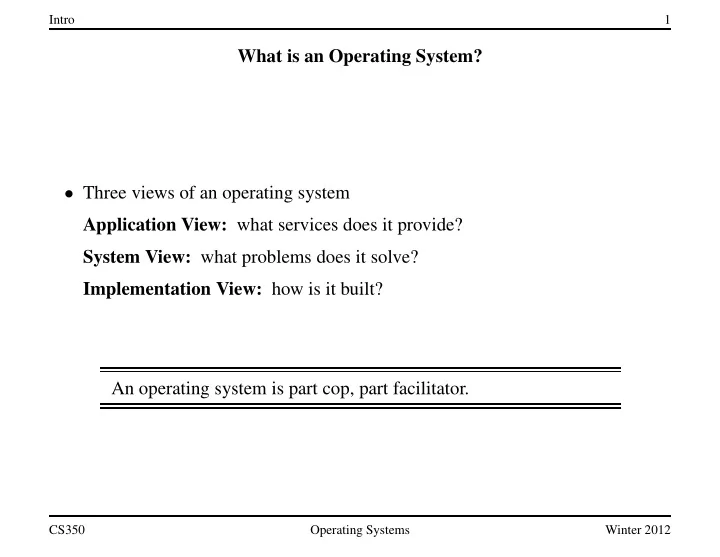
Intro 1 What is an Operating System? Three views of an operating system Application View: what services does it provide? System View: what problems does it solve? Implementation View: how is it built? An operating system is part cop, part


slide-1
SLIDE 1

Intro 1

What is an Operating System?

  • Three views of an operating system

Application View: what services does it provide? System View: what problems does it solve? Implementation View: how is it built? An operating system is part cop, part facilitator.

CS350 Operating Systems Winter 2012

slide-2
SLIDE 2

Intro 2

Application View of an Operating System

  • The OS provides an execution environment for running programs.

– The execution environment provides a program with the processor time and memory space that it needs to run. – The execution environment provides interfaces through which a program can use networks, storage, I/O devices, and other system hardware components. ∗ Interfaces provide a simplified, abstract view of hardware to application programs. – The execution environment isolates running programs from one another and prevents undesirable interactions among them.

CS350 Operating Systems Winter 2012

slide-3
SLIDE 3

Intro 3

Other Views of an Operating System System View: The OS manages the hardware resources of a computer system.

  • Resources include processors, memory, disks and other storage devices,

network interfaces, I/O devices such as keyboards, mice and monitors, and so on.

  • The operating system allocates resources among running programs. It

controls the sharing of resources among programs.

  • The OS itself also uses resources, which it must share with application

programs. Implementation View: The OS is a concurrent, real-time program.

  • Concurrency arises naturally in an OS when it supports concurrent

applications, and because it must interact directly with the hardware.

  • Hardware interactions also impose timing constraints.

CS350 Operating Systems Winter 2012

slide-4
SLIDE 4

Intro 4

The Operating System and the Kernel

  • Some terminology:

kernel: The operating system kernel is the part of the operating system that responds to system calls, interrupts and exceptions.

  • perating system: The operating system as a whole includes the kernel, and

may include other related programs that provide services for applications. This may include things like: – utility programs – command interpreters – programming libraries

CS350 Operating Systems Winter 2012

slide-5
SLIDE 5

Intro 5

Schematic View of an Operating System

Operating System data and interrupts commands system calls system call and data results Resources User Programs system call interface kernel user−space Kernel

CS350 Operating Systems Winter 2012

slide-6
SLIDE 6

Intro 6

Operating System Abstractions

  • The execution environment provided by the OS includes a variety of abstract

entities that can be manipulated by a running program. Examples: files and file systems: abstract view of secondary storage address spaces: abstract view of primary memory processes, threads: abstract view of program execution sockets, pipes: abstract view of network or other message channels

  • This course will cover

– why these abstractions are designed the way they are – how these abstractions are manipulated by application programs – how these abstractions are implemented by the OS

CS350 Operating Systems Winter 2012

slide-7
SLIDE 7

Intro 7

Course Outline

  • Introduction
  • Threads and Concurrency
  • Synchronization
  • Processes and the Kernel
  • Virtual Memory
  • Scheduling
  • Devices and Device Management
  • File Systems
  • Interprocess Communication and Networking (time permitting)

CS350 Operating Systems Winter 2012