What is Alzheimers Disease? A progressive disease, notorious for - - PowerPoint PPT Presentation

what is alzheimer s disease
SMART_READER_LITE
LIVE PREVIEW

What is Alzheimers Disease? A progressive disease, notorious for - - PowerPoint PPT Presentation

Current Tetra-Gelatin Tetra-Gelatin Alzheimers Consequences Alzheimers Magnetic Magnetic Disease of TeGMaC Treatments Carrier: I Carrier: II What is Alzheimers Disease? A progressive disease, notorious for its incurable


slide-1
SLIDE 1

Alzheimer’s Disease Current Alzheimer’s Treatments Tetra-Gelatin Magnetic Carrier: I Tetra-Gelatin Magnetic Carrier: II Consequences

  • f TeGMaC

What is Alzheimer’s Disease?

  • A progressive disease, notorious for its incurable

nature and devastating impact on the elderly

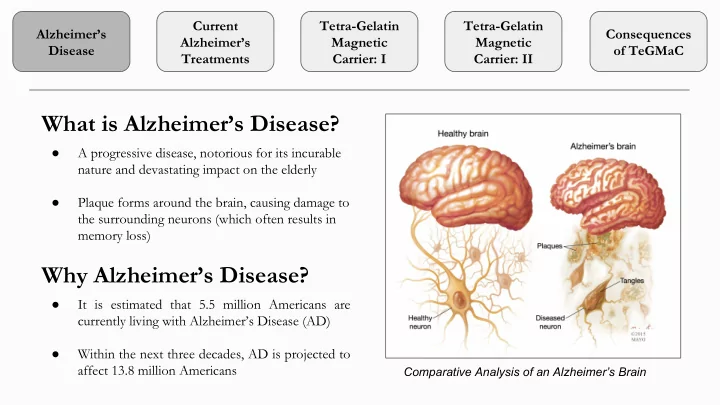
  • Plaque forms around the brain, causing damage to

the surrounding neurons (which often results in memory loss)

Why Alzheimer’s Disease?

  • It is estimated that 5.5 million Americans are

currently living with Alzheimer’s Disease (AD)

  • Within the next three decades, AD is projected to

affect 13.8 million Americans

Comparative Analysis of an Alzheimer’s Brain

slide-2
SLIDE 2

Alzheimer’s Disease Current Alzheimer’s Treatments Tetra-Gelatin Magnetic Carrier: I Tetra-Gelatin Magnetic Carrier: II Consequences

  • f TeGMaC

Nanotechnology and Alzheimer’s:

  • Used in the early detection of Alzheimer’s disease through the

identification of biomarkers in the blood

  • Utilized as nanocarriers to deliver therapeutic treatments in a

non-invasive and non-toxic manner

  • Applied as scaffolds for on-site neural tissue regrowth and surfaces

for stem cell culturing

Risks and Problems:

  • Current nanotechnology does not take into account the Blood

Brain Barrier (BBB) and fails to address AD’s specialized nature

The Use of Nanotechnology in a Standard Laboratory Setting

slide-3
SLIDE 3

Alzheimer’s Disease Current Alzheimer’s Treatments Tetra-Gelatin Magnetic Carrier: I Tetra-Gelatin Magnetic Carrier: II Consequences

  • f TeGMaC

inhibits the progression of tau tangles by using Kinase-3β

Tetra Gelatin Magnetic Carrier (TeGMaC): A Novel Treatment for Alzheimer’s Disease

works chemically to remove plaque by using the HEPPS molecules monitors, records, and sends information to a patient’s neurologist regarding TeGMaC’s effectiveness delivers stem cells to the sites

  • f degenerated neurons where

they are differentiated as neurons and transplanted throughout the brain harnesses the properties of magnetism to attract and repel the four gelatin carriers

slide-4
SLIDE 4

Alzheimer’s Disease Current Alzheimer’s Treatments Tetra-Gelatin Magnetic Carrier: I Tetra-Gelatin Magnetic Carrier: II Consequences

  • f TeGMaC

The Delivery

  • In order to pass the blood brain barrier, TeGMaC is administered

through the olfactory mucosa which gives it direct access to the brain

  • These gelatin nanocarriers, being biocompatible, are able to pass

through the olfactory mucosa directly to the central nervous system and dissolve in the bloodstream

The introduction of TeGMaC into the body intranasally, bypassing the blood brain barrier. TeGMaC separates into four individual components to perform their respective functions.

slide-5
SLIDE 5

Alzheimer’s Disease Current Alzheimer’s Treatments Tetra-Gelatin Magnetic Carrier: I Tetra-Gelatin Magnetic Carrier: II Consequences

  • f TeGMaC

Consequences of TeGMaC:

  • Can drastically improve the quality and quantity of life for

Alzheimer’s patients worldwide

  • TeGMaC fails to chemically remove current tau tangles and can only

prevent their formation in the future

  • TeGMaC may run into complications with the immune system in the

form of stem cell rejection

  • Adaptable method for applications in other neurodegenerative

diseases and research ○ Parkinson’s Disease; ■ TeGMaC could carry dopamine and stem cells, rather than HEPPs and Kinase-3

Civil rights activist, Rosa Parks, suffered from Alzheimer’s Disease. With the application of our technology, people around the world affected by the same illness as Rosa Parks will be able to live longer and healthier lives, revolutionizing the treatment of Alzheimer’s.