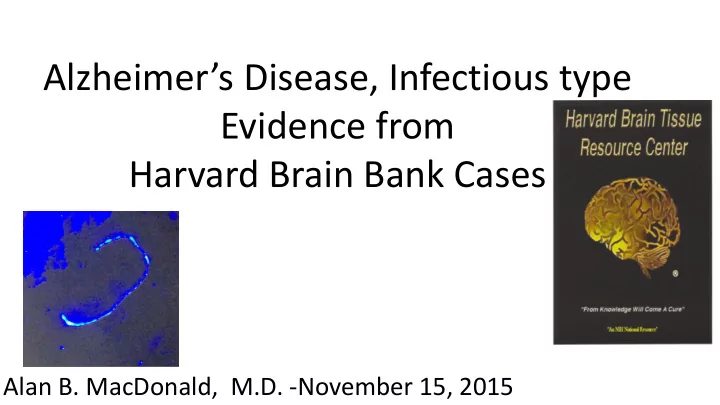
Alzheimer s Disease, Infectious type Evidence from Harvard Brain - - PowerPoint PPT Presentation

alzheimer s disease infectious type
SMART_READER_LITE
LIVE PREVIEW

Alzheimer s Disease, Infectious type Evidence from Harvard Brain - - PowerPoint PPT Presentation

Alzheimer s Disease, Infectious type Evidence from Harvard Brain Bank Cases Alan B. MacDonald, M.D. -November 15, 2015 1. Comprehend the naissance of the idea that Alzheimer's Disease is the Borrelia equivalent of: Dr. Hideyo


slide-1
SLIDE 1

Alzheimer’s Disease, Infectious type Evidence from Harvard Brain Bank Cases

Alan B. MacDonald, M.D. -November 15, 2015

slide-2
SLIDE 2
  • 1. Comprehend the

naissance of the idea that Alzheimer's Disease is the Borrelia equivalent of:

  • Dr. Hideyo Noguchi's

solution to the etiology of syphilitic Dementia ( General Paresis) in very late ( Tertiary Syphilis) – as proven in year 1913

slide-3
SLIDE 3
  • 2. Comprehend the historical overview of pathology

evidence linking Chronic Deep Brain Borrelia infections with development of future Alzheimer's Disease

slide-4
SLIDE 4
  • 3. Comprehend the ancillary research dating from year 1986 :

vis: pure culture of borrelia spirochetes from Alzheimer's Autopsy Fresh Frozen Brain tissues.

slide-5
SLIDE 5
  • 4. Comprehend the evidence for detection of Bacterial cell

products in the Alzheimer's Amyloid Plaques by Dr. Judith Miklossy

slide-6
SLIDE 6
  • 5. Comprehend the evidence for Bacterial produced Amyloid

inside of the Amyloid Plaques of Alzheimer's Disease

host reaction to that occurring in AD could be induced by infectious agents, we

exposed mammalian glial and neuronal cells in vitro to Borrelia burgdorferi spirochetes and to the inflammatory

bacterial lipopolysaccharide (LPS). Morphological changes

analogous to the amyloid deposits of AD brain were observed following 2–8 weeks of exposure to the spirochetes. Increased levels of β-amyloid precursor protein AβPP and

hyperphosphorylated tau were also detected by Western blots of extracts of cultured cells that had been treated with spirochetes or LPS. These observations indicate that, by exposure to

bacteria or to their toxic products, host responses similar in nature to those observed in AD may be induced.

slide-7
SLIDE 7
  • 6. Comprehend the linkage Granulo-vacuolar Degeneration products inside
  • f Dying neurons ( GVB deposits) by In situ DNA Hybridization using

Borrelia burgdorferi specific Molecular Beacon DNA probes, and also using linear/planar type Borrelia Flagellin B Dna Probes in Alzheimer's Autopsy Tissues.

slide-8
SLIDE 8
  • 7. Review individual Clinical Case studies of Lyme/Borreliosis Dementia

which were treated with long term high dose Intravenous antibiotics and which demonstrated objective Return of Dementia patients with Alzheimer's Disease to a normal or much improved Cognitive Status using detailed Neurocognitive Testing of patients before and following Parenteral Antibiotic therapies.

slide-9
SLIDE 9
  • 8. Comprehend the Eradication of spirochetal induced dementia due to

late Syphilis ( General Paresis of the Insane) with High dose Penicillin Therapies after year 1945, and the worldwide eradication of Syphilis Dementias since the end of World War 2, and the release of Penicillin to the civilian physicians who treated Syphilis Dementias with Penicillin.

The Lancet Volume 292, Issue 7583, 28 December 1968, Pages 1370–1371 Originally published as Volume 2, Issue 7583

PROGNOSIS OF GENERAL PARESIS AFTER TREATMENT

E Wilner, M.D. George Washington, J.A Brody, M.D. New York State

slide-10
SLIDE 10
slide-11
SLIDE 11
slide-12
SLIDE 12
slide-13
SLIDE 13
slide-14
SLIDE 14
slide-15
SLIDE 15
slide-16
SLIDE 16
slide-17
SLIDE 17
slide-18
SLIDE 18