
1
A Scientific Update on Alzheimer’s Disease: Etiology, Diagnosis and Treatment
Mark W. Bondi, Ph.D., ABPP/CN
Professor of Psychiatry UC San Diego School of Medicine Director, Neuropsychological Assessment Unit VA San Diego Healthcare System
Research was supported by NIA grants P50 AG05131, R01 AG049810 & K24 AG026431. Dr. Bondi has received financial support from Oxford Univ Press, Takeda Pharmaceutical Co. and Novartis Pharmaceutical Co. There are no other financial disclosures to report.
NAMS Annual Conference Thursday, October 4th, 2018, 11:50 am – 12:10 pm
Alzheimers Disease
Auguste D.
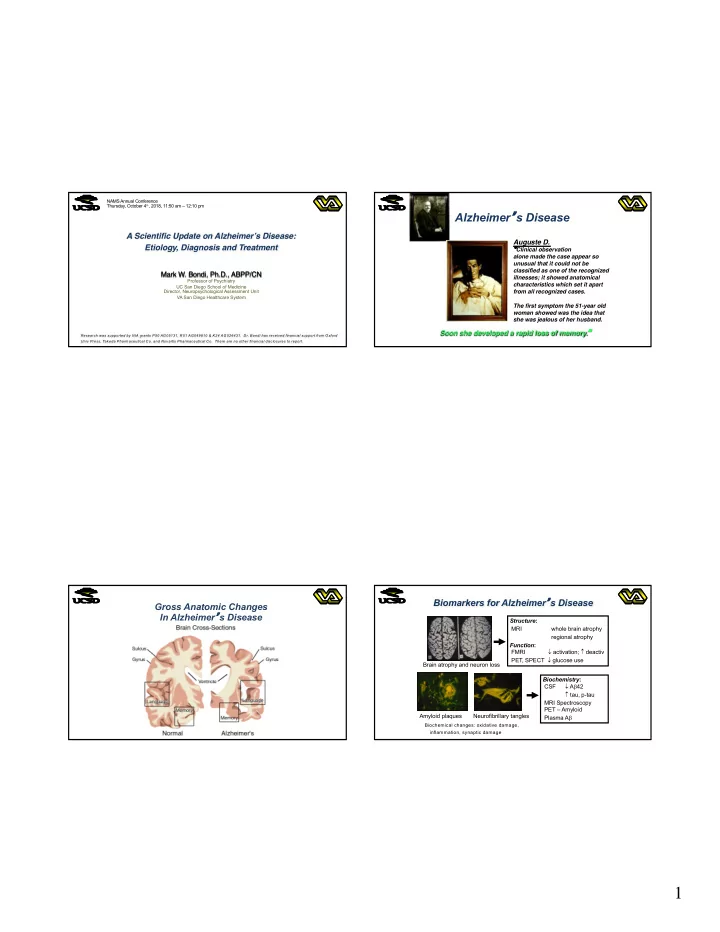
Clinical observation alone made the case appear so unusual that it could not be classified as one of the recognized illnesses; it showed anatomical characteristics which set it apart from all recognized cases. The first symptom the 51-year old woman showed was the idea that she was jealous of her husband.
Soon she developed a rapid loss of memory.
Gross Anatomic Changes In Alzheimers Disease
Neurofibrillary tangles Amyloid plaques Brain atrophy and neuron loss Structure: MRI whole brain atrophy regional atrophy Function: FMRI ¯ activation; deactiv PET, SPECT ¯ glucose use
Biochemical changes: oxidative damage, inflammation, synaptic damage
Biochemistry: CSF ¯ Ab42 tau, p-tau MRI Spectroscopy PET – Amyloid Plasma Ab