What is a TPN? To ensure safe, optimal execution, the control - - PDF document

what is a tpn
SMART_READER_LITE
LIVE PREVIEW

What is a TPN? To ensure safe, optimal execution, the control - - PDF document

Goals Autonomous Robust Execution of Complex Robotic Missions Paul Robertson, Robert T. Effinger, Brian C. Williams 1. Enable development of complex missions with MERS, CSAIL, MIT (papers on http://mers.mit.edu) contingencies (Complexity) 2.


slide-1
SLIDE 1

1

Autonomous Robust Execution of Complex Robotic Missions Paul Robertson, Robert T. Effinger, Brian C. Williams

MERS, CSAIL, MIT (papers on http://mers.mit.edu)

Goals

  • 1. Enable development of complex missions with

contingencies (Complexity)

  • 2. Provide robustness to component, temporal, and

contingency failure (Robustness)

  • 3. Support online optimal temporal planning with

contingencies (Optimality)

What I won’t talk about

  • 1. Health Management/Maintenance
  • 2. Mapping/localization
  • 3. Path Planning
  • 4. Distribution over multiple robots
  • 5. Algorithms for Performance
  • 6. Generative Activity Planner

Model-based Programming

  • Suspicious
  • Monitors intentions and plans
  • Self-Adaptive
  • Exploits and generates

contingencies

  • State and Fault Aware
  • Specified at level of states.
  • Achieved using failure knowledge.
  • Anticipatory

– Plans and verifies into the future – Predicts likely future states – Plans contingencies “RMPL” reactive Model-Based Programming Language

S Services and Hardware Obs Cntrl

Model-based Embedded Programs

S

Continuous Reactive Commanding Continuous Mode/State Estimation Model

Lazy Activity Scheduling

Model-predictive Method Selection

RMPL Activity Planning Observation Planning Path Planning Mapping Health Management Temporal Planning

Model-Predictive Method Selection

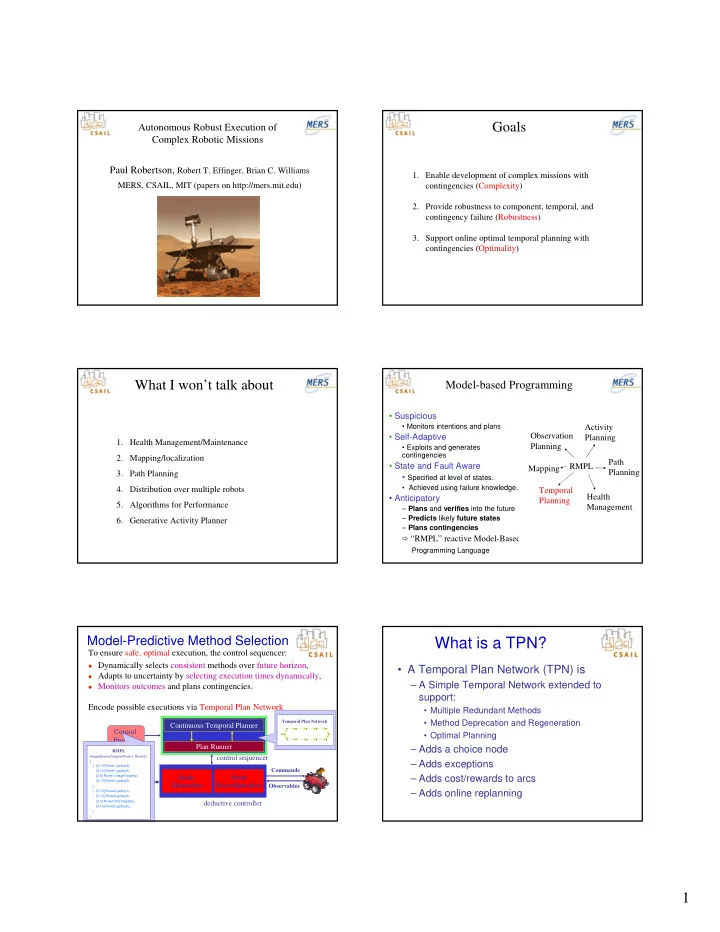
To ensure safe, optimal execution, the control sequencer:

Dynamically selects consistent methods over future horizon, Adapts to uncertainty by selecting execution times dynamically, Monitors outcomes and plans contingencies.

Encode possible executions via Temporal Plan Network

Continuous Temporal Planner Control Program

Commands Observables

Mode Estimation Mode Reconfiguration

Model of Subsystems Plan Runner

RMPL

imageScienceTargets(Rover1, Rover2) { { [5,10] Rover1.goto(p4); [5,10] Rover1.goto(p5); [2,5] Rover1.imageTargets(); [5,10] Rover1.goto(p3); }, { [5,10] Rover2.goto(p1); [5,10] Rover2.goto(p2); [2,5] Rover2.findTargets(); [5,10] Rover2.goto(p3); } }

Temporal Plan Network

control sequencer deductive controller

What is a TPN?

  • A Temporal Plan Network (TPN) is

– A Simple Temporal Network extended to support:

  • Multiple Redundant Methods
  • Method Deprecation and Regeneration
  • Optimal Planning

– Adds a choice node – Adds exceptions – Adds cost/rewards to arcs – Adds online replanning

slide-2
SLIDE 2

2

Temporal Planner Block Diagram

TPN RMPL RMPL Compiler TPN Macro Library Algorithm Nexus Common Data Repository Suite of Algorithms FIFO SSSP SDSP APSP Kernel

Initialize Mission Temporal Consistency Check Tell Consistency Check Ask Consistency Check Location Consistency Check Macro Expansion Exception Handling

Executive

TPN updates plan updates exceptions processed TPN data TPN data TPN data

CSP

Variables and Domains Constraints

Dynamic Optimal CSP Solver

CSP problem updates partial solutions

Temporal Planner Block Diagram

TPN RMPL RMPL Compiler TPN Macro Library Algorithm Nexus Common Data Repository Suite of Algorithms FIFO SSSP SDSP APSP Kernel

Initialize Mission Temporal Consistency Check Tell Consistency Check Ask Consistency Check Location Consistency Check Macro Expansion Exception Handling

Executive

TPN updates plan updates exceptions processed TPN data TPN data TPN data

CSP

Variables and Domains Constraints

Dynamic Optimal CSP Solver

CSP problem updates partial solutions

Mission Specification Dynamic OCSP Kernel TPN

Architecture Walkthrough

RMPL RMPL Compiler TPN Macro Library

1.The human writes a mission program in RMPL. 2.The RMPL Compiler compiles the RMPL code and populates a library of TPN specifications. This library contains the main program, along with any macros that may be called.

Architecture Walkthrough

TPN Macro Library Kernel

Initialize Mission Temporal Consistency Check Tell Consistency Check Ask Consistency Check Location Consistency Check Macro Expansion Exception Handling

The Kernel connects the specification, TPN, and CSP parts of the system, translating data so that these sub- systems can work together. The Kernel contains a variety of modules that it uses to update the TPN and CSP.

Reformulating the TPN into a conditional optimal CSP

  • Step 1:

– Walk the TPN and create variables and constraints corresponding to the decision nodes

  • Step 2:

– Create variables and constraints corresponding to the non-causal link constraint arcs (these come from arbitrary temporal constraints)

Tell(A=y) Tell(A=x)

Initialize: Reformulate TPN into CSP

Tell(B=x) Tell(B=y) Ask(B=x) Start

End

Step 1: Walk the TPN and create variables corresponding to the decision nodes V1={ } VI={V1} V2={ , } V3={ , } V4={ , } V2 V3 V4

Initial Variables Variables Constraints

initialize

slide-3
SLIDE 3

3

Initialize: Reformulate TPN into CSP

Start End

Step 2: Create variables and constraints corresponding to the non-causal link constraint arcs V1={ } VI={V1} V2={ , } V3={ , } V4={ , } V2 V3 V4

Initial Variables Variables Constraints

V5={ } V5 V6={ } V6

initialize

Architecture Walkthrough

TPN RMPL RMPL Compiler TPN Macro Library Algorithm Nexus Common Data Repository Suite of Algorithms FIFO SSSP SDSP APSP Kernel

Initialize Mission Temporal Consistency Check Tell Consistency Check Ask Consistency Check Location Consistency Check Macro Expansion Exception Handling

Executive

TPN updates plan updates exceptions processed TPN data TPN data TPN data

CSP

Variables and Domains Constraints

Dynamic Optimal CSP Solver

CSP problem updates partial solutions

The CSP solver finds a solution or partial solution to the CSP problem, and passes it back to the Kernel for analysis.

Architecture Walkthrough

TPN Kernel

Initialize Mission Temporal Consistency Check Tell Consistency Check Ask Consistency Check Location Consistency Check Macro Expansion Exception Handling

TPN updates TPN data

CSP

Variables and Domains Constraints

Dynamic Optimal CSP Solver

CSP problem updates partial solutions

The first analysis kernel module is Temporal Consistency Check.

When the CSP solver returns a partial solution to the Kernel, the Kernel analyzes the partial solution. Each analysis module may generate additional TPN nodes & arc, as well as additional CSP variables and constraints.

Solution Analysis: Temporal Consistency Check

Start End

V1={ } VI={V1} V2={ , } V3={ , } V4={ , } V2 V3 V4

Initial Variables Variables Constraints

V5={ } V5 V6={ } V6

TC Check

Partial Solution

V1={ } V2={ } V3={ } If the temporal consistency checking algorithm detects a negative cycle, the conjunction of variable assignments that contributes to the negative cycle become a new conflict constraint.

Solution Analysis: Tell Consistency Check

Start End

V1={ } VI={V1} V2={ , } V3={ , } V4={ , } V2 V3 V4

Initial Variables Variables Constraints

V5={ } V5 V6={ } V6

Tell(A=y) Tell(A=x)

V7={ , } V7

Tell(B=x) Tell(B=y)

Tell Consist Check

Partial Solution

V1={ } V2={ } V6={ } Possible Overlap!! Tell Consistency Check ensures that any potentially co-occuring mutually exclusive Tells are ordered so they do not co-occur.

Solution Analysis: Tell Consistency Check

Start End

V1={ } VI={V1} V2={ , } V3={ , } V4={ , } V2 V3 V4

Initial Variables Variables Constraints

V5={ } V5 V6={ } V6

Tell(A=y) Tell(A=x)

V7={ , } V7

Tell Consist Check

Partial Solution

V1={ } V2={ } V6={ } The CSP is updated with a new variable and constraint The TPN is updated with two new conflict avoidance arcs

slide-4
SLIDE 4

4

Tell(B=y)

Solution Analysis: Ask Consistency Check

Start End

V1={ } VI={V1} V2={ , } V3={ , } V4={ , } V2 V3 V4

Initial Variables Variables Constraints

V5={ } V5 V6={ } V6

Tell(A=y) Tell(A=x)

V7={ , } V7

Tell(B=x) Ask(B=x)

Ask Consistency Check

Partial Solution

V1={ } Phase 1: Create Ask Variables Phase 2: Populate Ask Domains V8 V8={ } When we detect an Ask, we create a new CSP variable.

The Ask variable’s domain is empty, because we have not yet identified any satisfying Tells

  • V8={ }

Tell(B=y)

Solution Analysis: Ask Consistency Check

Start End

V1={ } VI={V1} V2={ , } V3={ , } V4={ , } V2 V3 V4

Initial Variables Variables Constraints

V5={ } V5 V6={ } V6

Tell(A=y) Tell(A=x)

V7={ , } V7

Tell(B=x) Ask(B=x)

V8

Ask Consistency Check

Partial Solution

V1={ } V4={ } Phase 1: Create Ask Variables Phase 2: Populate Ask Domains

When a Tell is detected that could satisfy an Ask, containment arcs are added to the TPN, and a domain assignment is added to the Ask’s CSP variable.

Location Consistency

Summary:

– Location Consistency must ensure that mutex location constraints can be ordered (like Tell Consistency) – Location Consistency must add time-bounds that guarantee feasible travel-time exists between temporally-adjacent location constraints

Tell ( location = A ) Tell ( location = B ) Tell ( location = C )

[time(A,B),+INF] [time(B,C),+INF]

Architecture Walkthrough

TPN Kernel

Initialize Mission Temporal Consistency Check Tell Consistency Check Ask Consistency Check Location Consistency Check Macro Expansion Exception Handling

TPN updates TPN data

CSP

Variables and Domains Constraints

Dynamic CSP Solver

CSP problem updates partial solutions

During execution, a primitive activity may fail, triggering an exception and replanning. Before replanning occurs, the Exception Handling module must process the executive’s exception.

Executive

plan updates exceptions

The exception handler interacts with the TPN, the CSP, and the executive.

  • V8={ }

Tell(B=y)

Solution Analysis: Exception Handling

Start End

V1={ } VI={V1} V2={ , } V3={ , } V4={ , } V2 V3 V4

Initial Variables Variables Constraints

V5={ } V5 V6={ } V6

Tell(A=y) Tell(A=x)

V7={ , } V7

Tell(B=x) Ask(B=x)

V8

Ask Consistency Check

  • 1. Execution begins…
  • 2. An error occurs, and an exception is thrown

Partial Solution

V1={ } V4={ } V2={ } V5={ } V3={ } V8={ } EXCEPTION

Solution Analysis: Exception Handling

Ask Consistency Check

  • 1. Execution begins…
  • 2. An error occurs, and an exception is thrown
  • 3. The exception-handling code is inserted

EXCEPTION

handler delay The handler is the TPN sub-process corresponding to the RMPL “catch” statement that matches the thrown exception The delay represents the amount of time spent in the original process before the exception was thrown, plus an upper-bound on replanning time

slide-5
SLIDE 5

5

  • V8={ }

Tell(B=y)

Solution Analysis: Exception Handling

Start End

V1={ } VI={V1} V2={ , } V3={ , } V4={ , } V2 V3 V4

Initial Variables Variables Constraints

V5={ } V5 V6={ } V6 V7={ , } V7

Tell(B=x) Ask(B=x)

V8

Ask Consistency Check

Partial Solution

V1={ } V4={ } V2={ } V5={ } V3={ } V8={ } EXCEPTION

  • 1. Execution begins…
  • 2. An error occurs, and an exception is thrown
  • 3. The exception-handling code is inserted
  • 4. Replanning begins, pre-selecting anything

that has already been executed

Execution

TPN RMPL RMPL Compiler TPN Macro Library Algorithm Nexus Common Data Repository Suite of Algorithms FIFO SSSP SDSP APSP Kernel

Initialize Mission Temporal Consistency Check Tell Consistency Check Ask Consistency Check Location Consistency Check Macro Expansion Exception Handling

Executive

TPN updates plan updates exceptions processed TPN data TPN data TPN data

CSP

Variables and Domains Constraints

Dynamic CSP Solver

CSP problem updates partial solutions

When the CSP solver generates a complete solution and none of the kernel modules generate additional constraints or variables, the TPN associated with the solution is sent as output to the executive.

Temporal Plan Network Represents Possible Threads of Execution

Start End Rover1.goto(p4) Rover2.goto(p1) Rover1.imageTargets Rover1.goto(p5) Rover1.goto(p3) Rover2.goto(p2) Rover2.imageTargets Rover2.goto(p3)

imageScienceTargets(Rover1, Rover2) { { [5,10] Rover1.goto(p4); [5,10] Rover1.goto(p5); [2,5] Rover1.imageTargets(); [5,10] Rover1.goto(p3); }, { [5,10] Rover2.goto(p1); [5,10]Rover2.imageTargets(); [2,5] Rover2.goto(p2); [5,10] Rover2.goto(p3); } }

p1 p2 p3 p4 p5

1 2

[5,10] [5,10] [2,5] [5,10] [5,10] [5,10] [2,5] [5,10]

2 1

Choice Nodes Represent Decision Theoretic Choices Between Threads of Execution

Start End

Rover1.goto(p4) Rover2.goto(p1) Rover1.imageTargets Rover1.goto(p5) Rover1.goto(p3) imageScienceTargets(Rover1, Rover2) {{ [5,10] Rover1.goto(p4); choose { { [5,10] Rover1.goto(p5); [2,5] Rover1.imageTargets(); } { [2,5] Rover1.imageTargets(); [5,10] Rover1.goto(p5); } }; [5,10] Rover1.goto(p3); }, { [5,10] Rover2.goto(p1); choose { { [5,10] Rover2.goto(p2); [2,5] Rover2.findTargets(); } { [2,5] Rover2.imageTargets(); [5,10] Rover2.goto(p2); [5,10] Rover2.goto(p3); } } }

p1 p2 p3 p4 p5

1 2

Rover1.goto(p5) Rover1.imageTargets Rover2.goto(p2) Rover2.imageTargets Rover2.goto(p3) Rover2.goto(p2) Rover2.goto(p3) Rover2.imageTargets

Maintenance and Success Conditions Specified via Asks

Start End

Rover1.goto(p4) Rover2.goto(p1) Rover1.imageTargets Rover1.goto(p5) Rover1.goto(p3) imageScienceTargets(Rover1, Rover2) { { [5,10] Rover1.goto(p4); choose { { do { [5,10] Rover1.goto(p5); } maintaining( site1 = ¬ obstructed); [2,5] Rover1.imageTargets(); } { [2,5] Rover1.imageTargets(); [5,10] Rover1.goto(p5); } }; [5,10] Rover1.goto(p3); }, { [5,10] Rover2.goto(p1); choose { { do { [2,5 ]Rover2.imageTargets(); } maintaining ( site1 = ¬ obstructed); [5,10] Rover2.goto(p2); [5,10] Rover2.goto(p3); } { [5,10] Rover2.goto(p2); [5,10] Rover2.goto(p3); [2,5] Rover2.imageTargets(); } } }

p1 p2 p3 p4 p5

1 2

Rover1.goto(p5) Rover1.imageTargets Rover2.goto(p2) Rover2.imageTargets Rover2.goto(p3) Rover2.goto(p2) Rover2.goto(p3) Rover2.imageTargets Ask site1 = ¬ obstructed Ask site1 = ¬ obstructed Tell site1 = ¬ obstructed

Restoration of Functional States After Failure Achieved Via Catch and Throw

Start End

Rover1.goto(p4) Rover2.goto(p1) Rover1.imageTargets Rover1.goto(p5) Rover1.goto(p3)

p1 p2 p3 p4 p5

1 2

Rover1.goto(p5) Rover1.imageTargets Rover2.goto(p2) Rover2.imageTargets Rover2.goto(p3) Rover2.goto(p2) Rover2.goto(p3) Rover2.imageTargets Ask site1 = ¬ obstructed Ask site1 = ¬ obstructed

Failure

Throw: Type: imageTargets Reason: site1 = obstructed

Tell site1 = ¬ obstructed

  • bstructed

imageScienceTargets(Rover1, Rover2) { { [5,10] Rover1.goto(p4); choose { { do { [5,10] Rover1.goto(p5); } maintaining( site1 = ¬ obstructed); [2,5] Rover1.imageTargets(); } { [2,5] Rover1.imageTargets(); [5,10] Rover1.goto(p5); } }; [5,10] Rover1.goto(p3); }, { [5,10] Rover2.goto(p1); choose { { do { [2,5 ]Rover2.imageTargets(); } maintaining ( site1 = ¬ obstructed); [5,10] Rover2.goto(p2); [5,10] Rover2.goto(p3); } { [5,10] Rover2.goto(p2); [5,10] Rover2.goto(p3); [2,5] Rover2.imageTargets(); } } } Catch: Type: imageTargets Handler: Rover1.goto(p4) Tell: site1 = obstructed 1 2 2

slide-6
SLIDE 6

6

Recovering From Failure

Wrap up

  • 1. Enable development of complex missions with

contingencies (Complexity)

  • 2. Provide robustness to component, temporal, and

contingency failure (Robustness)

  • 3. Support online optimal temporal planning with

contingencies (Optimality) Supports development of very complex missions by (i) raising the level of programming to coaching (from commanding); (ii) Sub-plan and component reuse. Complexity Handles recovery (with graceful degradation) from: (i) Robot health failure; (ii) Temporal plan failure (iii) Failed contingencies Robustness Uses least commitment temporal planning for optimal solutions Handles incremental replanning for contingencies Continuous monitoring and replanning Optimality

Architecture

Temporal Planner Deductive Controller Plant Models Plan Runner Mode Estimation Mode Reconfiguration

Mission Models Plant Models Goal States Estimated States And Exceptions Task Completion Times And Exceptions Dispatchable Plan Commands Observations