What is a Regulatory Binder? Paperwork required to keep updated on - - PDF document

what is a regulatory binder
SMART_READER_LITE
LIVE PREVIEW

What is a Regulatory Binder? Paperwork required to keep updated on - - PDF document

Regulatory Binder: 1.26.15 Sara L. Douglas, PhD, RN Amy R. Lipson, PhD Information in this Presentation Is Up-to-Date as of 8.18.17 What is a Regulatory Binder? Paperwork required to keep updated on studies where patients are being consented


slide-1
SLIDE 1

Regulatory Binder: 1.26.15 1

Sara L. Douglas, PhD, RN Amy R. Lipson, PhD

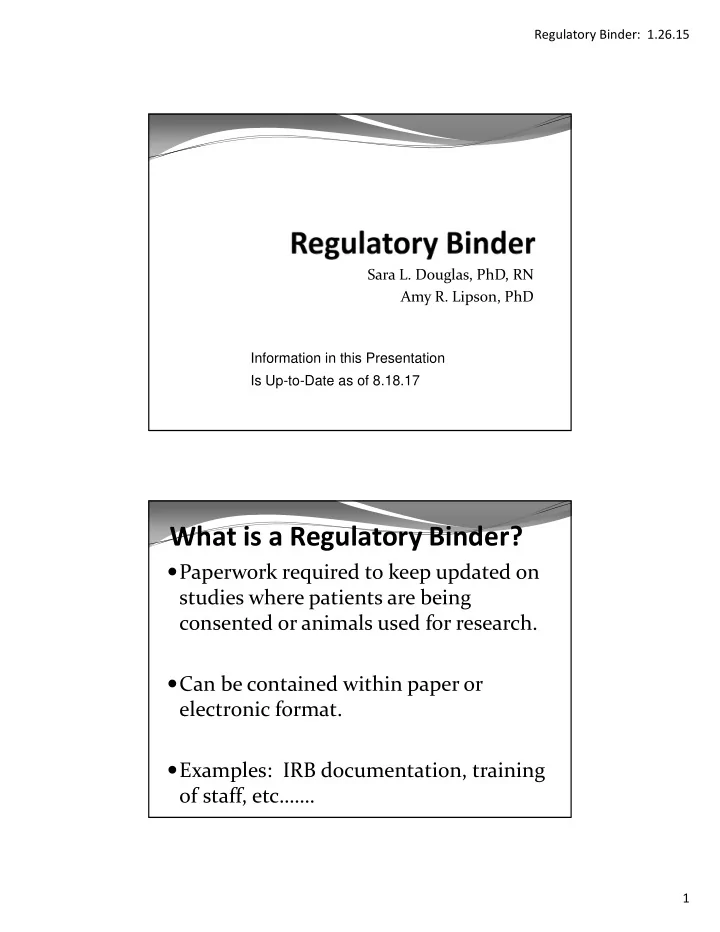
What is a Regulatory Binder?

Paperwork required to keep updated on

studies where patients are being consented or animals used for research.

Can be contained within paper or

electronic format.

Examples: IRB documentation, training

  • f staff, etc…….

Information in this Presentation Is Up-to-Date as of 8.18.17

slide-2
SLIDE 2

Regulatory Binder: 1.26.15 2

Why Bother?

IRB requirement. If audited—need

this information to be organized and accessible.

Excellent way to organize study,

reports, procedures, consents etc.

Binder: Table of Contents

See handout NOTE: Sections will vary according to

type of research, type of subject, and study design. (e.g. FDA studies versus behavioral, descriptive studies)

slide-3
SLIDE 3

Regulatory Binder: 1.26.15 3

  • 1. IRB Protocols & Amendments

IRB Protocols and Changes to IRB Protocols Protocol Deviations Log

Protocol ID/Number: 10‐11‐08 Codes for types of change: Key personnel: KP Instruments: IN Amendments: AM Informed Consent Versions: ICV Protocol Title (Abbreviated): Mapping Complexity of CCI Principal Investigator: BJD Versio n No. Type of Change Date of submission to IRB Date of IRB approval Date of Expiration Detailed Description of Change Investigator’s Signature and Date 1.1 Original IRB submission 10/1/2011 11/11/2011 11/9/2012 No changes/original submission 1.2 KP, AM 1/5/12 2/17/2012 11/9/2012 Addition of Amy Petrenic, Barb Bovington‐Molter

IRB Protocols and Changes to IRB Protocols: Log (key personnel, instruments, amendments)

slide-4
SLIDE 4

Regulatory Binder: 1.26.15 4

Protocol Deviations Log

  • 2. CVs, Licensure: Personnel

CV (needs to be signed) & updated

every 2 years

Delegation of Responsibility, CREC,

COI, UH Credentials Log

Training Log

slide-5
SLIDE 5

Regulatory Binder: 1.26.15 5

Delegation of Responsibility, CREC, COI, UH Credentials Log

Print Name Signature Title Respo nsibilit ies* CREC exp date Start Date COI form complet ed Yes/No Is there a COI Yes/ no UH Crede ntials Cred exp date PI Initials (Protocol Training Completed) Barbara Daly PI 1, 6, 7 9/1/16 11/11/11 yes no yes never Sara Douglas Co-I 2, 6, 7 9/1/16 11/11/11 yes no yes 4/15

Please Print Obtain Informed Consent Data Collection Apache Charlson Rounding EMR Data Entry Data Cleaning Regulatory Document Maintenance Adminstrative IRR Apache NAME: Mary Leuchtag x x x x x x x x x x STUDY ROLE: RA SIGNATURE: DATES OF STUDY INVOLVEMENT: 11/11/11‐present

Training log

slide-6
SLIDE 6

Regulatory Binder: 1.26.15 6

  • 3. Screening & Enrollment

Note where to find screening &

enrollment data: “Refer to screening & enrollment logs for study participation information (found on encrypted laptop)”

Study Eligibility: Inclusion/Exclusion Study Completion form

Study Eligibility

slide-7
SLIDE 7

Regulatory Binder: 1.26.15 7

  • 4. IRB Correspondence

IRB approval notifications (initial and

  • n‐going)

Continuing Reviews

  • 5. Informed Consent Documents
  • Keep updated consent documents

in binder

slide-8
SLIDE 8

Regulatory Binder: 1.26.15 8

  • 6. Investigatory, IRB Brochures

IRB approved study

brochures/Information sheets

  • 7. Laboratory Certification
  • Certification forms
  • Normal lab values for each lab
  • 8. Drug & Device Accountability

Refer to FDA documentation

requirements

  • 9. Blank Set of Study Instruments
  • PDF or word document for all study

instruments

slide-9
SLIDE 9

Regulatory Binder: 1.26.15 9

  • 10. FDA Required Forms

Refer to FDA documentation

requirements

  • 11. NIH or Sponsor Correspondence
  • Notice of award
  • Progress reports
  • Final report
  • 12. DSMB, Adverse Events

 DSMB  Adverse Events

slide-10
SLIDE 10

Regulatory Binder: 1.26.15 10

  • 13. Monitoring Visit Log

Tips from our experience

Mark calendar for IRB and NIH progress

report renewal dates

Track CREC expiration dates 4x per year Must keep paper copies of all consents Back up data using password protected

documents, save to flash drive and keep in locked office. ?Iron key?

Or Box.Com

slide-11
SLIDE 11

Regulatory Binder: 1.26.15 11

For CVs‐date signature not the actual

date that CV was created

Have line for ID number on every page

  • f every tool

Have RA sign and date every tool on

the date of consent

Online Resources: Regulatory Binder

 UH IRB: http://www.uhhospitals.org/clinical‐

research/research‐compliance‐and‐education/clinical‐ research‐tools

 FDA: Good Clinical Practice

http://www.fda.gov/downloads/Drugs/Guidances/uc m073122.pdfNIH

 NIH: https://nccih.nih.gov/grants/toolbox

slide-12
SLIDE 12

Regulatory Binder Template Table of Contents (Douglas, Lipson)

  • 1. IRB Protocols & Amendments

a) Addenda b) Original IRB Submission & Approval c) FORM-IRB protocols, Changes to IRB, Log (key personnel, instruments, amendments, informed consent versions) d) FORM – Protocol Deviation Log

  • 2. CVs, Licensure, Signatures, Delegation of Responsibility Log, Training Log

a) CVs (updated, signed, dated every 2 years) b) Professional licenses c) Signatures (electronic) d) FORM-Delegation of responsibility log (role on grant, CREC, COI, UH Credentials) e) FORM-Training log

  • 3. Screening & Enrollment Logs, Inclusion-Exclusion, Enrollment Form, Study

Completion Form a) Screening & Enrollment logs: document that states these logs are on encrypted laptop b) FORM-Inclusion/Exclusion (completed for each screened patient) c) FORM-Enrollment, Randomization, Refusal, Consent Documentation (completed for each approached subject for consent) d) FORM-Study Completion (completed for every enrolled subject)

  • 4. IRB Correspondence, CR

a) All IRB correspondence b) Continuing Reviews and Approvals

  • 5. Informed Consent Documents (Note: put current protocol number next to each

subject ID)

  • 6. Investigatory, Device Manual, IRB Approved Study Brochures
  • 7. Laboratory Certification (include normal values for each lab)
  • 8. Drug or Device Accountability Records
  • 9. Blank Set of Study Instruments
  • 10. FDA Required Forms
slide-13
SLIDE 13
  • 11. NIH or Sponsor Correspondence, Annual Progress Reports, Final Report

a) NIH Correspondence (notice of award) b) NIH Progress Reports c) NIH Final Report

  • 12. DSMB Plan, Adverse Events

a) DSMB

  • 1. DSMB Plan
  • 2. DSMB Monitor FORM – Sample

b) Adverse Events

  • 1. FORM - Adverse Events
  • 2. FORM – Serious Adverse Events
  • 13. Monitoring Visit Log

a) FORM-Monitoring log

slide-14
SLIDE 14

Department What to maintain How How long

DHHS (Department

  • f Health and

Human Services)  Records of IRB approved activities  IRB Submission and Approvals  Signed Informed Consent Documents and any documentation of such activity  May be preserved in hardcopy, electronic or other media  Must be accessible for inspection and copying  Retention of multiple copies of each record is not required  Three (3) years after completion of research (45 CFR 46.115(b)) FDA (Food and Drug Administration 21 CFR312.62, 21 CFR812.40, and 21 CFR511.1  Records of IRB approved activities, disposition of drug, case histories including medical records and CRF  IRB Submission and Approvals  Signed Informed Consent documents and any documentation of such activity  Must be accessible for inspection  Accurate, legible, contemporaneous,

  • riginal, attributable

 Two (2) years following the date a marketing application is approved for the drug for the indication for which it is being investigated OR  If no application is to be filed OR if the application is not approved for such indication two (2) years after the investigation Is discontinues and FDA is notified Device  Two (2) years from the date on which the investigation is terminated or completed OR  the date that the records are no longer required for purposes of supporting a premarket approval application or a notice of completion of a product development protocol NIH (National Institutes of Health) Grant awards  Financial and programmatic records  Supporting documents and statistical records  All other records required by terms of a grant  Silent (Default to institutional requirements)  Three (3) years from the date the annual Financial Status Report (Grant close out)  If any litigation, claim, financial management review, or audit is started before the expiration of the 3-year period, records must be retained until all litigation, etc. is resolved and final action taken (See 45 CFR 74.53 and 92.42 for exceptions)

slide-15
SLIDE 15

ICH GCP GCP E6 4.9.5, 5.5.11 and 5.5.12  Trial documents as specified in Essential Documents for the Conduct of a Clinical Trial and as required by applicable regulatory requirement (s).  Recorded, handled, and stored in a way that allows accurate reporting, interpretation, and verification  Should take measures to prevent accidental or premature destruction of these documents  2 years after last approval of marketing application and until there are no pending or contemplated marketing applications OR  At least 2 years have elapsed since the formal discontinuation of clinical development of investigational product  Retained longer if required by applicable regulatory requirements or by agreement with sponsor CWRU SBER IRB  IRB Submission and Approvals  Records relating to research  Signed Informed Consent documents and any documentation of such activity  Secure in lockable filing cabinets, password protected disk, etc.  Encouraged to make research data anonymous (all identifiers, including master lists) destroyed as soon as possible.

  • Balance mandate with

requirements of sponsors, regulatory bodies (OHRP and FDA) and University policies to maintain original data  Research data normally retained in the unit where produced  Should include reasonable and prudent practice for off site back-up of electronic and hard-copy data (Whichever occurs last, with original data retained) How long (whichever occurs last, with original data retained)  For the purposes of research integrity, it is suggested that investigators retain study records for six years  At least three (3) years after the final publication of the data  Final publication of the data in accordance institutional policy Any of the following circumstances may justify longer periods of retention:

  • 1. As long as may be necessary to protect any

intellectual property or COI

  • 2. Degree is awarded or work is clearly abandoned by

student
slide-16
SLIDE 16

UHCMC IRB  Records associated with a human subject’s research project  Adequate and accurate case histories recording all

  • bservations and other data

pertinent to investigation (Case histories: CRF, medical records, progress notes of physician and nurses’ notes)  Original signed Informed Consent -Documents and documentation of such activity  In a secure, protected, confidential manner  Per protocol  Minimum of three (3) years following the end of the study  Requirements vary depending on the funding source AND if conducted under FDA regulations

  • Records for FDA regulated articles (drugs,

devices, biologics, assays, etc.) must be kept as required by FDA regulations based on role of PI (sponsor or investigator)  Projects not funded by Federal agency OR do not involve -FDA regulated articles, must be kept according to the Case Policy on Data Retention. UH  All records are maintained and retained in accordance with federal and Ohio laws and regulations  Electronic must be backed-up  On site or offsite with approved vender Records Retention Schedules (some records are destroyed as early as 1 year) Medical Research Records Research papers, published Permanent Human experimentation records 30 years IRB Documentation 3 years Research reports 10 years *if documents are scanned in to an EHR; destroy originals within 30 days unless a legal hold exists on these documents