What is a City For? Confessions of an Urban Geographer Dr. - - PowerPoint PPT Presentation

what is a city for
SMART_READER_LITE
LIVE PREVIEW

What is a City For? Confessions of an Urban Geographer Dr. - - PowerPoint PPT Presentation

What is a City For? Confessions of an Urban Geographer Dr. Alexander Vasudevan School of Geography and the Environment Open Day June 2017 Dr. Alexander Vasudevan Trained as a Human Geographer Associate Professor of Human Geography


slide-1
SLIDE 1

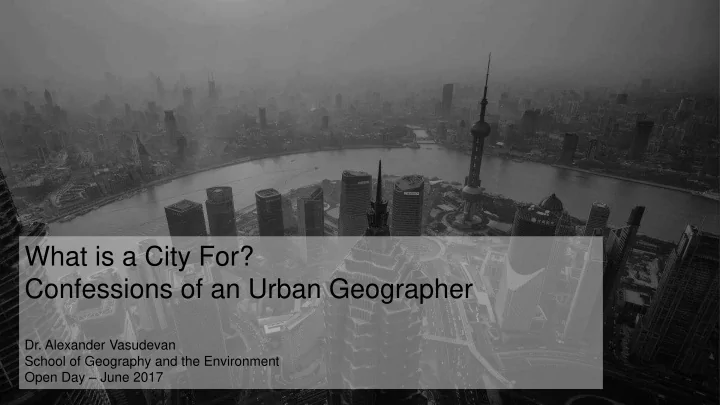
What is a City For? Confessions of an Urban Geographer

  • Dr. Alexander Vasudevan

School of Geography and the Environment Open Day – June 2017
slide-2
SLIDE 2
  • Dr. Alexander Vasudevan

Associate Professor of Human Geography Tutorial Fellow, Christ Church Trained as a Human Geographer (University of British Columbia) Studies Cities Research focuses on: Contemporary Urbanisation Social Movements and Urban Protest Cultural and Historical Geography of Cities Cultural Geographies of Artistic Practice

slide-3
SLIDE 3
slide-4
SLIDE 4

The ‘Urban Age’

slide-5
SLIDE 5

“I’ll begin with the following hypothesis: Society has been completely

  • urbanised. This hypothesis implies a definition: An urban society is a

society that results from a process of complete urbanisation. This urbanisation is virtual today, but will become real in the future.”

  • Henri Lefebvre, The Urban Revolution (1970: 1)
slide-6
SLIDE 6

‘The Urban Explosion’ “The universalization of urbanism is a new

  • fact. Before the year 2000, for the first time

in the history of humanity, the world will have more town dwellers than country dwellers . . . This demographic and urban evolution is taking place in the context of an economic crisis and the imbalance in population distribution will be accompanied by an increasing gap in the distribution of wealth” (UN report, 1984)

slide-7
SLIDE 7

“Sometimes it takes just one human being to tip the scales and change the course of

  • history. In the year 2007, that human being

will either move to a city or be born in one. Demographers watching urban trends will mark it as the moment in which the world entered a new millennium, a period in which, for the first time in history, the majority of the world’s people will live in cities” (UN-Habitat, 2007: 1).

slide-8
SLIDE 8

“Given that more than half the world’s population is now living in cities — a number that is likely to reach 75 percent by 2050, while it was only 10 percent in 1900 — […] urban questions have become truly global ones, with significant consequences for the future of our planet” (Burdett and Rode, 2006: 8). From the LSE-Deutsche Bank project, The Urban Age

slide-9
SLIDE 9
  • In 1990, 43 percent (2.3 billion) of the

world’s population lived in urban areas; by 2015, this had grown to 54 percent (4 billion).

  • In 1995, there were 22 large cities, and

14 megacities; by 2015, there were 44 large cities and 29 megacities.

(UN, World Cities Report, 2016)

slide-10
SLIDE 10
slide-11
SLIDE 11
slide-12
SLIDE 12

“During the last thirty years, however, the form of urbanisation has been radically reconfigured” (Brenner and Schmid, 2013: 11) “The city is everywhere and in everything” (Amin and Thrift, 2002: 1)

The City in an Age of Planetary Urbanisation

What is a city…. For? Discrete entity Process of urbanisation

slide-13
SLIDE 13

The City in an Age of Planetary Urbanisation

slide-14
SLIDE 14

The City in an Age of Planetary Urbanisation

Cities and Global finance

slide-15
SLIDE 15

The City in an Age of Planetary Urbanisation

Cities and Global finance

Globalisation as Financialisation

slide-16
SLIDE 16

The City in an Age of Planetary Urbanisation

Cities and Habitation

slide-17
SLIDE 17

The City in an Age of Planetary Urbanisation

Cities and Habitation

The ’housing question’: affordability and insecurity

slide-18
SLIDE 18

The City in an Age of Planetary Urbanisation

Cities as insecure places

slide-19
SLIDE 19

The City in an Age of Planetary Urbanisation

Cities as insecure places

The Precarious City?

slide-20
SLIDE 20

The City in an Age of Planetary Urbanisation

Cities as sites of resistance

slide-21
SLIDE 21

The City in an Age of Planetary Urbanisation

Cities as sites of resistance

The New Urban Revolutions

slide-22
SLIDE 22

The City in an Age of Planetary Urbanisation

Cities as ‘stuff’

slide-23
SLIDE 23

The City in an Age of Planetary Urbanisation

Cities as ‘stuff’

Urban Infrastructure and the Making of Cities

slide-24
SLIDE 24

The City in an Age of Planetary Urbanisation

Cities as creative places

slide-25
SLIDE 25

The City in an Age of Planetary Urbanisation

Cities as creative places

The city as site of creativity, experimentation and innovation

slide-26
SLIDE 26

The City in an Age of Planetary Urbanisation

Cities as sanctuaries

slide-27
SLIDE 27

The City in an Age of Planetary Urbanisation

Cities as sanctuaries

Citizens, Refugees, Strangers in the Contemporary City

slide-28
SLIDE 28

The City in an Age of Planetary Urbanisation

Cities and environmental change

slide-29
SLIDE 29

The City in an Age of Planetary Urbanisation

Cities and environmental change

Future-Proofing Cities

slide-30
SLIDE 30

Concluding Thoughts

  • The city has become a key site of investigation for

geographers

  • What the city is remains a source of debate
  • Geographers have developed new concepts and tools for

researching cities across the global North and South

  • Geographers have increasingly focused on urbanisation as

a dynamic process

slide-31
SLIDE 31

Thank You