What has been done since 1970? Conclusion : Mops, stored wet, - - PowerPoint PPT Presentation

what has been done since 1970
SMART_READER_LITE
LIVE PREVIEW

What has been done since 1970? Conclusion : Mops, stored wet, - - PowerPoint PPT Presentation

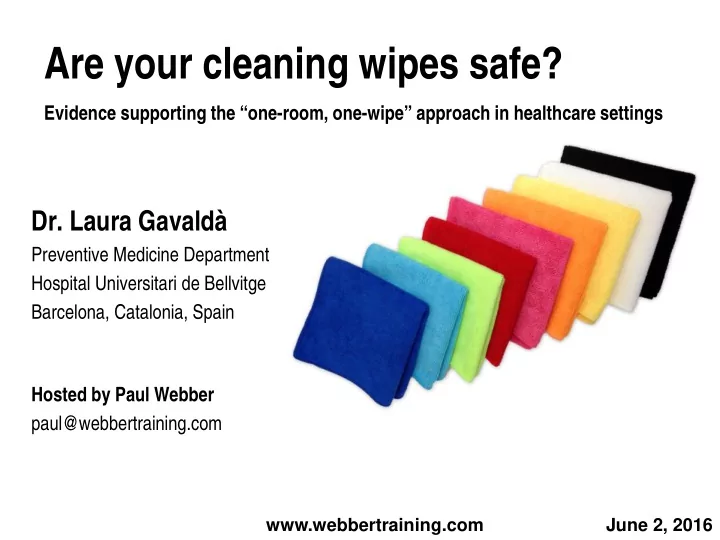
Are your cleaning wipes safe? Evidence supporting the one-room, one-wipe approach in healthcare settings Dr. Laura Gavald Preventive Medicine Department Hospital Universitari de Bellvitge Barcelona, Catalonia, Spain Hosted by Paul


slide-1
SLIDE 1
  • Dr. Laura Gavaldà

Preventive Medicine Department Hospital Universitari de Bellvitge Barcelona, Catalonia, Spain

Are your cleaning wipes safe?

Evidence supporting the “one-room, one-wipe” approach in healthcare settings

www.webbertraining.com June 2, 2016

Hosted by Paul Webber paul@webbertraining.com

slide-2
SLIDE 2

What has been done since 1970?

Conclusion: Mops, stored wet, supported bacterial growth to very high levels and could not be adequately decontaminated by chemical disinfection. Laundering and adequate drying provided effective deconatamination but build-up of bacterial counts occurred if mops were not changed daily.

2

slide-3
SLIDE 3
slide-4
SLIDE 4
slide-5
SLIDE 5
slide-6
SLIDE 6
slide-7
SLIDE 7
slide-8
SLIDE 8
slide-9
SLIDE 9
slide-10
SLIDE 10
slide-11
SLIDE 11

800-bed referral teaching hospital in Barcelona, Spain 3 medical-surgical ICUs, 12 rooms each Standard cleaning procedure:

  • Color coded, double bucket technique
  • Reusable cotton cloths shared between rooms
  • Hypochlorite solutions shared between rooms
  • Exception: isolated patients
  • Used cloths manually disinfected

11

slide-12
SLIDE 12
  • 13 ICU rooms with patients in

contact precautions infected with MRSA, multiresistant P. aeruginosa

  • r multiresistant A. baumannii.
  • Cultures of 7 high-touch surfaces

within the first hour after daily cleaning.

  • Surfaces cleaned 3 times/day with a

0.1% chlorine solution with reusable cotton wipes. New wipes and new cleaning solutions used for each

  • room. Wipes manually disinfected

with a 0.1% chlorine solution.

12

slide-13
SLIDE 13

OVERALL: 29%

13

slide-14
SLIDE 14

Surfaces with same strain as patient: 22% in MRSA rooms 5% in P. aeruginosa rooms 14

slide-15
SLIDE 15

Conclusions

Despite performig the correct routine daily cleaning, high-touch surfaces in intensive care units remain contaminated with the same MDRO as the occupant. Using the same wipe for different rooms can pose a risk to patients because of cross-transmission.

15

slide-16
SLIDE 16
  • After a period of high endemicity, extensively drug-resistant A.

baumannii rates were quite stable in our hospital, but in 2011 an increase of new cases occured.

  • Intervention study, 4 years (13 months pre, 35 months post)
  • Interventions:
  • Screening, isolation and cohorting of patients
  • Improving cleaning applying the ‘one room, one wipe’

approach

16

slide-17
SLIDE 17

The ‘one-room, one-wipe’ approach

  • Aim: to avoid sharing cleaning wipes between different

rooms or patient locations.

  • Considered as a standard precaution: applied even when

the colonization status is not known nor suspected.

  • Patient-based approach, in contrast with colour coded

cleaning system (area-based approach).

  • Colour coded cleaning system can be applied within the

same room.

  • Same approach for furniture/surfaces (housekeepers) as

for clinical devices/equipment (auxiliary nurses).

17

slide-18
SLIDE 18

HOUSEKEEPERS

18

slide-19
SLIDE 19

HOUSEKEEPERS

19

slide-20
SLIDE 20

AUXILARY NURSES

20

slide-21
SLIDE 21

AUXILARY NURSES

21

slide-22
SLIDE 22

22

slide-23
SLIDE 23

23

slide-24
SLIDE 24
slide-25
SLIDE 25

WHAT WE KNOW?

25

slide-26
SLIDE 26

PERSIST

  • n surfaces

HIDE in biofilms

Clever hospital pathogens can...

TRANSFER to patients

26

slide-27
SLIDE 27

Conclusion: Most common nosocomial pathogens may persist on surfaces for months and can thereby be a continuous source of transmission if no regular surface disinfection is performed. 27

slide-28
SLIDE 28

Conclusion: Dry surface biofilms containing MDROs are found on hospital surfaces despite terminal cleaning. How these arise and how they might be removed requires further study.

  • Decomissioned intensive care unit:

surfaces were distroyed and sampled.

  • Samples taken after two terminal

cleans (500 ppm chlorine-free solution).

  • Biofilm in 93% (41/44) of samples.
  • Polymicrobial biofilms, species with

multidrug-resistant strains. 28

slide-29
SLIDE 29
  • Deterministic model of MRSA

fate, transport and exposure

  • Healthcare workers hands the

sole vector Conclusions 1.Porous surfaces highly contaminared but low transfer efficiency 2.Nonporous surfaces high MRSA transfer efficiency 29

slide-30
SLIDE 30

So where are we at this point?

Conclusions 1.Environmental cleaning is an important component of a multifaceted infection control strategy to prevent HAIs. 2.Emerging technologies have led to increased interest in evaluating environmental cleaning, disinfecting, and monitoring in hospitals. 3.A major limitation of the evidence is the lack of comparative studies addressing the relative effectiveness of various cleaning strategies. 4.Few studies assess clinical, patient- centered outcomes (HAIs rates).

slide-31
SLIDE 31

Taking a new look at the ideal disinfectant

  • Broad spectrum
  • Fast acting
  • Non toxic
  • Surface compatibility
  • (...)
  • Easy to use: it should

be available in multiple forms, such as wipes, sprays, pull-tops and

  • refills. Directions for use

should be simple.

slide-32
SLIDE 32

Effective Surface Decontamination: Product and Practice = Perfection

32

slide-33
SLIDE 33

Outbreak control by improving wiping Microbial transfer by wipes: real scenario evidences Microbial transfer by wipes: in vitro evidences

Cleaning wipes studies: evidence hierarchy

33

slide-34
SLIDE 34

IN VITRO STUDIES

slide-35
SLIDE 35

Microfiber cloths: less bacterial transfer

35

slide-36
SLIDE 36

Ten wipes tested for sporicidal efficacy using the 3-stage protocol 1.All wipes but one repetedly transferred C. difficile spores to

  • ther surfaces

2.It would be safer to ensure a “one-wipe, one-application, one- direction”. 3.The manufacturer should supply appropriate instructions on the use of the wipes.

Can wet wipes transfer bacteria?

36

slide-37
SLIDE 37
  • Seven detergent wipes
  • Transfer S. aureus and A. baumannii
  • 3 consecutive surfaces
  • 3-stage protocol.

Can wet wipes transfer bacteria?

37

slide-38
SLIDE 38

Used wipes are exhausted wipes

FRESH WIPE: 1) Spread aliquots containing C. difficile spores on 1 cm2 2) Wipe with premoistened hypoclorite wipe for 10 seconds 3) Sequentially wipe onto 4 clean sites for 10 seconds 4) Sample the sites after 5 minutes of wet contact time USED WIPE: 1) Apply fresh premoistened hypoclorite wipe

  • n a clean surface until it dries

2) Same procedure as fresh wipe

Transfer of C. difficile spores by hypoclorite premoistened wipes

38

slide-39
SLIDE 39

Good wiping = no fomite-to-hand transfer

Microbial transfer to hands: Non-treated fomites: 36% Disinfectant-wipe treated fomites, dried for 10 minutes: 0.1%

39

slide-40
SLIDE 40

STUDIES IN REAL SCENARIOS

40

slide-41
SLIDE 41

MRSA survival rates on dry mops used for cleaning the floors of rooms with colonized patients:

14 days: 26% - 42% 28 days: 0.1% - 16%

Oie & Kamiya. J Hosp Infect, 1996

slide-42
SLIDE 42

42

slide-43
SLIDE 43

Wipes: Predisinfection: 53% MRSA Postdisinfection: 68% MRSA Bed rails: Predisinfection: 86% MRSA Postdisinfection: 34% MRSA

43

slide-44
SLIDE 44
  • Strong and significant correlation between MRSA count
  • n bed rails and contamination of post-use wipes.
  • Reduction of MRSA load in wipes after rinsing with

disinfectant.

  • Conclusions:
  • Nondisposable wipes should be throroughly rinsed

immediately after use of each patient

  • Patients under contact precautions should have

separate cleaning tools from other patients

  • Disposable wipes are recommended for use in

case of outbreak situations.

44

slide-45
SLIDE 45
slide-46
SLIDE 46

OUTBREAK CONTROL

46

slide-47
SLIDE 47

Resposibilities for the cleaning of all areas of the ward environment , including equipment, were clearly desingnated. Wilks et al. Inf Control Hosp Epidemiol, 2006 Environmental cleaning with 1:100 sodium hypochlorite solution. Apisarnthanarak et al. Clin Inf Dis, 2008. Strict environmental cleaning policy following CDC recommendations.

Rodriguez-Baño et al. Am J Inf Control, 2009.

The original disinfectant was switched to bleach wipes. Munoz-Price et al. Am J Inf Control, 2014 […] reviewing the process of environmental cleaning and disinfection […] Liu et al. PLOS ONE, 2014.

Cleaning methods for controlling A. baumannii outbreaks

47

slide-48
SLIDE 48
  • Crossover study, 1 year, 2 ICUs
  • Standard cleaning: disposable cloths
  • Intervention: additional twice-daily

enhaced cleaning of hand-contact surfaces:

  • Ultramicrofiber cloths
  • Bed area divided into four zones,

with one cloth being used for each

  • Cloths washed in washing machine

at 92ºC for 10 minutes

Conclusion: Enhaced cleaning reduced environmental contamination and hand carriage, but no significant effect was observed on patient acquisition of MRSA.

‘One room, one wipe approach’: indirect evidences (1)

48

slide-49
SLIDE 49

‘One-room, one-wipe approach’: indirect evidence (2)

  • Traditional technique: 2-step process first with a detergent followed

by sodium hypoclorite solution.

  • New technique: combination of microfiber and steam technology

Microfiber cloths dampened with water, no chemicals used Dry steam dislodges organic matter The microfiber cloth picks up the loosened matter

49

slide-50
SLIDE 50

Outbreak of Norovirus gastroenteritis

‘One-room, one-wipe approach’: indirect evidence (2)

VRE transmission in ICU 50

slide-51
SLIDE 51

Old cleaning system: hydrogen peroxide with cotton rags. New cleaning system: accelerated hydrogen peroxide in disposable wipes.

‘One-room, one-wipe approach’: indirect evidence (3)

51

slide-52
SLIDE 52

‘One-room, one-wipe approach’: indirect evidence (3)

  • C. difficile

MRSA

52

slide-53
SLIDE 53

A more precise approach 1 ROOM 1 SURFACE 1 WIPE 1 DIRECTION

slide-54
SLIDE 54
slide-55
SLIDE 55
slide-56
SLIDE 56
slide-57
SLIDE 57