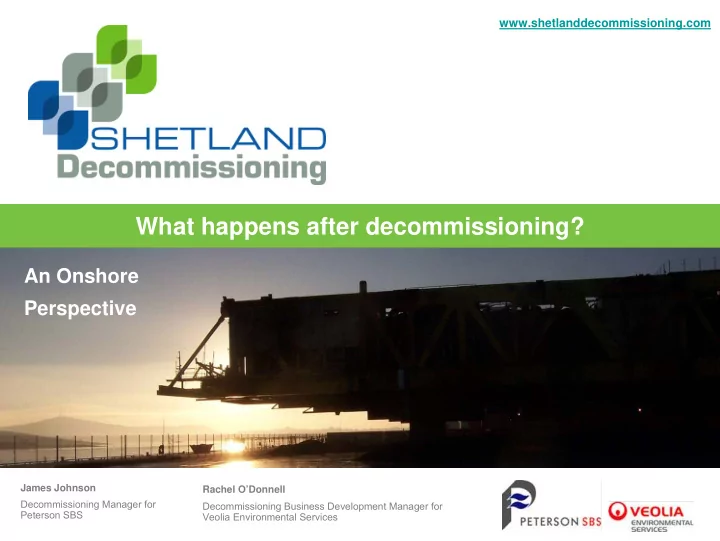
SLIDE 1 www.shetlanddecommissioning.com
What happens after decommissioning?
An Onshore Perspective
James Johnson Decommissioning Manager for Peterson SBS Rachel O’Donnell Decommissioning Business Development Manager for Veolia Environmental Services
www.shetlanddecommissioning.com
SLIDE 2 www.shetlanddecommissioning.com
What happens after Decommissioning?
- What happens after Decommissioning…?
- Onshore Operations are not AFTER decommissioning,
- They are essentially the end of the Decommissioning process…
- “Getting it to the Beach”…
…is only part of the story… Hopefully we can provide some insight into the onshore perspective.
SLIDE 3 www.shetlanddecommissioning.com
Decommissioning – an Onshore perspective:
- Background Information on Shetland Decommissioning
- Who we are, Where we are, What we’ve achieved
- What can be done to Reduce Costs ?
- Project Organisation and Optimisation
- Effective / Efficient Waste Management
- Re-use of equipment – the practicalities and opportunities
- How are Shetland Decommissioning Integrating these ideas?
- Working with contractors/operators
- Investigating infrastructure requirements
SLIDE 4 www.shetlanddecommissioning.com
Background - Decommissioning Interest began in 1999
- Market Development
- Established in 1999 to market and develop Decommissioning opportunity for Shetland
- Contract award in 2005 from Aker Solutions and Total for the Frigg Cessation Project
- Currently working on development & feasibility studies for Topsides, Jackets, Subsea & Single Lift
- Operational Philosophy
to build on Best Industry practice to develop Shetland into a
“centre of excellence”
for Decommissioning
SLIDE 5 www.shetlanddecommissioning.com
Background - Company Stakeholders
Shetland Decommissioning
- The marketing name for a joint venture / cooperation agreement between PetersonSBS [PSBS]
and Veolia Environmental Services [Veolia] with support from Lerwick Port Authority [LPA]
Stakeholders Today
- Peterson SBS Develop & Operate the Facility Providing Marine & Quayside Service
- Veolia provide the Decontamination, Deconstruction, Waste Management & Environmental Services
- Lerwick Port Authority Operate the Harbour
SLIDE 6 www.shetlanddecommissioning.com
Background - Geography
SLIDE 7 www.shetlanddecommissioning.com
Background - Geography
SLIDE 8 www.shetlanddecommissioning.com
Background - Geography
SLIDE 9 www.shetlanddecommissioning.com
Background - Geography
SLIDE 10 www.shetlanddecommissioning.com
Background – Lerwick Harbour
- All Weather Port
- Open 24/7
- Over 3,000m of Quayside
- Excellent Freight
Links with the UK Mainland
with 30 years of Oil & Gas Experience
Greenhead Base
Drill Cuttings Plant New Landfill Site Decommissioning Facility Energy Recovery Incinerator Fabrication Facility
SLIDE 11 www.shetlanddecommissioning.com
Background – Decommissioning Facility
Concrete Pad with impermeable membrane - covering an area of ~20,000 sq. m.
- Includes Wash Bay, Bunded Storage, Quarantine Area & Emergency Stations
The Pad is Fully Enclosed - all drainage leads to Class 1 Interceptor
- Fully Licensed with PPC permit issued by SEPA
- RSA authorisation approved for receipt, handling and temporary storage of LSA / NORM
SLIDE 12 www.shetlanddecommissioning.com
Experience - Piece Small
- Piece Small Operations
- Piece Small Decommissioning of platform MCP-01 started in 2006
- The 1st Campaign ran from Aug-Dec 2006
- This was completed in 2008 with the 2nd Campaign running through Jan-Dec 2008
- The Greenhead Base acted as the forwarding supply for all of MCP-01 Logistics
requirements
- All piece-small Waste materials were processed through Greenhead
SLIDE 13 www.shetlanddecommissioning.com
Experience – Large Scale Decommissioning Operations
- Load-in of TCP2 Module Support Frame
- 8730 Te Structure – with grillage and trailers = 11,100 Te crossing quay
- Months of preparatory Engineering and Construction works required onshore
- 358 axle lines mobilised - Europe and America and Australia
- Significant Barge works required in advance of operations – 3 weeks
- Operations scheduled for specific date and tide conditions
- Completed on Schedule and without significant incident or LTI
SLIDE 14 www.shetlanddecommissioning.com
Experience – Onshore Decommissioning
- Decontamination & Deconstruction of TCP2 Module Support Frame
- 12 weeks of Decontamination works
- Establishing Safe Access, Detailed Inventory and finalising of the Deconstruction Plans
- Handling: Asbestos, WEEE, NORM, Insulation Material, etc
- 5 months of Deconstruction works
- Reduction by Machine maximised - Leibherr 984 + 19Te LaBounty shear
- Hot-work & Pre-cutting required due to steel thickness (Up to 100mm)
- Full Environmental Accounting
SLIDE 15 www.shetlanddecommissioning.com
Waste Management – Indicative split of fractions
Hazardous Materials to Landfill Sale / Reuse of Materials Permitted Discharges Non-Hazardous Materials Recycled Non-Hazardous Materials to Landfill Hazardous Materials Recovered Recycling of Metals Temporary Equipment Removed
SLIDE 16 www.shetlanddecommissioning.com
Waste Management – Indicative Metal Recycling Breakdown
EE Waste Aluminium Titanium Copper Nickel Mixed Non- Ferrous Ferrous Metals ~94% Copper Isolation Material Stainless Steel
SLIDE 17 www.shetlanddecommissioning.com
What can be done to Reduce costs and Environmental Impacts?
- Options for improvement/optimisation
- Have a more integrated approach to the programme management of
decommissioning from before CoP – not a staged approach
- Engage the Onshore project team early in the design process to
ensure Load-in and Deconstruction are taken into consideration
- Get actual characterisation data early – taking samples offshore, allows
for more investigation into recovery options
- Plan the Post Operational Clear Out [POCO] phase based on
decommissioning to optimise activities conducted offshore
- Full understanding of the programme work breakdown structure to
remove duplication and smooth workflow
SLIDE 18 www.shetlanddecommissioning.com
What can be done to Reduce costs and Environmental Impacts?
- Effective/efficient waste management
- Link into POCO offshore – focus on waste: “Is this activity going to
create a problem onshore?” Built into decom planning mind set
- Plan activities so that cleaning only gets done once and the records are
maintained and handed over to prove this
- Only maintain during NUI what is needed to maintain safety, any
equipment needed during lifting operations, access equipment and recognised items with an identified re-use/re-sale route
- Offshore Sampling of wastes will enable more effective waste
management planning
- Allows Waste routes to be identified and fully costed – allowing for
reduced risk exposure and hence reduced cost to client.
SLIDE 19 www.shetlanddecommissioning.com
Re-use / Re-sale of Equipment – the practicalities
- Considerations & Obstacles:
- Oil & Gas Industry does not generally want 2nd hand equipment
- Equipment from Decommisisioned platforms may be 20-30 yrs old
- and hence can be out-moded / obsolete or at the end of its design life
- Lack of Maintenance from CoP to Onshore
- Lack of certification for equipment when it arrives
- No maintenance or No certification = low value or lack of interest
- Value of equipment vs. the Logistics of retrieving the equipment.
- Cutting access holes to extract the equipment deep from a structure
- Rigging and Crane requirements for extraction
- HSEQ issues
- Delays to deconstruction programme from performing extraction
- If you try to extract during deconstruction you introduce men to the workface and HSE issues
- Must be wary of storing these items “in the garage” for a rainy day…
SLIDE 20 www.shetlanddecommissioning.com
Re-use / Re-sale of Equipment – opportunities
- Opportunities:
- Specialist equipment can command high re-sale value if the buyer can
be found
- Opportunity to provide RARE spares for older equipment in service on
- ther platforms / fields
- Re-use of concrete structures should be investigated wherever
possible
- The energy requirements for recovery / recycling are excessive
- Re-use opportunities as Marine foundations or similar presents
excellent added value to Waste hierarchy
SLIDE 21 www.shetlanddecommissioning.com
How are Shetland Decommissioning Integrating these ideas…
- Marketing our Capabilities to the industry
- Taking a proactive approach to integrating onshore disposal into the
decommissioning design process
- Forming collaborative relationships with operators / contractors
- Develop infrastructure investment process over several projects
- Programme certainty is key to the development of facilities and stimulating the
market to rise to the challenge
- Optimising our Onshore solutions to client and contractors’ specific
requirements
- Identified and Investigating Development options for future projects
- Be it Subsea equipment, Piece Small materials, Modular receipt or Single Lift
SLIDE 22 www.shetlanddecommissioning.com
The Future – Potential Infrastructure Developments
SLIDE 23
The Future - Study works & Development Options - Animation
SLIDE 24
The Future - Study works & Development Options - Animation
Existing
SLIDE 25
The Future - Study works & Development Options - Animation
Development option - South
SLIDE 26
The Future - Study works & Development Options - Animation
Development option - North
SLIDE 27
The Future - Study works & Development Options - Animation
Development option – North Phase 2 – extend to -20m
SLIDE 28
The Future - Study works & Development Options - Animation
SLIDE 29
The Future - Study works & Development Options - Animation
SLIDE 30
The Future - Study works & Development Options - Animation
SLIDE 31 www.shetlanddecommissioning.com
The Future – Uncertainties
2005 2007
- The Uncertainties:
- Market Timing – Projects always slip to the right…
- These uncertainties hinder investment.
SLIDE 32 www.shetlanddecommissioning.com
Integrated Approach – to Project Design & Programme Management
End of Field Life, Decom preparations & Hook-down, Programme Coordination Onshore Decommissioning Requirements
(Facilities and Methods for Decontamination & Deconstruction)
Onshore Infrastructure & Transport requirements
(quay, ground strength, trailers, cranes, skids etc)
Offshore Removal & Marine Transport Methodology
Early inclusion of the Onshore team can allow optimisation “Getting to the Beach…” …is only part of the story. Ignoring Onshore concerns can only add cost Uncertainties add Risk & Cost
SLIDE 33 www.shetlanddecommissioning.com
Thank you – any Questions
www.shetlanddecommissioning.com