
SLIDE 1
Sudeep Das
DAVID SCHRAMM FELLOW
ARGONNE NATIONAL LABORATORY
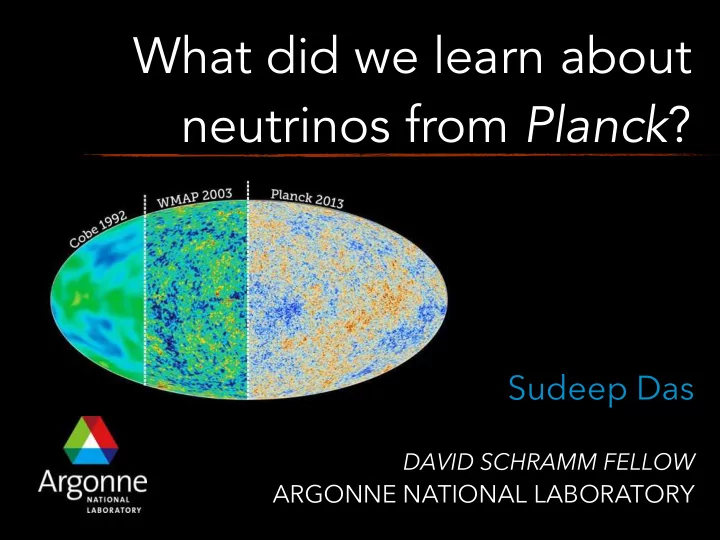
What did we learn about neutrinos from Planck ? Sudeep Das DAVID - - PowerPoint PPT Presentation
What did we learn about neutrinos from Planck ? Sudeep Das DAVID SCHRAMM FELLOW ARGONNE NATIONAL LABORATORY Planck: the CMB satellite mission was launched in 2009 COBE WMAP Planck 7 0 . 3 1 degree 0 . 1 .. the first
DAVID SCHRAMM FELLOW
ARGONNE NATIONAL LABORATORY
COBE
WMAP
Sudeep Das - ANL
Sudeep Das - ANL
Sudeep Das - ANL
Sudeep Das - ANL
Sudeep Das - ANL
Sudeep Das - ANL
Sudeep Das - ANL
When neutrinos become non-relativistic, they reduce the time variation of the gravitational potential inside the Hubble radius. This affects the photon temperature through the early ISW effect and leads to a depletion in the temperature spectrum on multipoles 20 < l < 500. The late ISW effect happens due to decay of potentials due to accelerated expansion in recent past (5< l < 50). Massive neutrinos contribute to the total matter density and shifts the balance between dark energy density and matter density.
Sudeep Das - ANL
Sudeep Das - ANL
The RMS deflection is about 2.7 arcmins, but the deflections are coherent on degree scales.
11
12
Left: dark matter clustering with zero neutrino mass, right: same with sum of three neutrino masses equal to 250000th that of the
Sudeep Das - ANL
Lensing smears acoustic peaks. Higher neutrino mass -> less amplitude of matter fluctuations -> less lensing -> less smearing
Sudeep Das - ANL
Sudeep Das - ANL
Apart from its impact on the early-ISW effect and lensing potential, the total neutrino mass affects the angular-diameter distance to last scattering, and can be constrained through the angular scale of the first acoustic peak. However, this is degenerate with dark energy density. Low redshift measurements of angular diameter distance through Baryon Acoustic Oscillations (BAO) alleviates this degeneracy and gives a tighter constraint:
Sudeep Das - ANL
where Neff is 3.046 in the standard picture where the only relativistic particles are 3 species of neutrinos.
Recently, there has been some mild preference for Neff > 3.046 from recent CMB anisotropy measurements (Komatsu et al. 2011; Dunkley et al. 2011; Keisler et al. 2011; Archidiacono et al. 2011; Smith et al. 2011, Hinshaw et al. 2012; Hou et al. 2012).
Sudeep Das - ANL
Sudeep Das - ANL
Increasing Neff at fixed θ∗ and z_eq necessarily raises the expansion rate at low
measurements can therefore improve constraints
Sudeep Das - ANL
(assumes degenerate eigenstates, and extra species as massless)
Sudeep Das - ANL
(assumes Y_p determined from Neff and w_b using BBN consistency relation).
Add observed Helium and Deuterium abundances to CMB constraint:
Sudeep Das - ANL
Let both Helium fraction and Neff be constrained using CMB
22
Left: dark matter clustering with zero neutrino mass, right: same with sum of three neutrino masses equal to 250000th that of the
Sudeep Das - ANL
Sudeep Das - ANL
Das et al. (2011)
Sudeep Das - ANL
Das et al. (2011)
Sudeep Das - ANL
WMAP7 only Komatsu et al. 2010
Sudeep Das - ANL
Planck + high resolution CMB experiments + BAO constrains neutrino mass sum to have an upper limit of 0.23 eV