Supernova neutrinos and Supernova Relic Neutrinos using a Water - - PowerPoint PPT Presentation

supernova neutrinos and supernova relic neutrinos using a
SMART_READER_LITE
LIVE PREVIEW

Supernova neutrinos and Supernova Relic Neutrinos using a Water - - PowerPoint PPT Presentation

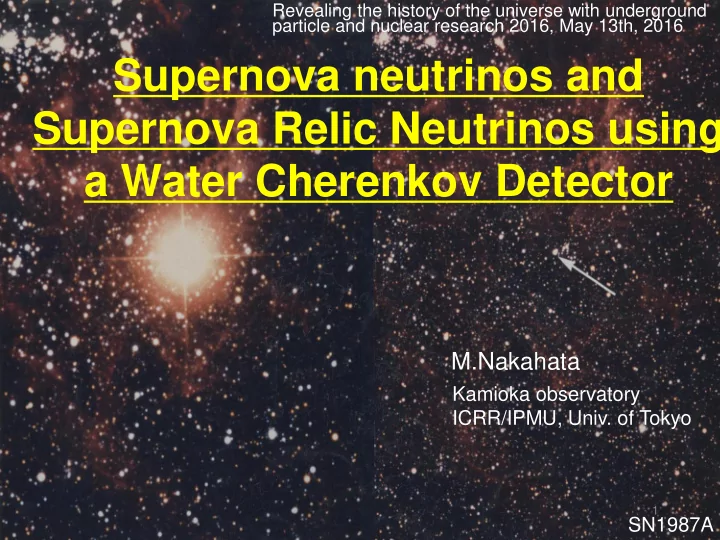
Revealing the history of the universe with underground particle and nuclear research 2016, May 13th, 2016 Supernova neutrinos and Supernova Relic Neutrinos using a Water Cherenkov Detector M.Nakahata Kamioka observatory ICRR/IPMU, Univ. of


slide-1
SLIDE 1

1

SN1987A

1

Supernova neutrinos and Supernova Relic Neutrinos using a Water Cherenkov Detector

Revealing the history of the universe with underground particle and nuclear research 2016, May 13th, 2016

Kamioka observatory ICRR/IPMU, Univ. of Tokyo

M.Nakahata

slide-2
SLIDE 2

Contents

 What we have learned from SN1987A?  What can we learn from current supernova detectors in the world  Supernova relic neutrinos

(Diffuse Supernova Neutrino Background)

  • Expected signals
  • SK-Gd project

2

slide-3
SLIDE 3

Detectors which observed SN1987A

Kamiokande-II IMB-3 BAKSAN

Japan Kamioka mine 2140ton fiducial Water Cherenkov USA Ohio state Morton mine ~5000ton Fiducial Water Charenkov Russia Baksan tunnel 330ton in 3150tanks Liquid scintillator Detection efficiencies (50% eff.) ~8.5 MeV @ Kamiokande ~28 MeV @ IMB ~10 MeV @ Baksan

3

slide-4
SLIDE 4

4

Neutrino signals from SN1987A

Kam-II (11 evts.) IMB-3 (8 evts.) Baksan (5 evts.)

Observed events

24 events total

What was learned? Total energy released by ν̅e: ~5x1052 erg  Assuming equi-partition, total released energy is ~3x1053 erg, which corresponds to a neutron star with 1.0-1.7M

x1053erg

  • K. Sato and H. Suzuki

Phys.Lett.B196 (1987) 267 Jegerlehner, Neubig & Raffelt, PRD 54 (1996) 1194

The obtained binding energy is almost as expected. Large error in neutrino mean energy. No detailed information of burst process.

PRL 58, 2722 (1987)

slide-5
SLIDE 5

Super-Kamiokande KamLAND Baksan LVD Borexino SNO+

(under construction)

IceCube HALO Daya Bay NOvA

地表

XMASS

Liquid scintillator Water, Ice Lead, Xe

32 kt 1 kt 0.8 t 0.3 kt 1 kt 0.3 kt 14 kt 1 kt 76 t 1 gt 160 t target mass Pb Xe

5

Supernova burst detectors in the world

slide-6
SLIDE 6

Super-K: Number of events

Supernova at 10 kpc 32kton SK volume 4.5MeV(kin) threshold No oscillation case.

Livermore simulation T.Totani, K.Sato, H.E.Dalhed and J.R.Wilson, ApJ.496,216(1998) Nakazato et al.

K.Nakazato, K.Sumiyoshi, H.Suzuki, T.Totani, H.Umeda, and S.Yamada, ApJ.Suppl. 205 (2013) 2, (20Msun, trev=200msec, z=0.02 case)

For each interaction Number of events vs. distance

Ethr=3.5MeV(kin)

32kton water Cherenkov

6

Livermore Nakazato

ν̅ep  e+n 7300 3100

ν+e-  ν+e-

320 170

16O CC

110 57 Directional info.
slide-7
SLIDE 7

7

Neutrino luminosity from various model predictions

Cooperation: H. Suzuki

slide-8
SLIDE 8

8

Sensitivity of Super-K for the model discrimination

10kpc supernova Time variation of mean energy

High statistics enough to discriminate models

Cooperation: H. Suzuki

Time variation of event rate

slide-9
SLIDE 9

Single volume liquid scintillator detectors

KamLAND Borexino SNO+

1000ton liq.sci.

Running since 2002.

300ton liq.sci.

Running since 2007.

1000ton liq.sci.

Under construction. (Kamioka, Japan) (Gran Sasso, Italy) (SNO Lab.,Canada)

From K.Inoue, G.Bellini, M.Chen

9

slide-10
SLIDE 10

10

Expected energy spectrum (10kpc) νx parameter measurement with νp elastic scattering events (3000t eqv.)

Energy spectrum expected at the liquid scintillation detectors

  • Phys. Rev. D 86, 125001 (2012)

~80 events about 200keV ~30 events about 500keV νp elastic scattering Determine luminosity and mean energy of νx ν̅ep e+n NC gamma ν-e scattering ν̅eC e+B νeC e-N 2.2MeV gamma

From K. Ishidoshiro

(νx : νµ , ντ at the source)

1000ton, Nakazato-model

slide-11
SLIDE 11

Estimates of the Galactic SN rate

  • From historical record
  • 3.4 +7.8

-2.8SNe / 100yrs (Adams et al., ApJ,778,164(2013))

  • 2.5 +0.8

-0.5SNe / 100yrs (Tammann et al., ApJS,92,487(1994))

  • 5.7 ±1.7 SNe / 100yrs (Strom, A&A,288,L1(1994))
  • Massive star birthrate
  • 1-2 SNe / 100yrs (Reed, AJ,130,1652(2005))
  • 26Al from massive stars
  • 1.9 ±1.1 SNe/ 100yrs (Diehl et al.,Natur,439,452006(2006))
  • Pulsar rate
  • 2.8 ±0.1SNe/ 100yrs (Keane&Kramer,MNRAS,391,2009(2008))
  • 10.8 +7

-5 SNe/ 100yrs (Faucher-

Giguère&Kaspi.,ApJ,643,332(2006))

  • From Extragalactic SN rate
  • 2.8 ±0.6 SNe/ 100yrs (Li et al.,MNRAS,412,1473(2011))

11

Contents from Adams et al., ApJ,778,164(2013))

slide-12
SLIDE 12

Big Bang Now

S.Ando, Astrophys.J. 607, 20(2004)

12

Supernova neutrinos from all past SNe 1010 stars/galaxy ×1010 galaxy×0.3%(massive star->SN) ~O(1017)SNe

Supernova Relic Neutrinos

slide-13
SLIDE 13

Expected SRN events

1.3 -6.7 events/year/22.5kt

(10-30MeV)

SRN flux from Horiuchi et al. PRD, 79, 083013 (2009)

SK fiducial volume

Supernova Relic Neutrinos

SRN predictions (νe fluxes)

Large target mass and high background reduction are necessary.

13

slide-14
SLIDE 14

Observing failed collapse

14

Galactic core collapse: neutrino emission drops; can be detected

Beacom et al (2001) Liebendoerfer et al (2004)

Failed case (40Msun) NS case (13Msun)

Lunardini (2009), Lien et al (2010), Keehn & Lunardini (2010), Nakazato (2013),Yuksel & Kistler (2014)

Diffuse supernova neutrino background: guaranteed signal, failed collapse can significantly increase the expected flux.

Slide from S.Horiuchi @ ASJ meeting 2016

slide-15
SLIDE 15

Identify νep events by neutron tagging with Gadolinium. Gadolinium has large neutron capture cross section and emit 8MeV gamma cascade.

γ

p n Gd e+

8 MeV

ΔT~20μs Vertices within 50cm

νe

Gadolinium project at Super-K: SK-Gd

Captures on Gd

Gd in Water

100% 80% 60% 40% 20% 0% 0.0001% 0.001% 0.01% 0.1% 1% 0.1% Gd gives ~90% efficiency for n capture In Super-K this means ~100 tons of water soluble Gd2(SO4)3

15

slide-16
SLIDE 16

16

10 12 14 16 18 20 22 24 26 28

Position Energy (MeV)

SRN flux from Horiuchi, Beacom and Dwek, PRD, 79, 083013 (2009)

BG assumption BG can be reduced by neutron tagging as follows  νµ CC BG 1/4  νe CC BG 2/3  NC elastic BG 1/3 (require only one neutron)

Model 10-16MeV (evts/10yrs) 16-28MeV (evts/10yrs) Total (10-28MeV) Significance (2 energy bin) HBD 8MeV 11.3 19.9 31.2 5.3 σ HBD 6MeV 11.3 13.5 24.8 4.3 σ HBD 4MeV 7.7 4.8 12.5 2.5 σ HBD SN1987a 5.1 6.8 11.9 2.1 σ BG 10 24 34

  • Expected SRN signal and its significance

preliminary

slide-17
SLIDE 17

In case of Galactic supernova Improve pointing accuracy ν̅e w/o tagging ν̅e tagged with 80% eff.

If ν̅e can be tagged,directional events (ν+e scattering events) can be enhanced in the plot and pointing accuracy can be

  • improved. For 10kpc SN ~5° ~3°(@90%C.L.).

(Note: It is better than Field of View size of LSST.)

17 (10kpc SN simulation)

ν̅e+p ν+e scattering

slide-18
SLIDE 18

EGADS

Evaluating Gadolinium’s Action on Detector Systems 200 m3 test tank with 240 PMTs 15m3 tank to dissolve Gd Gd water circulation system (purify water with Gd)

Transparency measurement (UDEAL)

18

18

slide-19
SLIDE 19

240 PMTs in the 200 m3 tank

The detector fully mimic Super-K detector. Gd dissolving test has been performed since Oct.2014. (see next page)

19

slide-20
SLIDE 20

From here 0.2% Gd2(SO4)3

20

Transparency of Gd-loaded water

The light left at 15 m in the 200m3 tank was ~75% for 0.2% Gd2(SO4)3 , which corresponds to ~92% of SK-IV pure water average.

slide-21
SLIDE 21

21

On June 27, 2015, the Super-Kamiokande collaboration approved the SK-Gd project which will enhance neutrino detectability by dissolving gadolinium in the Super-K water. T2K and SK will jointly develop a protocol to make the decision about when to trigger the SK-Gd project, taking into account the needs of both experiments, including preparation for the refurbishment of the SK tank and readiness of the SK-Gd project, and the T2K schedule including the J-PARC MR power upgrade. Given the currently anticipated schedules, the expected time of the refurbishment is 2018.

Approval of the SK-Gd project, agreement with T2K and timeline 201X 201X+1 201X+2 201X+3 201X+4

Observation Observation

~ ~ ~ ~

T0 = Start leak stop work(~3.5 months) T1 = Load first 10 ton Gd2(SO4)3

corresponds to 0.02%

T2 = Load full 100 ton Gd2(SO4)3

0.2% solution Fill water (2 months) Pure water circulation Stabilize water transparency

Very preliminary Timeline

slide-22
SLIDE 22

How to stop the leak

Cover welded places with sealing materials

Cover with two layers. Lower layer is BIO-SEAL 197 (epoxy resin) which sneaks into small gaps, and upper layer is a viscous material which allows more displacement.

22

This material must be leak tight, water tight and low Rn emanation. We have developed such material. At present, water leak rate is about 1-2 tons/days. We plan to reduce it more than one orders of magnitude.

slide-23
SLIDE 23

Intrinsic RIs in Gd2(SO4)3 could add BG in

8B solar n region of spectrum

  • BG reduction  Purification of 100 tons of Gd2(SO4)3

Chain

Main sub- chain isotope

Radioactive concentration (mBq/kg)

238U

238U

50

226Ra

5

232Th

228Ra

10

228Th

100

235U

235U

32

227Ac/ 227Th

300

  • 238U Spontaneous Fission:

~ 5.5 [ γ(Eγ>10.5 MeV) + 1n ] / year / FV

1 order reduction

For SRN For solar neutrino

Current BG ~200 events/day/FV Expected signal ~5 events/year/FV

  • U (n) ~320events/day/ FV
  • Th/Ra (β,γ)~3 x 10 5 events/day/ FV

1 order reduction 3 orders reduction Typical Gd2(SO4)3 on the market

23

23

slide-24
SLIDE 24

Approach #1: Remove radio-isotopes from normal Gd2(SO4)3 ourselves

  • Removal of U and Ra
  • Ra exists in Gd2(SO4)3 water in the form of Ra2+
  • At pH above 6, U exists as uranyl sulfate complex UO2(SO4)3

4-

Ion-exchange resins can be used, while Gd3+ and SO4

2- must be kept.

Special resins have been developed.

  • U removal anion resin (AJ4400) is established (1-2 orders reduction).
  • Ra removal cation resin (AJ1020) is under tests. Reduction of 3 orders
  • f magnitude was confirmed using high Ra contentration water.
  • Removal of Th and Rn
  • These exist in neutral

form.

  • Under tests.
  • Colloidal Th: w/ filter
  • Rn: degasification

Cation resin (AJ1020) test bench @ EGADS

24

slide-25
SLIDE 25

Approach #2: Cooperative development of pure Gd2(SO4)3 with chemical companies

  • We are cooperating with several companies to produce clean

Gd2(SO4)3 /Gd2O3. Ex.) 232Th: Existing samples of high purity Gd powders are ~50X cleaner.

Chain Gd2(SO4)3 Sample A* Gd2(SO4)3 Sample B Gd2O3 Sample C Gd2O3 Sample D

238U 238U

< 37 <139 <280 <317

226Ra

< 0.8 <2.1 <4 <8.9

232Th 228Ra

< 1.1 2.8±1.9 <10 <4.39

228Th

2.0 ± 0.5 1.8±0.9 <9

235U 235U

< 0.6 <2.4 <7 <52.2

227Ac/227

Th

11 ± 4 <10 <11 Others 40K < 3 <14 <11 <44.6

137Cs

2.6 ± 0.3 <0.9 <0.8 <1.85

mBq/kg

RI of existing samples

* Company of sample A cannot provide 100 tons of Gd2(SO4)3

25

slide-26
SLIDE 26

Conclusions

  • Only SN1987A so far for supernova neutrinos. We learned

that basic principle of supernova explosion is OK but more data are necessary to understand detailed mechanism.

  • Many detectors in the world are waiting for next supernova.
  • SK-Gd project:
  • SK collaboration approved the project.
  • Actual timeline will be determined taking into account the

T2K schedule.

  • Study for radioactive background reduction for SK-Gd is

in progress.

26