What are we looking at? GE Energy Timothy S Irwin December 2005 - - PowerPoint PPT Presentation

what are we looking at
SMART_READER_LITE
LIVE PREVIEW

What are we looking at? GE Energy Timothy S Irwin December 2005 - - PowerPoint PPT Presentation

Proximity Signal Use What are we looking at? GE Energy Timothy S Irwin December 2005 Proximity Signal Use What are our Goals: Accurate information to provide: Machinery Condition Monitoring Machinery Diagnostics Machinery


slide-1
SLIDE 1

Proximity Signal Use

GE Energy Timothy S Irwin December 2005
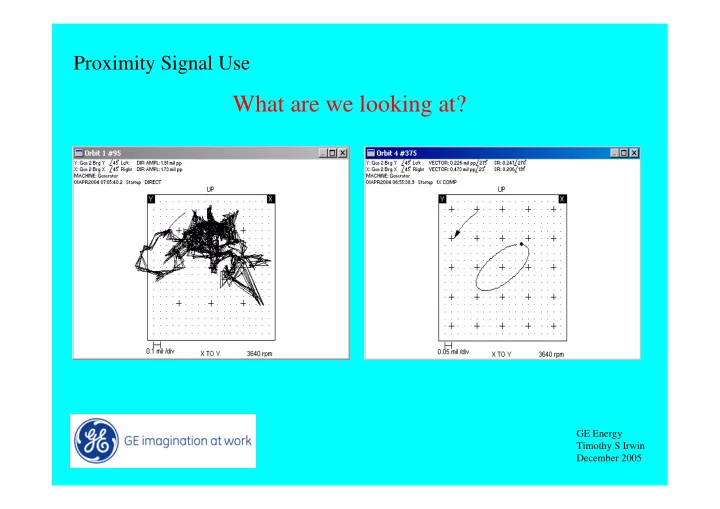
What are we looking at?

slide-2
SLIDE 2

Proximity Signal Use

GE Energy Timothy S Irwin December 2005

What are our Goals:

  • Accurate information to provide:
  • Machinery Diagnostics
  • Machinery Condition Monitoring
  • Machinery Reliability Improvements
  • Etc.
slide-3
SLIDE 3

Proximity Signal Use

GE Energy Timothy S Irwin December 2005

3000 and 7000 Series 3200 and 7200 Series

Probe Coil Types

slide-4
SLIDE 4

Proximity Signal Use

GE Energy Timothy S Irwin December 2005

RF SIGNAL RF SIGNAL RF SIGNAL

Oscillator/Demodulator

slide-5
SLIDE 5

Proximity Signal Use

GE Energy Timothy S Irwin December 2005

Common Installation Problems

  • Cross coupling effects
  • Probe tip side clearance
  • Radial probe orientation
  • Bracket resonance
  • Incorrectly gapped probes
  • Noise and signal errors
  • Wrong target material
  • Target area has an overlay (I.e. chrome, etc.)
slide-6
SLIDE 6

Proximity Signal Use

GE Energy Timothy S Irwin December 2005

Cross coupling effects

slide-7
SLIDE 7

Proximity Signal Use

GE Energy Timothy S Irwin December 2005

Probe tip side clearance

slide-8
SLIDE 8

Proximity Signal Use

GE Energy Timothy S Irwin December 2005

Radial probe orientation

slide-9
SLIDE 9

Proximity Signal Use

GE Energy Timothy S Irwin December 2005

Bracket resonance

slide-10
SLIDE 10

Proximity Signal Use

GE Energy Timothy S Irwin December 2005

Incorrectly gapped probes

slide-11
SLIDE 11

Proximity Signal Use

GE Energy Timothy S Irwin December 2005

Noise and signal errors

  • Ground loop problems
  • Electrical noise from other signal cables

Noise Definition – Undesirable signal components that: What can cause errors?

  • Distort the Data.
  • Contains no relevant information to the measurements being taken.
  • Interferes with the ability to accurately diagnose the machine condition.
  • Integration noise.
  • Runout.
  • Transducer resonance.
  • Mismatched parts
  • Target Material Issues
slide-12
SLIDE 12

Proximity Signal Use

GE Energy Timothy S Irwin December 2005

Noise and signal errors

Removing or eliminating noise:

  • Proper electrical installation practices
  • Proper grounding practices
  • Filters
  • Compensation
  • Single point ground, shielded cables, verify cable

and connector integrity, separate cable trays, etc.

  • Perform grounding using philosophy that we are looking at

two circuits; a power circuit and a signal circuit.

  • Proper matching of transducer system components
slide-13
SLIDE 13

Proximity Signal Use

GE Energy Timothy S Irwin December 2005

  • Transducer System
  • Three pieces are tuned to get a proper signal.
  • Probe, Extension Cable, and Proximitor.
  • If any of the components do not match, this will change

the scale factor and the amplitude levels will not be accurate.

  • There are many variables that would determine how far off of

the curve the ‘modified’ scale factor would be.

  • Just please be sure that the components have to be a matched set!!
slide-14
SLIDE 14

Proximity Signal Use

GE Energy Timothy S Irwin December 2005

  • Target Material Issues
  • It is critical to have the properly identified target material to

ensure accurate signals.

  • Typical transducer systems are calibrated to send a 200mV/mil

signal (scale factor) when the target is 4140 steel.

  • If the target is not 4140 or similar the scale factor of that material

needs to be verified and if significantly different the system can be calibrated as necessary.

  • If the target has an overlay the scale factor and response of

the transducer system can be affected. Chrome plating or any corrosion resistant overlay will cause problems on an off the shelf system.

slide-15
SLIDE 15

Proximity Signal Use

GE Energy Timothy S Irwin December 2005

  • Glitch
  • We list several items together that affect the signal and call it Glitch.
  • Surface scratches
  • Residual magnetism.
  • Electrical runout.
  • Mechanical runout.
  • All of the above items will show up as amplitude levels and

‘vibration’ at shaft speeds that are too low to create real dynamic motion. If you are at 200 rpm on a 3600 rpm machine and your monitor says there is over 1 mil of vibration, it is probably ‘Glitch’ and needs to be corrected.

slide-16
SLIDE 16

Proximity Signal Use

GE Energy Timothy S Irwin December 2005

What signal(s) do we actually see from a Proximity Probe?

  • The DC signal
  • Quantifies the gap between the probe tip and

the target

  • The AC signal
  • Quantifies the variation in the DC signal to

determine the shaft movement to and away from the probe.

slide-17
SLIDE 17

Proximity Signal Use

GE Energy Timothy S Irwin December 2005

Here are some raw signals at slow roll Generator Front Bearing Data at slow roll X – 1.60 mils at 230 rpm Y – 1.64 mils at 230 rpm

slide-18
SLIDE 18

Proximity Signal Use

GE Energy Timothy S Irwin December 2005

Here are those raw signals at operating speed Y – 1.88 mils at 3600 rpm X – 1.93 mils at 3600 rpm Generator Front Bearing Data

slide-19
SLIDE 19

Proximity Signal Use

GE Energy Timothy S Irwin December 2005

Filtered Data Y – 0.45 mils at 230 rpm X – 0.34 mils at 230 rpm Generator Front Bearing Data

slide-20
SLIDE 20

Proximity Signal Use

GE Energy Timothy S Irwin December 2005

Compensated Data Y – 0 mils at 230 rpm X – 0 mils at 230 rpm Generator Front Bearing Data

slide-21
SLIDE 21

Proximity Signal Use

GE Energy Timothy S Irwin December 2005

Compensated Data Y – 0.26 mils at 3600 rpm X – 1.02 mils at 3600 rpm Generator Front Bearing Data

slide-22
SLIDE 22

Proximity Signal Use

GE Energy Timothy S Irwin December 2005

Filtered and Compensated Data Y – 0.08 mils at 3600 rpm X – 1.03 mils at 3600 rpm Generator Front Bearing Data

slide-23
SLIDE 23

Proximity Signal Use

GE Energy Timothy S Irwin December 2005

Orbits – Are Combined Waveforms Raw Orbit at 3600 rpm Filtered and Compensated Orbit at 3600 rpm

slide-24
SLIDE 24

Proximity Signal Use

GE Energy Timothy S Irwin December 2005

How does filtering and compensation affect spectral data?

  • If we remove runout, we affect the 1X
  • If we remove noise or ‘glitch’ (I.e. scratches, magnetism, etc.)

we typically see a reduction in 1X multiples.

  • A quick and dirty way (if you can catch coast down or start-up

data) to determine if multiples are made from FFT calculations

  • f noise, is to see if the 1X multiples drop in amplitude with a

drop in speed. If the multiples stay relatively the same amplitude over a large speed range, it is probably noise and not real vibration.

slide-25
SLIDE 25

Proximity Signal Use

GE Energy Timothy S Irwin December 2005

Here is the raw signal

138 rpm and 0.95 mils 3600 rpm and 2.09 mils

slide-26
SLIDE 26

Proximity Signal Use

GE Energy Timothy S Irwin December 2005

Here is the compensated signal:

Compensated and 2.44 mils

slide-27
SLIDE 27

Proximity Signal Use

GE Energy Timothy S Irwin December 2005

Here is the raw spectrum and then compensated spectrum:

Compensated and 2.44 mils Uncompensated and 2.09 mils

slide-28
SLIDE 28

Proximity Signal Use

GE Energy Timothy S Irwin December 2005

Uncompensated waterfall plot:

slide-29
SLIDE 29

Proximity Signal Use

GE Energy Timothy S Irwin December 2005

Compensated waterfall plot:

slide-30
SLIDE 30

Proximity Signal Use

GE Energy Timothy S Irwin December 2005

What are we looking at?

What I want are the tools to make the plot on the left look like the plot on the right and be reasonably sure that I know where the weaknesses are in the signal processing.

slide-31
SLIDE 31

Proximity Signal Use

GE Energy Timothy S Irwin December 2005

Any Questions? The End.