SLIDE 1 1
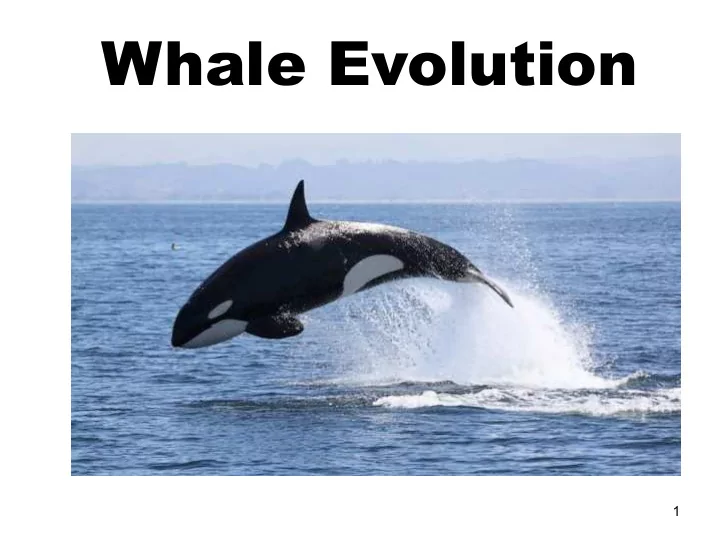
Whale Evolution
SLIDE 2 2
Whales and dolphins are mammals. They are some of the only mammals that live in water.
SLIDE 3 3
What do you think the ancestor of modern day whales were like?
SLIDE 4 If whales evolved from one common ancestor, what did it look like? What size was it? What did it eat? Where did it live?
With a partner, draw a quick sketch of the ancestor.
SLIDE 5 Scientists believe whales evolved from land mammals.
VOCABULARY: Tetrapod - a 4-limbed
ancestor of one)
SLIDE 6 6
Check out this short animation showing how scientists believed whales evolved:
http://collections.tepapa.govt.nz/exhibitions/whales/Segment.aspx?irn=161
SLIDE 7 7
Fossil records show these ancestors evolving over time.
SLIDE 8
The different species that existed on the journey from ancient land mammal to whale are called TRANSITIONAL FORMS
SLIDE 9 9
Transitional forms are evolutionary steps an organism goes through as it transitions from one set of adaptations to
- another. Transitional forms
show adaptations as they appear (or disappear) from an
DEFINITION:
SLIDE 10
A transitional form is a species that shows an organism TRANSITIONING into something new. Through fossils, they show the slow changes in body structures over millions of years.
SLIDE 11
Scientists have studied whale evolution through fossils and DNA comparison.
SLIDE 12
Why do you think the ancestors of whales returned to the sea?
SLIDE 13 Watch this short video:
http://museumvictoria.com.au/melbournemuseum/discoverycentre/600-million- years/videos/whale-evolution/
SLIDE 14
Let’s Look at Ancient Ancestors
SLIDE 15
Sinonyx
65 Million Years Ago
SLIDE 16
Pakicetus
50 Million Years Ago
SLIDE 17
Ambulocetus
48 to 50 Million Years Ago
SLIDE 18
Indohyus
48 Million Years Ago
SLIDE 19
Rodhocetus
47 Million Years Ago
SLIDE 20
Basilosaurus
34 to 40 Million Years Ago
SLIDE 21
Dorudon
33 to 40 Million Years Ago
SLIDE 22 Adaptations
From Sinonyx to Humpback Whale
SLIDE 23 Adaptations
Streamlined Body
SLIDE 24 Adaptations
Forelimbs Modified Into Flippers
SLIDE 25 Adaptations
Tail Broadened Horizontally
SLIDE 26 Adaptations
Hind Limbs Disappeared Completely
SLIDE 29 Adaptations
Blubber Instead of Hair
SLIDE 30 Adaptations
Nostrils on Top of Head
SLIDE 31 Adaptations
Highly Developed Hearing