WG2 Agenda: Overview Evaluation of emissions Benchmarking Emission - - PowerPoint PPT Presentation

wg2 agenda overview
SMART_READER_LITE
LIVE PREVIEW

WG2 Agenda: Overview Evaluation of emissions Benchmarking Emission - - PowerPoint PPT Presentation

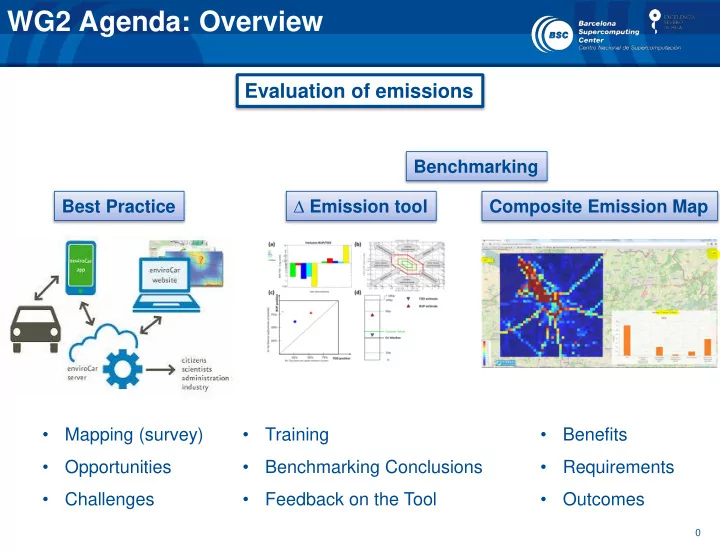
WG2 Agenda: Overview Evaluation of emissions Benchmarking Emission tool Best Practice Composite Emission Map Best Practice Mapping (survey) Training Benefits Opportunities Benchmarking Conclusions


slide-1
SLIDE 1

WG2 Agenda: Overview

Best Practice

Evaluation of emissions

Best Practice Benchmarking

  • Mapping (survey)
  • Opportunities
  • Challenges
  • Training
  • Benchmarking Conclusions
  • Feedback on the Tool
  • Benefits
  • Requirements
  • Outcomes

∆ Emission tool Composite Emission Map

slide-2
SLIDE 2

1

Good practice guidelines on urban traffic emission compilation

Marc Guevara1, Susana López Aparicio2, Matthias Vogt2, Leonor Tarrasón2

1 Barcelona Supercomputing Center - Centro Nacional de Supercomputación, Earth Sciences

Department, Barcelona, Spain.

2 NILU - Norwegian Institute for Air Research, Urban Environment and Industry, Kjeller, Norway.

FAIRMODE Technical Meeting 27-29 June 2016, Zagreb, Croatia

slide-3
SLIDE 3

2

Urban traffic emissions

Road traffic is the emission source that contributes most to air pollution in urban areas

Daily PM10 LV Annual NO2 LV

slide-4
SLIDE 4

3

Air Quality Planning effectiveness

Air quality observations Air quality modelling

Traffic flow

Vehicle fleet composition

EF model

Traffic Emissions

Traffic pollution- reduction measures

Road Network

slide-5
SLIDE 5

4

Current review works

slide-6
SLIDE 6

5

Mapping the best practices for urban traffic emissions

Brower (2014) Adapted from Ejik (2012) and Bedogni (2014)

Floating Car Data Automatic Number Plate Recognition systems Extended Floating Car Data Traffic models and wireless traffic sensors

https://envirocar.org/

slide-7
SLIDE 7

6

Overview of participation in the survey

  • A total of 16 participants
  • More than 30 cities from 13 different countries
slide-8
SLIDE 8

7

General information on your emission inventory

  • 1. For which components do you estimate urban traffic emissions?
  • 2. For which purpose do you estimate urban traffic emissions?
slide-9
SLIDE 9

8

Information on activity data

  • 3. What of the following methods do you use to compile traffic volume data?

10 answers: Combination of the 3 methods Calibration Validation

slide-10
SLIDE 10

9

Information on activity data

  • 4. What of the following methods do you use to compile speed data?

7 answers: Combination of the 3 methods Calibration Validation

slide-11
SLIDE 11

10

Information on activity data

  • 5. What of the following methods do you use to obtain vehicle fleet composition?

Kolli et al. (2011) André et al. (2014)

Source of Uncertainty

André et al. (2014)

Cover the diversity of the areas within a city Cover the temporal variation of the fleet 2 week-days ~ 600,000 observations

slide-12
SLIDE 12

11

Emission factor models

  • 6. What of the following emission factor models do you use?

In-house EF datasets (based

  • n real-driving tests)

Even though the approaches behind COPERT and HBEFA are somewhat different, they are largerly underpinned by the same experimental data (Franco et al., 2012)

slide-13
SLIDE 13

12

Emission factor models

  • 7. Do you apply corrections to the emission factors?

Franco et al. (2014)

Ratio of on-road emissions to legal limits (NOx Euro6): All cars: 7.1

PEMS, RSD

slide-14
SLIDE 14

13

Future work

  • 7. Do you plan to change your method to compile activity data in the future?
  • 8. Do you plan to change your emission factor model?
  • No (62.5%)
  • Use of high frequency pollution sensors to estimate traffic volume in

locations where emission inventories are poor.

  • Better integration of models/scales with regional traffic demand models /

microsimulation models

  • Use of FCD to estimate hourly speed data
  • No (50%)
  • Alternative models for emission computation at microscale level.
  • EF based on real world measurements (Diesel Euro V, IV categories)
  • 9. Which information would you like to receive before planning any changes?
  • Quality, accuracy and uncertainty of emission factors
  • Comparison between methodologies

Guidance on and benchmarking of models, Uncertainty, Test cases!

slide-15
SLIDE 15

14

Conclusions

  • Vehicle activity data: Traffic models combined with Automatic Traffic Recorders,

Manual Counting and Instrumented Vehicles is the most applied approach to

  • btain traffic volume and speed data
  • FCD: Its use is limited due to:
  • Privacy concerns (private companies own the data)
  • Big data concerns (large amount of data to process)
  • Limited Volume (need for extrapolation)
  • Vehicle fleet composition: Automatic Number Plate Recognition data
  • Official registration data is commonly used
  • Automatic Number Plate Recognition Systems is gaining ground
  • Emission Factor Models:
  • COPERT and HBEFA are the leading EU models.
  • Measurement based corrections (PEMS, RSD) applied to reduce associated

uncertainty

slide-16
SLIDE 16

www.bsc.es

For further information please contact marc.guevara@bsc.es

Thank you!

Masterplan for Masdar City, Abu Dhabi, which keeps cars out of the centre

slide-17
SLIDE 17

16

FCD: Challenges and Opportunities

  • Challenges:
  • Multiple information sources (not free)
  • Navigation and Car Insurance Companies
  • Specific fleets (e.g. Taxis)
  • Privacy concerns (restricted information)
  • Fuel type, Euro category
  • Big data concerns (large amount of data to process)
  • 3,000 cars (1 week information)  500MB
  • Opportunities:
  • Information based on real-world data
  • NRT emission modelling
  • Detection of potential modelling sites (hot spots)
slide-18
SLIDE 18

17

Other Sector to Focus On: Residential Combustion

Use of wood and other biomass in residential sector enhanced by:

  • National GHG strategies and targets for renewable energy
  • Increase during the economic crisis of other fuel prices (e.g. fuel oil)

Lack of regulation of small combustion appliances at EU level (Eco-design Directive)