western Kenya By James Miser Akoko University of Edinburgh summer - - PowerPoint PPT Presentation

western kenya
SMART_READER_LITE
LIVE PREVIEW

western Kenya By James Miser Akoko University of Edinburgh summer - - PowerPoint PPT Presentation

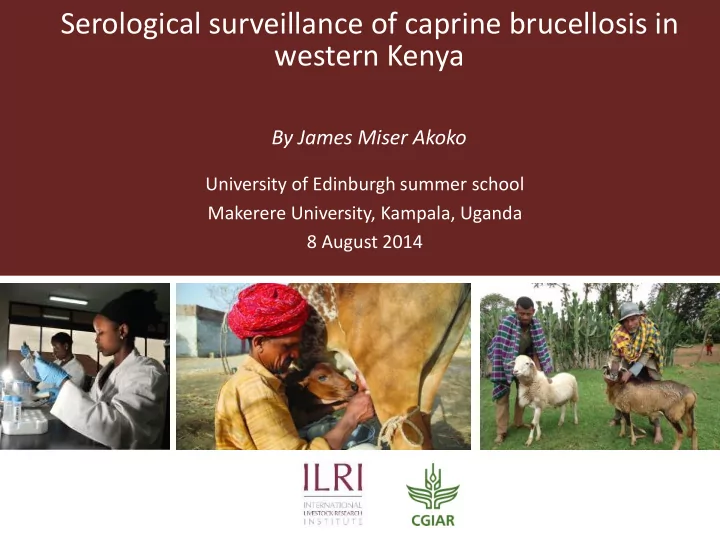
Serological surveillance of caprine brucellosis in western Kenya By James Miser Akoko University of Edinburgh summer school Makerere University, Kampala, Uganda 8 August 2014 Presentation outline People, Animals and their Zoonoses project


slide-1
SLIDE 1

Serological surveillance of caprine brucellosis in western Kenya

By James Miser Akoko

University of Edinburgh summer school Makerere University, Kampala, Uganda 8 August 2014

slide-2
SLIDE 2

Presentation outline

People, Animals and their Zoonoses project

Brief overview of brucellosis in Kenya Serological survey of caprine brucellosis in western Kenya

slide-3
SLIDE 3

Pending question from earlier presentation

Brucellosis in camels?

  • Waghela et al. (1978): 172 camels were sampled from Northeastern
  • province. 11 of 172 sera tested reacted in RBPT, 11 in SAT and 21 in CFT.
  • Saudi Arabia 8% prevalence B. melitensis (Radwan 1992)
slide-4
SLIDE 4

People, Animals and their Zoonoses (PAZ) project

  • Partners involved: UE, KEMRI & ILRI
  • Study site: western Kenya. www.zoonotic-diseases.org/home/research/paz

 The caprine brucellosis work was added as a component of the PAZ project. I am very grateful for the opportunity and support offered by Professor Eric Fèvre (PI. PAZ Project)

People

Peri-domestic animals

slide-5
SLIDE 5

Study site

slide-6
SLIDE 6

Brucellosis in Kenya

  • According to WHO report, under-reporting of brucellosis in Africa is

probably higher than 99%, since almost all diagnosed cases are a result of special studies on the disease (WHO 2011, P.15)

  • Brucellosis persists more in the pastoral systems (Radoz et al. 2013). This

is a true reflection in Kenya.

  • Brucellosis recognized as a notifiable disease in 2011.
  • ZDU formed in 2008 to enhance One Health approach and co-ordination
slide-7
SLIDE 7

Some of the prevalence studies done in Kenya

Author & year of study Sample Place Test (s) Prevalence (%) Namanda (2009) Milk (cattle) Eldoret MRT Waghela et al. (1978) Serum (camel) Northeastern RBT & SAT 6.4 Waghela et al. (1978) Serum (camel) CFC 12.2 Kang’ethe et al. (2000) Milk(cattle) Nairobi ELISA & MRT 4.9 Kiambu ‘’ 3.9 Nakuru ‘’ 2.4 Narok ‘’ 3.4 Waghela (1986) Serum (blue wildebeest) Maasai Mara SAT and CFT 18 Serum (African buffalo) ‘’ ‘’ 30

slide-8
SLIDE 8

Brucellosis laboratory data recorded from 2003 to 2010 (Olwande 2013)

slide-9
SLIDE 9

Why the study?

  • B. melitensis causes more prolonged, severe and debilitating illness than that caused by B.

abortus or B. suis (McDevitt 1973)

  • No data (study) on the role of goats in the epidemiology of brucellosis in western Kenya
  • Farmers in western Kenya are slowly adopting dairy goat rearing, therefore consuming goat

milk

slide-10
SLIDE 10

Study objectives

  • Estimate the seroprevalence of caprine brucellosis in western Kenya
  • Assess the spatial distribution of the sero-positive cases of caprine

brucellosis in western Kenya

  • Assess the risk factors associated with the transmission of brucellosis
slide-11
SLIDE 11

Sample size calculation

slide-12
SLIDE 12

Sampling design

Division Since we had no sampling frame, the

number of households to be sampled per sub-location depended on the divisional livestock population. E.g. sub- locations falling in highly populated livestock divisions were given more households than those with lower populations

Sub-location GPRS to select households Household Goats - questionnaire and

jugular blood collection

slide-13
SLIDE 13

Pictorial presentation of data collection and laboratory sample processing

Data collection/tecording in hand palm computer

Data analysis

slide-14
SLIDE 14

Laboratory work

  • 1. Sample

recording at the lab

  • 2. Centrifuged

at 3000 rpm for 20 minutes 3.Kept at

  • 20°C
  • 4. Test

using RBT 5.Confirmatory testing (ELISA)

slide-15
SLIDE 15

Results

Map showing the location of the sampled households

Key: Dots represent the sampled households

Map of Kenya

slide-16
SLIDE 16

Results contd.

  • A total of 412 homesteads were selected for sampling
  • 27% (112/412) of the selected households kept goats
  • 4.29% goats sampled had experienced abortion
  • Rose Bengal Test: No positive results (n = 355)
slide-17
SLIDE 17

Discussion & conclusion

  • The RBT results gave a prevalence of zero, suggesting that goats in western Kenya may

be free from B. melitensis. Since RBT has a sensitivity of 80.2% and a specificity of 99.6%, unlike ELISA that has specificity of 92.9% and is 99.6% specific(Rahman et al. 2013), there is need for this result to be confirmed with ELISA to rule out the 19.8% chance

  • f a false negative. We will therefore use ELISA to confirm the results before making a final

conclusion of this result.

  • There is need for regular surveillance and education on the prevention and control of

brucellosis to reduce or avoid the risk of transmission in animals and people.

slide-18
SLIDE 18

Parting shot

  • Goats can easily pass

zoonotic infections due to their close interaction with people

  • Let’s join hands in

controlling brucellosis for a better future!

slide-19
SLIDE 19

This work was financed by It is implemented in partnership with

Acknowledgements

slide-20
SLIDE 20

The presentation has a Creative Commons licence. You are free to re-use or distribute this work, provided credit is given to ILRI.

better lives through livestock ilri.org

Thank you