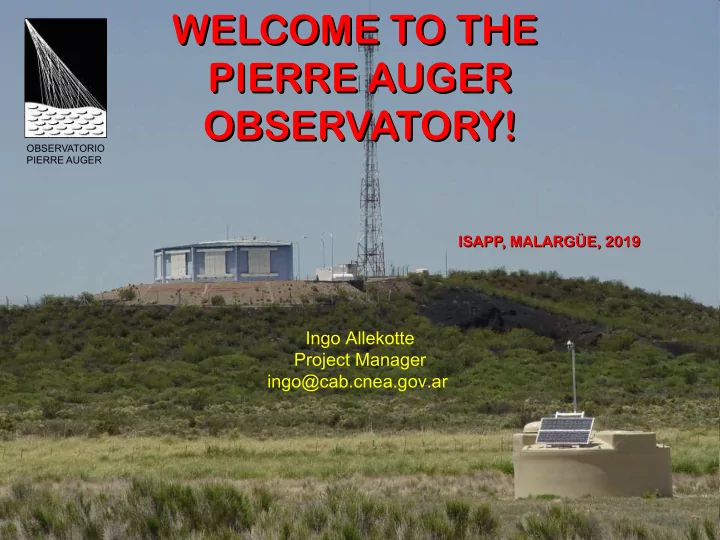
SLIDE 1 OBSERVATORIO PIERRE AUGER
WELCOME TO THE WELCOME TO THE PIERRE AUGER PIERRE AUGER OBSERVATORY! OBSERVATORY!
ISAPP, MALARGÜE, 2019 ISAPP, MALARGÜE, 2019
Ingo Allekotte Project Manager ingo@cab.cnea.gov.ar
SLIDE 2 A BIT OF HISTORY A BIT OF HISTORY
- End of XIX Century: radioactivity known, highly penetrating radiation
discovered.
- 1912: Viktor Hess flies up to 5000 m altitude with electroscopes:
DISCOVERY OF COSMIC ORIGIN OF RADIATION!
SLIDE 3 A BIT OF HISTORY A BIT OF HISTORY
- 1930's Millikan-Compton debate composition: particles or photons?
Denomination as “Cosmic Rays” misleading CR are mostly charged massive particles.
SLIDE 4 A BIT OF HISTORY A BIT OF HISTORY
- 1930's Millikan-Compton debate composition: particles or photons?
Denomination as “Cosmic Rays” misleading CR are mostly charged massive particles.
SLIDE 5 A BIT OF HISTORY A BIT OF HISTORY
- 1938: Pierre Auger discovers “Extensive Air Showers”.
- Coincidences in Geiger counters
- Shower components:
- Electrons, positrons, photons
- Muons
- Hadrons
- Energy of primary: estimated above 1015 eV
SLIDE 6 A BIT OF HISTORY A BIT OF HISTORY
- 1950´s: CNEA performs cosmic ray studies in Mendoza, Argentina.
- Photographic emulsions to study particle interactions
SLIDE 7 A BIT OF HISTORY A BIT OF HISTORY
- 1950´s: CNEA performs cosmic ray studies in Mendoza, Argentina.
- Photographic emulsions to study particle interactions
SLIDE 9 A BIT OF HISTORY A BIT OF HISTORY
- At “low” energies: satellite experiments to study primary cosmic rays
- At high energies: ground-based experiments:
- Volcano Ranch (USA)
- Yakutsk (USSR)
- Sugar (Australia)
- Agasa (Japan)
- Haverah Park (UK)
- Kascade - KGrande (Germany)
- Fly's Eye - HiRes - Telescope Array (USA)
Events with E > 1020 eV! GZK cutoff: interaction with CMBR propagation?
SLIDE 10 A BIT OF HISTORY A BIT OF HISTORY
- Agasa (Japan): scintillator surface detectors
- HiRes: atmospheric fluorescence detectors
Interaction with CMBR? GZK cutoff? Origin of UHECRs? UHECR astronomy? Composition? Magnetic fields? New physics?
SLIDE 11 THE PIERRE AUGER OBSERVATORY in Malargüe, Argentina
Problems with Ultra-High Energy Cosmic Rays (E > 1018 eV):
- very few! (one per km2 per CENTURY at E > 1019 eV)
- sources unknown
- source location unknown
- propagation not understood
- composition unknown
- ultra-high energy collissions never studied
- unknown unknowns?
James Cronin, 1931-2016 Chicago University
SLIDE 12 “THE GIANT ARRAY PROJECT” (still today, we have GAP-Notes) 1992 - 1995: To build a 5000 km2 detector Hybrid: surface detectors and fluorescence detectors Both hemispheres In the South: Australia? South Africa? Argentina? (Mendoza? Patagonia?)
James Cronin, Chicago University Alan Watson, Univ. of Leeds
SLIDE 13 “THE GIANT ARRAY PROJECT” (still today, we have GAP-Notes) 1992 - 1995: To build a 5000 km2 detector Both hemispheres In the South: Australia? South Africa? Argentina? (Mendoza? Patagonia?)
James Cronin, 1931-2016 Chicago University
SLIDE 14 “THE GIANT ARRAY PROJECT” (still today, we have GAP-Notes) 1992 - 1995: To build a 5000 km2 detector Both hemispheres In the South: Australia? South Africa? Argentina? (Mendoza? Patagonia?)
James Cronin, 1931-2016 Chicago University
SLIDE 15
“THE GIANT ARRAY PROJECT” (still today, we have GAP-Notes)
SLIDE 16 What was needed to tackle the challenge:
- 18 countries (nowadays 17)
- 86 institutions
- > 500 scientists, engineers, technicians
- $(USD) 53 millions (construction costs)
- a 3000 km2 flat surface…
- Belgium
SLIDE 17 What was needed to tackle the challenge:
- 18 countries (nowadays 17)
- 86 institutions
- > 500 scientists, engineers, technicians
- $(USD) 53 millions (construction costs)
- a 3000 km2 flat surface…
SLIDE 18 The Pierre Auger Observatory The Pierre Auger Observatory
Ultra-high energy cosmic rays: Ultra-high energy cosmic rays: Very few - large surface: Very few - large surface: 3000 km2! Hybrid system: Hybrid system:
- 1600 surface detectors sample
- 1600 surface detectors sample
particles at ground level particles at ground level
- 27 telescopes collect
- 27 telescopes collect
fluorescence light in atmosphere fluorescence light in atmosphere (in 4 buildings + 3 “containers”) (in 4 buildings + 3 “containers”) Reconstruction of Energy, Reconstruction of Energy, direction, composition, time direction, composition, time
SLIDE 19
PIERRE AUGER OBSERVATORY PIERRE AUGER OBSERVATORY
SLIDE 20
1600 surface detectors. Spacing: 1500 m. (Cherenkov radiation)
SLIDE 21
SURFACE DETECTORS SURFACE DETECTORS
SLIDE 22 FLUORESCENCE TELESCOPES FLUORESCENCE TELESCOPES
MIRRORS 3,6 m x 3,6 m, with 30º X 30º aperture CAMERA 440 PHOTOTUBES FILTER + APERTURE
SLIDE 23 TELESCOPE BUILDINGS
Los Leones Los Morados Coihueco Loma Amarilla 24 telescopes in 4 buildings
SLIDE 24 FLUORESCENCE DETECTORS
Los Leones HEAT: larger elevation, lower energy FD for ENERGY Callibration E proportional to fluorescence light Composition: Xmax showe maximum
SLIDE 25
SLIDE 26
SLIDE 27 ATMOSPHERIC MONITORING SYSTEMS ATMOSPHERIC MONITORING SYSTEMS
Central Laser Facility - CLF + XLF IR Cloud Cameras Photometric telescope Aerosol Monitors
SLIDE 28 ATMOSPHERIC MONITORING SYSTEMS: ATMOSPHERIC MONITORING SYSTEMS: atmospheric LIDARs atmospheric LIDARs
Central Laser Facility - CLF + XLF Photometric telescope Aerosol Monitors
SLIDE 29
OPERATION OF THE OBSERVATORY OPERATION OF THE OBSERVATORY
Central Station + Assembly Building Central Station + Assembly Building
SLIDE 30
OPERATION OF THE OBSERVATORY OPERATION OF THE OBSERVATORY
Local staff: 33 persons Local staff: 33 persons Visiting scientists and technicians Visiting scientists and technicians Task groups Task groups Local FD shifts Local FD shifts Remote FD shifts Remote FD shifts
SLIDE 31 WHAT KEEPS US BUSY NOW: AUGER “UPGRADE”: AugerPrime - until 2025!
- To determine event-by-event composition at highest energies
- To search for protons at high energies (particle astronomy)
- Study Extended Air Showers and hadron interactions
SCINTILLATORS: SSD UNDERGROUND MUON DETECTORS: AMIGA RADIO DETECTION OF AIR SHOWERS new electronics Extension of FD uptime
To be installed until 2020, 12 MEUR.
SLIDE 32
AUGER “UPGRADE”: SSD
SSD: 1600 plastic scintillators (4 m2 each) combined with SD
SLIDE 33
AUGER “UPGRADE”: SSD First prototypes in the field!
SLIDE 34 AUGER “UPGRADE”: SSD
(0) Determinar composición evento por evento a las más altas E (1) Comprender composición y el origen de la supresión a las más altas energías (2) Buscar componente protónica (10%?) a las más altas energias (3) Estudiar lluvias atmosféricas y producción hadrónica
Detectores SSD (ASCII desarrollados en Bariloche)
(Bertou, Berisso, Asorey, Arnaldi, Golup, Sofo-Haro)
AMIGA (detectores de muones subterráneos) Nueva electrónica SD Extensión de FD
SLIDE 35 AUGER “UPGRADE”: SSD
(0) Determinar composición evento por evento a las más altas E (1) Comprender composición y el origen de la supresión a las más altas energías (2) Buscar componente protónica (10%?) a las más altas energias (3) Estudiar lluvias atmosféricas y producción hadrónica
Detectores SSD (ASCII desarrollados en Bariloche)
(Bertou, Berisso, Asorey, Arnaldi, Golup, Sofo-Haro)
AMIGA (detectores de muones subterráneos) Nueva electrónica SD Extensión de FD
SLIDE 36 AUGER “UPGRADE”: AMIGA
(0) Determinar composición evento por evento a las más altas E (1) Comprender composición y el origen de la supresión a las más altas energías (2) Buscar componente protónica (10%?) a las más altas energias (3) Estudiar lluvias atmosféricas y producción hadrónica
Detectores SSD (ASCII desarrollados en Bariloche)
(Bertou, Berisso, Asorey, Arnaldi, Golup, Sofo-Haro)
AMIGA (detectores de muones subterráneos) Nueva electrónica SD Extensión de FD
SLIDE 37 AUGER “UPGRADE”: AMIGA
(0) Determinar composición evento por evento a las más altas E (1) Comprender composición y el origen de la supresión a las más altas energías (2) Buscar componente protónica (10%?) a las más altas energias (3) Estudiar lluvias atmosféricas y producción hadrónica
Detectores SSD (ASCII desarrollados en Bariloche)
(Bertou, Berisso, Asorey, Arnaldi, Golup, Sofo-Haro)
AMIGA (detectores de muones subterráneos) Nueva electrónica SD Extensión de FD
SLIDE 38 AUGER “UPGRADE”: AMIGA
(0) Determinar composición evento por evento a las más altas E (1) Comprender composición y el origen de la supresión a las más altas energías (2) Buscar componente protónica (10%?) a las más altas energias (3) Estudiar lluvias atmosféricas y producción hadrónica
Detectores SSD (ASCII desarrollados en Bariloche)
(Bertou, Berisso, Asorey, Arnaldi, Golup, Sofo-Haro)
AMIGA (detectores de muones subterráneos) Nueva electrónica SD Extensión de FD
SLIDE 39
AUGER “UPGRADE”: RADIO DETECTION
SLIDE 40 01/03/19
PIERRE AUGER OBSERVATORY
visit us: www.auger.org facebook
Diego Harari, Centro Atómico Bariloche, Argentina
SLIDE 41 01/03/19
PIERRE AUGER OBSERVATORY
visit us: www.auger.org facebook
Diego Harari, Centro Atómico Bariloche, Argentina
SLIDE 42
We observe a 5.2 σ Dipole Excess at E > 8 EeV The first significant observation of anisotropies in UHECR-history, a signature of extragalactic UHECR origin
Enormous echo in the international press with more than 200 different reports in the media Enormous echo in the international press with more than 200 different reports in the media
2017 Science Paper
SLIDE 43 Karl-Heinz Kampert Finance Board, Buenos Aires, Nov. 20,
SLIDE 44 Karl-Heinz Kampert Finance Board, Buenos Aires, Nov. 20,
No fake news in RT…
SLIDE 45 Karl-Heinz Kampert Finance Board, Buenos Aires, Nov. 20,
SLIDE 46 Karl-Heinz Kampert Finance Board, Buenos Aires, Nov. 20,
SLIDE 47
Total: 392 ; Ongoing: 102 ; Defended: 290
PhD Recipients by year
Auger produces a PhD student every 2.5 weeks!
SLIDE 48 ASTROPARTICLE PHYSICS
- Auger has high sensitivity to NEUTRINOS
- Auger can identify high energy PHOTONS
- Arrival directions of cosmic rays correlated with
sources (if magnetic deflections low)
SLIDE 49
COLATERAL RESULTS
SOLAR PHYSICS (background signals) » ATMOSPHERIC SCIENCE (“Elves” and » ionospheric effects) » LIGHTNINGS »
SLIDE 50
HIGH ENERGY PARTICLE INTERACTIONS ! p-Air cross section at sqrt(s) = 57 TeV
- Phys. Rev. Lett. 109, 062002 (2012)
- Phys. Rev. D (2014)