
SLIDE 1
20th Anniversary of the foundation of the Pierre Auger Observatory 1
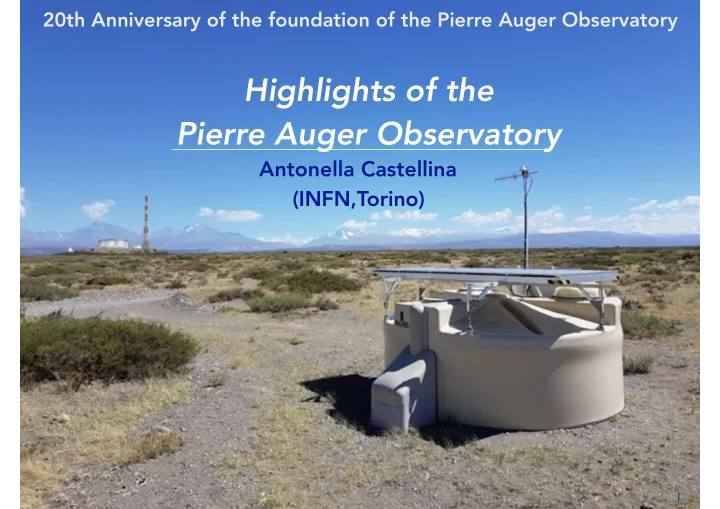
Highlights of the Pierre Auger Observatory Antonella Castellina - - PowerPoint PPT Presentation
20th Anniversary of the foundation of the Pierre Auger Observatory Highlights of the Pierre Auger Observatory Antonella Castellina (INFN,Torino) 1 20th Anniversary of the foundation of the Pierre Auger Observatory The Pierre Auger
20th Anniversary of the foundation of the Pierre Auger Observatory 1
20th Anniversary of the foundation of the Pierre Auger Observatory 2
Doctoral researchers
20th Anniversary of the foundation of the Pierre Auger Observatory 3
20th Anniversary of the foundation of the Pierre Auger Observatory 4
Water-Cherenkov stations ➡SD1500 : 1600, 1.5 km grid, 3000 km2
20th Anniversary of the foundation of the Pierre Auger Observatory 4
Water-Cherenkov stations ➡SD1500 : 1600, 1.5 km grid, 3000 km2 4 Fluorescence Sites ➡24 telescopes, 1-300 FoV
20th Anniversary of the foundation of the Pierre Auger Observatory 4
Water-Cherenkov stations ➡SD1500 : 1600, 1.5 km grid, 3000 km2 4 Fluorescence Sites ➡24 telescopes, 1-300 FoV Underground Muon Detectors ➡7 in engineering array phase - 61 aside the Infill stations HEAT ➡3 high elevation FD, 30-600 FoV
UMD
HEAT ➡61, 0.75 km grid, ~25 km2
20th Anniversary of the foundation of the Pierre Auger Observatory 4
Water-Cherenkov stations ➡SD1500 : 1600, 1.5 km grid, 3000 km2 4 Fluorescence Sites ➡24 telescopes, 1-300 FoV Underground Muon Detectors ➡7 in engineering array phase - 61 aside the Infill stations HEAT ➡3 high elevation FD, 30-600 FoV
UMD
HEAT ➡61, 0.75 km grid, ~25 km2 AERA radio antennas ➡153 graded 17 km2 +Atmospheric monitoring devices CLF , XLF , Lidars, …
20th Anniversary of the foundation of the Pierre Auger Observatory 5
subm.PRD 2019
CIC evaluated at different energy thresholds Invisible energy fraction
20th Anniversary of the foundation of the Pierre Auger Observatory 6
Events 215030 Exposure 60426 km2 sr yr
20th Anniversary of the foundation of the Pierre Auger Observatory 7
Exposure [km2 sr yr] Events SD1500 (ϑ<600) 60426 215030 SD1500 (ϑ>600) 17447 24209 SD750 105.4 569285 Hybrids 2248 (1019 eV) 13655 Cherenkov 286 (1017 eV) 69793
dN dE ∝ E−γ
20th Anniversary of the foundation of the Pierre Auger Observatory
J(E) ∝ E−γ0
3
Y
i=0
1 + (E/Ei,i+1)γi 1 + (E/Ei,i+1)γi+1
8
20th Anniversary of the foundation of the Pierre Auger Observatory
9
∆i = t1/2 − tbench
1/2
σ1/2 ∆s = 1 N X
i
∆i hXmaxi = hXmaxip + fEhlnAi σ2(Xmax) = hσ2
shi + fEσ2(lnA) K.H.Kampert, M.Unger, AP35 (2012)
20th Anniversary of the foundation of the Pierre Auger Observatory 10
( 8 + 1 ) g / c m2 / d e c a d e (26+2) g/cm2/ decade
20th Anniversary of the foundation of the Pierre Auger Observatory 11
20th Anniversary of the foundation of the Pierre Auger Observatory 12
125005 events
20th Anniversary of the foundation of the Pierre Auger Observatory 13
Up to the ankle pure or (p+He) compositions excluded at >6σ At higher energies, correlation consistent with less mixed composition
38(1000)
max
rescaled at 10 EeV
Below the ankle
rG = (−0.141 ± 0.022)
Abow the ankle rG = (0.025 ± 0.028) log(E/eV)=18.5-19.0 rG = (−0.069 ± 0.017)
20th Anniversary of the foundation of the Pierre Auger Observatory 14
−0.8)%
20th Anniversary of the foundation of the Pierre Auger Observatory 15
Search for large scale anisotropies down to 0.03 EeV
20th Anniversary of the foundation of the Pierre Auger Observatory
CenA NGC4945 NGC253
16
Scan ranges: 32 EeV ≤ Eth ≤ 80 EeV (1 EeV steps) 1° ≤ ψ ≤ 30° (1° steps)
Most significant excess for E>38 EeV (α=2020, δ= -450) ~20 from CenA 3.9 σ effect (post-trial) for E>37 EeV, 280 window
20th Anniversary of the foundation of the Pierre Auger Observatory 17
𝛅 AGNs 3FHL catalog < 250 Mpc 33 sources (CenA, Fornax A, M87…) Flux proxy ɸ(>10 GeV) Starburst Galaxies 32 sources (Circinus, M82, M83,…) <250 Mpc Flux proxy ɸ(>1.4 GHz), > 0.3 Jy Swift-BAT >300 radio loud and quiet sources <250 Mpc ɸ>13.4 10-12 erg cm-2 s-1 2MRS ~104 sources with D>1 Mpc <250 Mpc Flux proxy ɸ(14-195 keV)
TS = 2Log [L(ψ, fanis)/L(fanis = 0)]
20th Anniversary of the foundation of the Pierre Auger Observatory 18
Rejection of isotropy hypothesis APJ 4.0 σ for SBGs [Jan 2004-Apr 2017] 2.7 σ for 𝛅-AGN ICRC2019 4.5 σ for SBGs [Jan 2004-Aug 2018] 3.1 σ for 𝛅-AGN ApJL853 (2018) ICRC2019
20th Anniversary of the foundation of the Pierre Auger Observatory 19
➡ Maximum sensitivity around EeV
k (90% CL) < 4.4. 10-9 GeV cm-2 s-1 sr-1
➡ Exclusion of a significant region of
parameter space (zmax, m) from non
result
excluded
GZK p (Gelmini ’08) GZK p (Kampert+, 2011) GZK Fe (Kampert+, 2011)
p + γ → p + π0 → γ + γ
p + γ → n + π+ → µ+ + νµ → e+ + νµ + νe
TA (2017) UL 95% CL
20th Anniversary of the foundation of the Pierre Auger Observatory 20
J.Alvarez-Muniz, UHECR2018
20th Anniversary of the foundation of the Pierre Auger Observatory 21
In the energy range 3x10¹⁷ eV to 2x10¹⁸ eV simulations fail to reproduce muon densities 38% (53%) increase in <Nμ> at 1 EeV needed for EPOS-LHC (QGSJetII-04)
20th Anniversary of the foundation of the Pierre Auger Observatory 22
Fluctuations in the muon number = probe of the first interation at UHE Post-LHC models describe well the fluctuations of energy partition in the first interaction up to UHE
Strong correlation between Ehad/E0 and Nμ , independent on the hadronic interaction model
Nµ = A1−β ✓ E0 Edec ◆β
20th Anniversary of the foundation of the Pierre Auger Observatory 23
Fluctuations in the muon number = probe of the first interation at UHE Post-LHC models give a good description of particle production in the first interaction
20th Anniversary of the foundation of the Pierre Auger Observatory 24
20th Anniversary of the foundation of the Pierre Auger Observatory 25 dipolar large scale anisotropy: UHCRs > 8 EeV are extraGalactic Dominance of heavier nuclei supported by non-observation of cosmogenic neutrinos intermediate anisotropy hinted by correlations above 38 EeV (SBGs, 4σ; AGN, 3.5σ)
20th Anniversary of the foundation of the Pierre Auger Observatory 26
Mass fractions at Earth from fitting templates of 4 mass groups to the measured Xmax distributions Peter’s cycle ∝ E/Z
Spallation ∝ E/A ? No data on mass composition in the UHE region
20th Anniversary of the foundation of the Pierre Auger Observatory 27
study the origin of the suppression evaluate the existence of a fraction of protons at the highest energies provide better estimates of the neutrino and 𝛅 flux study the hadronic interactions at UHE and look for non standard physics
[AugerPrime Design Report, arXiv:1604.03637 EPJ Web of Conf.210 (2019) 06002]
➡ fundamental constraints to the characteristics of the sources of UHECRs ➡ feasibility of charged particle astronomy ➡ potential of future CR experiments ➡ exploration of different interaction phase space
20th Anniversary of the foundation of the Pierre Auger Observatory 28
a large exposure detector with composition sensitivity above ~4 1019 eV
➡ 12 upgraded stations (Engineering Array) since 2016 with new electronics, higher sampling, large dynamic range ➡ the SSD preproduction array: 80 stations (since March 2019): 120 km2 ➡ 587 SSD stations already deployed ➡ Underground Muon detector ➡ the largest radio detector (3000 km2)
20th Anniversary of the foundation of the Pierre Auger Observatory 29
20th Anniversary of the foundation of the Pierre Auger Observatory
20th Anniversary of the foundation of the Pierre Auger Observatory 31
20th Anniversary of the foundation of the Pierre Auger Observatory 33
20th Anniversary of the foundation of the Pierre Auger Observatory
Energy threshold
8.86 EeV (Auger) 10 EeV (Telescope Array) Events ~31000 events
34
Agreement with Auger alone, smaller uncertainty Hint for a quadrupole moment
Large Scale Anisotropy Intermediate Scale Anisotropy Energy threshold
40 EeV (Auger) 53.2 EeV (Telescope Array) Events 969 events
(α=12h50m, δ= - 500), 4.7 local sign (2.6 post-trial) (α= 9h30m, δ= +540), 4.2 local sign (1.5 post-trial)
Blind search Local Sheet
26% higher flux in a band of +240 around the Local Sheet (global significance 2.8σ)
37
Energy range complementary to Icecube and Antares
[F.Pedreira PoS(ICRC2019) 979]
[LIGO,VIRGO.Auger.IceCube.Antares Coll., ApJL848 (2017) L12]
In the range 1017 - 2.5 1019 eV, the total energy emitted in ν𝞾 is +500 s : < 6.9 10-4 M⊙ +14 days : < 2.3 10-2 M⊙
38
sGRBs
dissipation in the jet), extended emission (afterglow due to forward shocks around the burst)
msec Magnetar remnant
interactions with ambient photons and baryons
contribution of magnetars to the bulk of UHECRs (light nuclei at 1017.5-1018 eV)
[S.Kimura+, ApJ848 (2017) L4] [K.Fang+, arXiv:1707.04263]
20th Anniversary of the foundation of the Pierre Auger Observatory 36
No neutrinos found Auger Auger
Flux needed for 1 ν in Auger 𝒫(10-9) erg cm-2 s-1 Complementary energy ranges
20th Anniversary of the foundation of the Pierre Auger Observatory
40
a class of TLE observed in ionosphere as rapidly expanding rings
➡80-90 km height, hundreds km observable area ➡a specific trigger is designed for the elves —> new one in 2017 (900 μs - 3x readout window) ➡Observatory footprint for elves > 3 106 km2 ➡more observed during Malargue summer ➡>40% correlated to lightening of ~6 1021 - 3 1022 eV (WWLLN- World Wide Lightning Location Network )
➡
Auger is the first and only ground- based facility that measures elves with year-round operation, full horizon coverage, controlled photon counting, and 100 ns resolution.
Antonella Castellina PPNT19, 7-9 October 21019
3 independent scenarios tested
Auger data used
Combined fit starting from simple source model
[@R.Guedes Lang, PoS(ICRC2019) 327] 41
Antonella Castellina PPNT19, 7-9 October 21019
Combined fit
Best fit: low maximum rigidity LIV effects suppressed by energy GZK photons propagated following the two scenarios (A=global and B=local minima) ➡ A: no limits on LIV can be imposed ➡ B: ➡
42
Antonella Castellina PPNT19, 7-9 October 21019
EPOS-LHC, LI EPOS-LHC, LIV
43
Antonella Castellina PPNT19, 7-9 October 21019
[@A.Aab et al (Auger Coll.) PRD94 (2016) 082002]
intermediate mass ultra-relativistic monopoles with M~1011-1016 eV/c2 (IMM), Emon ~ 1025 eV can be present today as relic of phase transitions in the early Universe search based on larger energy deposit and deeper development due to superposition of many showers produced by the IMM
44