Welcome to the MG Webinar Our speaker today is Wendy Wilber - - PowerPoint PPT Presentation

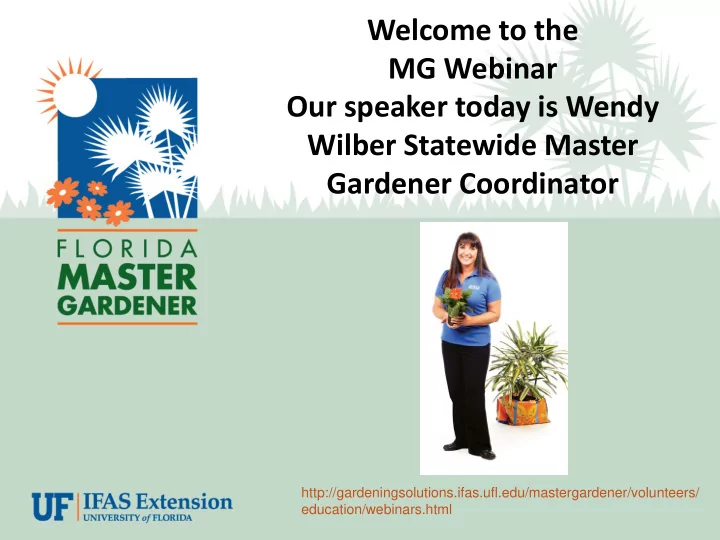
welcome to the mg webinar our speaker today is wendy
SMART_READER_LITE
LIVE PREVIEW

Welcome to the MG Webinar Our speaker today is Wendy Wilber - - PowerPoint PPT Presentation

Welcome to the MG Webinar Our speaker today is Wendy Wilber Statewide Master Gardener Coordinator http://gardeningsolutions.ifas.ufl.edu/mastergardener/volunteers/ education/webinars.html 2018 MG Webinars January 25th at 1pm Wings of

slide-1
SLIDE 1

Welcome to the MG Webinar Our speaker today is Wendy Wilber Statewide Master Gardener Coordinator

http://gardeningsolutions.ifas.ufl.edu/mastergardener/volunteers/ education/webinars.html

slide-2
SLIDE 2

2018 MG Webinars

  • January 25th at 1pm Wings of Florida a Butterfly Educational Program Samm Epstein and Dr. Jaret Daniels
  • February 22nd at 1 pm Turf Grass update: Fertilizing and Selection Dr. Laurie Trenholm
  • March 29th at 1 pm Tomatoes! Class for Successful tomato production Agent Larry Williams
  • April 26th at 1 pm Customer Service for Master Gardeners Wendy Wilber
  • May 31st at 1 pm Blueberries a MG update Dr. Jeff Williamson
  • June 28th at 1 pm Groundcovers Dr. Gary Knox
  • August 30th at 1 pm Snakes and reptiles in the landscape Dr. Steve Johnson
  • Sept 27th at 1 pm Things that go Ouch in the Garden Agent BJ Jarvis
  • October 25th at 1 pm Right Plant Right Habitat Agent Jane Morse
  • November 29th at 1 pm Top ten Insect problems and Top ten disease problems
  • December 13th at 1 pm The Art of Tea by Dr. Bart Schutzman
slide-3
SLIDE 3
slide-4
SLIDE 4

Objectives

Today we go over how to

  • Communicate effectively with customers
  • Create a positive impression
  • Develop and maintain customer service

standards

  • Plan good customer service
slide-5
SLIDE 5

Who are Customers?

Definition of a customer/client Internal/external customers

Customers are people who need your assistance. They are not an interruption to your job, they are the reason you have a job.

slide-6
SLIDE 6

Communicating Effectively with Customers

Definition: What describes GOOD service and BAD service?

Good customer service is taking that extra step to help without being asked! It’s all about attitude and skills.

slide-7
SLIDE 7

Attitude Checklist

What attitudes assist in providing good service?

  • Enjoy helping people
  • Handle people well
  • Care for your customers
  • Give fair and equal treatment to all
  • Be understanding of people with special needs
slide-8
SLIDE 8

Skills for Customer Service

  • Know about UF/IFAS and your County

Extension Office

  • Use up-to-date IFAS information (or
  • ther Land grant)
  • Be a well educated Master Gardener
  • Communicate well
  • Be consistent, double check your

answers

  • Be organized
  • Know your place on the team and be a

team player

slide-9
SLIDE 9

Greeting Customers

The purpose is to create and maintain a welcoming environment

  • Be attentive, acknowledge a person as soon as they appear,

even if you’re busy

  • SMILE!
  • Establish eye contact
  • Tell them your name
  • Ask how you can help
  • Give the customer your full attention
  • Be polite and courteous
slide-10
SLIDE 10

A Positive Organizational Image

First impressions count and will affect the interaction. A customer will decide in the first 15 seconds if you are competent, prepared, approachable and efficient

You only have one chance to make a first impression!

slide-11
SLIDE 11

Presentation and Manner

  • Logo shirt, badges, etc
  • Personal hygiene
  • Clothing – appropriate to the situation
  • Hair – cleanliness and style
  • Expression – facial expressions
  • Tone of voice
  • Body language
  • Surroundings (Can they see a messy desk? Dead flowers in the

vase? Eating your lunch?...)

slide-12
SLIDE 12

Make Positive First Impression

  • Be confident
  • Knowledge - know IFAS and your County Extension

Office and the services provided

  • Share your sources-- books, documents, etc
  • Follow up (don’t just say you’ll do something, do it)
  • Promote other services
slide-13
SLIDE 13

What to Avoid

  • Saying ‘I don’t know’ without saying “But I will find out”
  • Telling someone to Google something
  • Giving non Land grant biased information out
  • Saying you don’t know where a colleague is or saying

they’re at lunch/ toilet/ gone for coffee etc

  • Leaving people on hold for a long time
  • Ignoring people if you’re busy
  • Treating people unequally
slide-14
SLIDE 14

Factors Affecting the Quality of Service

  • Reliability
  • Unbiased
  • Confidence
  • Responsiveness
  • Efficiency
  • Consistency
  • Giving them what they cannot get on the internet
  • Acceptance of and adherence to policies and

procedures

slide-15
SLIDE 15

Establishing Rapport

  • Make the customer feel comfortable
  • Make the customer feel important and

valued

  • Use empathy
slide-16
SLIDE 16

Find out how You can Help

  • How can you find out what people want?
  • If you can’t help, what should you do?
  • Offer alternatives if possible
  • If they have to wait, how would you handle it?
slide-17
SLIDE 17

Communication is a 2-way Process

Communication skills involve:

  • Listening to others (Receiving) message
  • Asserting/ Expressing (Sending)

sender receiver sender receiver

Barriers

slide-18
SLIDE 18

The Communication Equation

What you hear

  • Tone of voice
  • Vocal clarity
  • Verbal expressiveness 40% of the message

What you see or feel

  • Facial expression
  • Dress and grooming
  • Posture/ Body Language
  • Eye contact
  • Touch
  • Gesture 50% of the message

WORDS…….. ONLY 10% of the message!

slide-19
SLIDE 19

Eye contact &Visible Mouth Body Language Silence Understanding ? Summary Encouragement Some questions

Effective communication

Effective Communication Skills

slide-20
SLIDE 20

Distractions Language Discomfort with the topic Judging or Putdowns Rushed Noise Too many questions

Barriers to Effective Communication

Barriers to Effective Communication

slide-21
SLIDE 21

How to Listen to Customers

Active listening = Attending skills (being ready)

  • Attend to immediate needs (if you need to finish

something before giving your full attention)

  • Being available
  • Eye contact
  • Attentive posture
  • Concentration
slide-22
SLIDE 22

Following Skills

This opens the door to further communication

  • Invitations
  • Questions
  • Encouragement
  • Empathetic Silence
slide-23
SLIDE 23

Questioning Skills

  • Open Questions
  • Closed Questions
  • Paraphrasing
  • Check for

Understanding

slide-24
SLIDE 24

Reflective Skills

Keeps the door open for further communication

  • Paraphrasing
  • Reflecting Facts
  • Reflecting Feelings
  • Reflecting Silence
  • Summarizing
  • Choosing your Words
  • Useful Phrases
  • It sounds like…,It seems that…, If I follow…., what I hear

you saying…..

slide-25
SLIDE 25
  • Try to look at each problem as if for the

first time

  • Ask questions about the problem as if for

the first time

  • Use fresh eyes
  • Even if you are sure what

the problem is.

  • Do your detective work
slide-26
SLIDE 26

Think about your Voice

Do you

  • Become loud when angry or upset
  • Speak faster when nervous
  • Speak slowly when tired or bored
  • Have a cheerful voice
  • Have a warm understanding tone of voice
  • Find it easy to talk to people you don’t know
  • Control your tone in most situations
  • Sound bossy, weak or unsure
  • Have a clear and easy-to-hear voice
  • Speak in a very formal or very trendy manner?

Think about how you might modify your voice in certain situations

slide-27
SLIDE 27

Body Language for a Positive Result

Smile

  • Introduce yourself (if appropriate) or wear a name

badge

  • Shake hands if appropriate
  • Lean forward
  • Be aware of cultural differences
slide-28
SLIDE 28

Telephone Skills

  • Know how to use the phones
  • Speak clearly and slowly
  • Smile (you can hear it in your voice!)
  • State your name and IFAS _____County Master Gardener
  • Write down the caller’s name and use it
  • Don’t say rude things while someone’s on hold
  • If they’re explaining something use words to show you’re

listening (ok, yes …)

  • Have pad and pencil ready to take notes or messages (check

spelling and message content)

  • Don’t eat or drink while on the phone
  • Don’t have your cell phone ring
slide-29
SLIDE 29

Email Communication

  • Write clearly and concisely
  • Refer to their call, date and question
  • Be friendly without being too informal
  • Check your spelling and grammar
  • Use bullets if possible
  • Make sure you’ve answered their question or

request or explained what is happening with their request

  • Always link or include the appropriate EDIS

documents or other IFAS materials

slide-30
SLIDE 30

Guaranteeing Return Business

  • Leave a positive impression, smile

– “Thank you for coming in”

  • Check that customers have everything they need

– “Is there anything else I can do for you?”

  • If you’ve said you’ll follow-up, do so
  • Invite them to upcoming classes or events
  • Invite them back or to tell their friends
  • Walk them out
  • Say Goodbye
slide-31
SLIDE 31

Customers with Special Needs

  • People for whom English is not their first language
  • People with disabilities
  • People with limited mobility
  • People with children
slide-32
SLIDE 32

Planning Good Customer Service

  • Be prepared with man power(when are your busy

times?)

  • Reporting procedures
  • Observe and report customer needs
  • Be proactive in improving service
  • Market your program
  • Have processes and procedures for dealing with difficult

situations BEFORE they happen and make everyone is trained.

slide-33
SLIDE 33

Dealing with Difficult Behavior

  • Label the behavior, not the customer
  • Listen
  • Don’t get defensive
  • Don’t take it personally
  • Find out what the customer wants
  • Discuss alternatives
  • Take responsibility for what you CAN do
  • Agree on action
slide-34
SLIDE 34

The Talkative Customer

  • Ask closed questions
  • Limit the time available for them to interrupt (don’t have

long pauses)

  • Provide minimal response
  • Smile and be pleasant, but don’t encourage them
  • Stand up
  • Wind up – thank them for coming, walk them to the

door but don’t be rude or dismissive

slide-35
SLIDE 35

The Angry Customer

  • Listen carefully without interrupting so you understand

the problem

  • Empathize in a broad way
  • Stay calm and remain polite
  • Don’t escalate the problem
  • Don’t take it personally, be defensive or blame others
  • Propose an action plan and follow it
  • Seek support if you are scared, if you can’t agree on a

solution or if the customer asks to see “whoever’s in charge”

slide-36
SLIDE 36

The ‘Know I t All’ Customer

  • Acknowledge what they say
  • Compliment them on their research
  • Be generous with praise
  • Don’t put them in their place no matter how tempting
  • Don’t try to be smart – you can’t win!
  • Ask them questions and use them to improve your

knowledge

slide-37
SLIDE 37

The I ndecisive Customer

  • Find out what they really want
  • Ask them for the options
  • Reflect back to them what they’ve said
  • Assume control gently and point out the best course of

action from what they’ve told you they need

  • Be logical
  • Confirm a plan of action with them
  • Maybe even put it in writing
slide-38
SLIDE 38

The Suspicious Customer

  • Establish your credibility
  • Ensure you know your material
  • They will try and catch you out so don’t guess or tell

them something you’re not sure of

  • Be careful what you say
  • Be polite
  • Don’t take it personally, they often don’t trust anyone!
slide-39
SLIDE 39

Trea reat others hers as you wo would exp xpect ect t to be e trea reated

slide-40
SLIDE 40
slide-41
SLIDE 41

Our Objectives were to review how to

Communicate effectively with customers Create a positive impression Develop and maintain customer service standards Plan good customer service  http://edis.ifas.ufl.edu/pdffiles/HR/HR00500.pdf

If you would like to take the 4 question quiz for CEU credit You can find it here https://ufl.qualtrics.com/jfe/form/SV_eaJw0pEi0GGFxcx and I will send this link to your coordinators